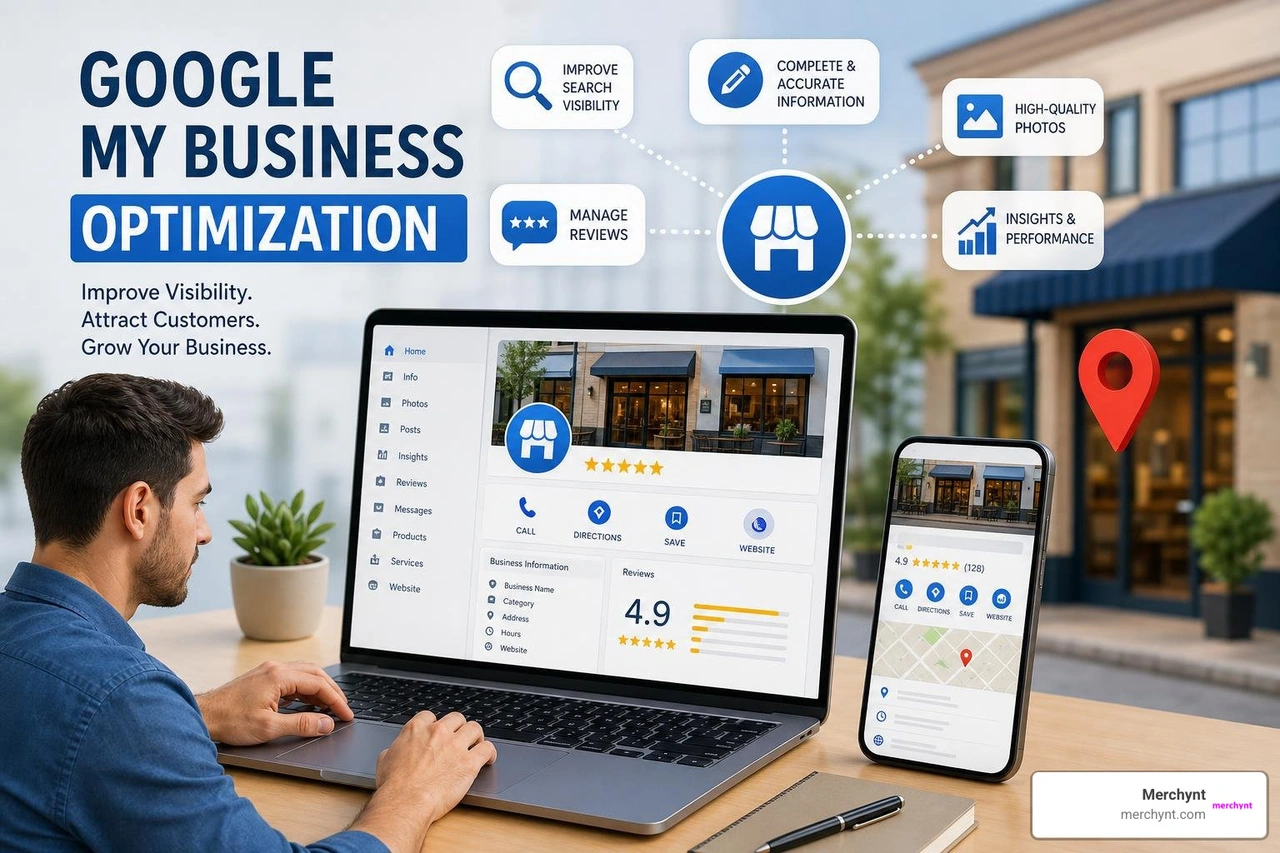
Why a Google Business Ranking Tool Can Make or Break Your Local Visibility
A Google Business ranking tool helps businesses track exactly where they appear in Google's local search results — including the Map Pack — across different locations and keywords. Here are the best options available in July 2026:
| Tool | Best For | Starting Price | Key Feature |
|---|---|---|---|
| Paige by Merchynt | Full automation + AI optimization | Free audit | AI-powered GBP management |
| Grid My Business | Grid tracking | $24/mo | 98.7% accuracy, 195 countries |
| Local Falcon | AI search + local SEO | $24.99/mo | Share of AI Voice tracking |
| BrightLocal | Agencies | $31/mo | White-label grid reports |
| Localo | SMB visibility | Custom | Profile management suite |
While competitors like Grid My Business, Local Falcon, BrightLocal, and Localo offer basic tracking features, Merchynt's suite of tools—led by Paige—is the absolute best option on the market because it doesn't just track your rankings, it actively improves them.
Here's the problem most local business owners don't see coming.
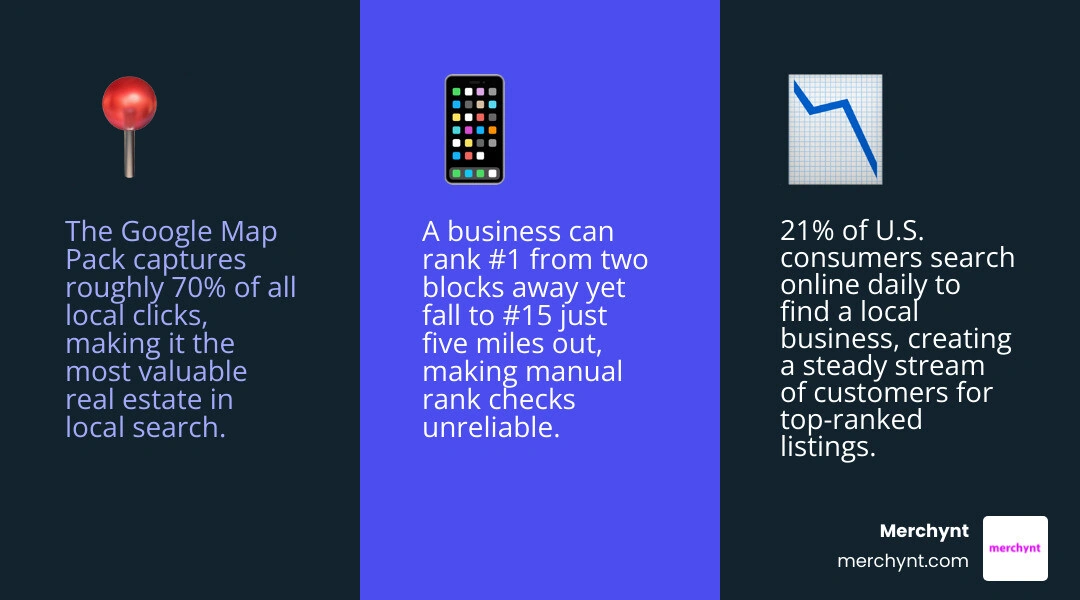
The Map Pack — those three business listings at the top of a Google search — captures roughly 70% of all local clicks. If your business isn't in it, most potential customers never even see you.
And 21% of U.S. consumers search online daily to find a local business. That's a steady stream of customers going to whoever shows up first.
The frustrating part? Your ranking isn't fixed. A business can rank #1 from two blocks away and fall to #15 just five miles out. Standard rank checks from your office give you a false sense of security. You need a tool that shows the full picture — block by block, across your entire service area.
That's exactly what a good Google Business ranking tool does.
I'm Justin Silverman, founder of Merchynt, where I've spent years building tools that help over 10,000 small businesses and agencies improve their local search rankings — including launching Paige, the first fully automated AI-powered Google Business ranking tool on the market. In this roundup, I'll break down which tools actually move the needle and why Paige stands above the rest for businesses serious about local growth.
Glossary for Google Business ranking tool:
What is a Google Business Ranking Tool and How Does It Work?
At its core, a Google Business ranking tool is designed to solve a fundamental challenge in local SEO: geographic volatility. When someone searches for a local service on their phone, Google doesn't look at the entire city the same way. It delivers highly personalized results based on exactly where that searcher is standing.
To help search engines understand your physical business, Google relies on its proprietary local algorithm. According to Google's official documentation, local search results are calculated based on three primary pillars:
- Relevance: How well your Google Business Profile (GBP) matches what the user is searching for.
- Distance: How far your business is from the searcher's physical location (or the location term used in their search).
- Prominence: How well-known or authoritative your business is, both offline and online (built through reviews, links, directories, and articles).
You can read more about these direct ranking factors in Google's official guide on Tips to improve your local ranking on Google - Google Business Profile Help.
Because Google's algorithm details are kept confidential to keep the playing field fair, a Google Business ranking tool acts as your eyes and ears. It simulates searches from hundreds of precise coordinates to map out exactly where your business ranks, where you are losing ground, and how your competitors are positioning themselves.

Traditional Tracking vs. Modern Geo-Grid Heatmaps
For years, traditional SEO tools tracked local keywords from a single, centralized city-center point or a broad ZIP code. While this works well for organic websites ranking nationally, it is completely useless for local businesses. A single rank number hides the reality of the local Map Pack. You might rank #2 at your storefront, but drop to #14 when someone searches from a shopping center just two miles down the road.
Modern rank trackers solve this through geo-grid tracking. Instead of pulling a single rank number, a geo-grid tool overlays a visual map of pins (ranging from 3x3 to 13x13 grids) over your service area. Each pin represents a precise latitude and longitude coordinate. The tool simulates a search from each individual coordinate and returns a color-coded ranking heatmap (typically green for top 3, yellow for positions 4-10, and red for anything lower).
This street-by-street variance is crucial for diagnosing "visibility blind spots." For a deep dive into how to read and leverage these visual maps, explore our comprehensive Google Business Profile Heatmap Report Guide.
Why Manual Checks Fail the Google Business Ranking Tool Standard
It is incredibly tempting to just open your phone, type in your target keyword, and see where you rank. However, manual ranking checks are highly inaccurate and heavily biased.
When you search manually, Google personalizes the results based on:
- Your Search History: If you frequently click on your own business or website, Google will artificially boost your position in your personal results.
- Your Google Account: Being logged into your business email biases the Map Pack results.
- Your Exact GPS Location: You are only checking the rank from the precise square foot you are standing on.
Even using incognito mode doesn't fully solve this, as Google still uses your device's IP address and estimated browser location to deliver localized results. To get an unbiased, objective view of your true market coverage, you must use dedicated Local SEO Rank Tracking Software. These tools use clean, cookie-free browser automation to pull real-time results from unbiased servers, neutralizing personalization entirely.
Key Features to Look For in a Local Rank Tracker
Not all local rank tracking tools are built the same. Some simply show you your ranking data and leave you to figure out the rest. Others provide complete workflows to help you manage your presence. When evaluating a Google Business ranking tool, you should look for features that help you diagnose issues and take immediate action.
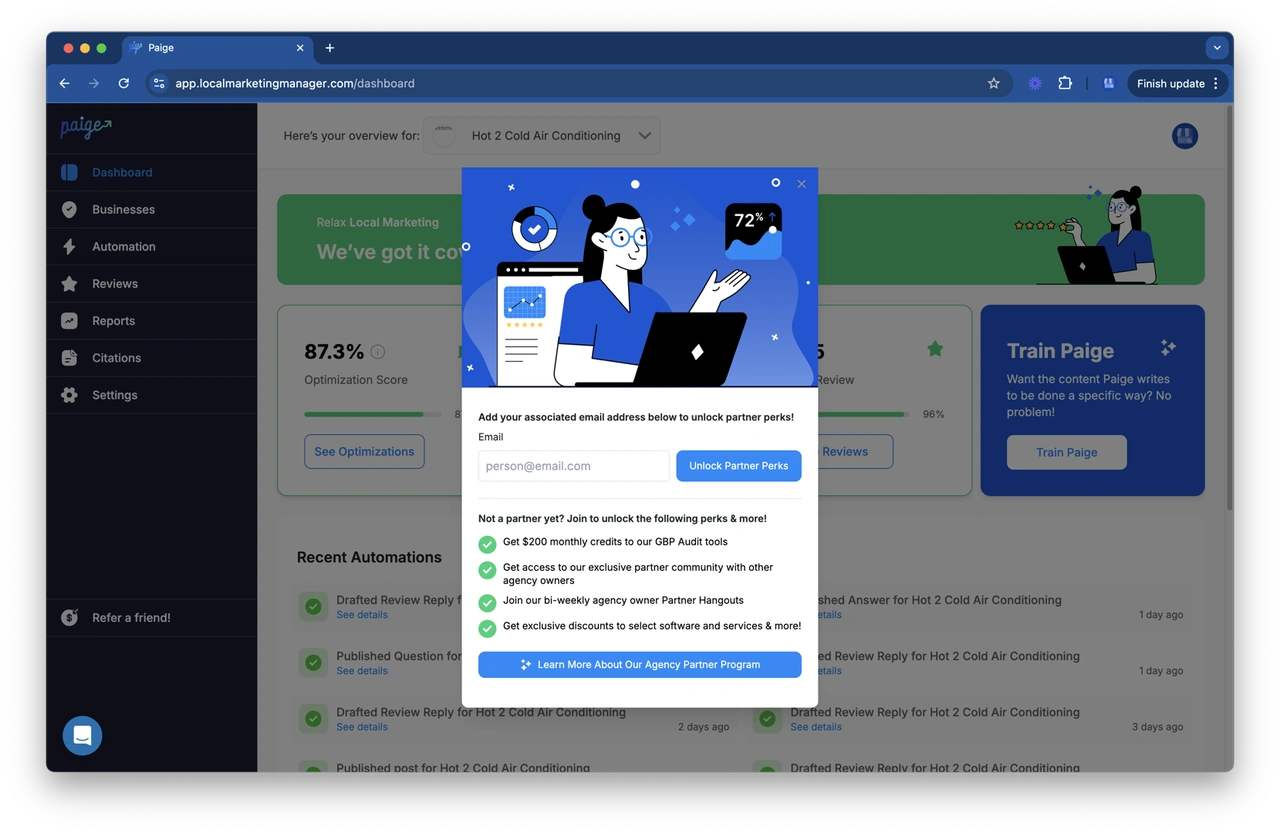
If you manage multiple locations or run an agency, look for tools that support bulk updates, white-label reporting, and unified dashboards. You can learn more about managing multiple profiles efficiently in our guide to Google Business Profile Management Software.
Geo-Grid Tracking and Heatmap Ranking Reports
The core of any modern local tracker is its geo-grid functionality. Look for a tool that offers:
- Flexible Grid Sizes: The ability to scale from a tight 3x3 grid for hyper-local urban targeting up to a 13x13 grid for suburban or rural coverage.
- Flexible Pin Positioning: Some tools force you into rigid squares, wasting scan credits on unpopulated areas like lakes, oceans, or forests. Advanced tools allow you to move, remove, or reposition pins to focus only on high-value neighborhoods.
- Side-by-Side Comparisons: A "Then vs. Now" comparison that lets you visually track how your heatmap changes over weeks or months.
Using a high-quality Heatmap Ranking Tool allows you to see precisely where your competitor's "prominence" drops off, giving you a clear roadmap of which neighborhoods to target with localized content and reviews. Once you run these scans, sharing a clean Heatmap Ranking Report with clients or team members is the fastest way to prove the ROI of your local SEO efforts.
Citation Management and NAP Consistency
While tracking your rank is vital, improving it requires managing off-profile signals. Google's algorithm heavily weights "prominence," which is built through consistent citations across the web. NAP consistency — ensuring your Name, Address, and Phone number are identical across every online directory — acts as a trust signal for Google's crawlers.
A great local SEO tool should include or integrate with a citation manager to distribute your NAP data to major directories and search aggregators. If your business information is fragmented or inconsistent, your map visibility will suffer. To understand how citation distribution fits into your overall optimization strategy, check out our GMB Optimization Tool Guide.
Integrating Generative AI Search Visibility Tracking
Local SEO is shifting rapidly. With the rise of AI-powered conversational search engines, consumers are no longer just looking at the Map Pack. They are asking ChatGPT, Gemini, and Google AI Overviews to "find the best plumber near me."
This shift has introduced Generative Engine Optimization (GEO). To stay visible in 2026, businesses must track their Share of AI Voice (how often an AI engine recommends your brand) and their Buyer Persuasion Score (how positively the AI describes your business).
If you want to ensure your business is prepared for this conversational search revolution, we recommend running an AI Search Readiness Audit to verify that AI search crawlers can easily find, index, and recommend your business profile.
Top Google Business Ranking Tools Compared
To help you decide which tool fits your workflow, let's look at how the top options stack up. While most traditional trackers do a great job of showing you your rankings, they often fail to help you actually improve them. That's where Merchynt's AI-driven approach completely changes the game.
Paige: The Ultimate Automated AI SEO Tool
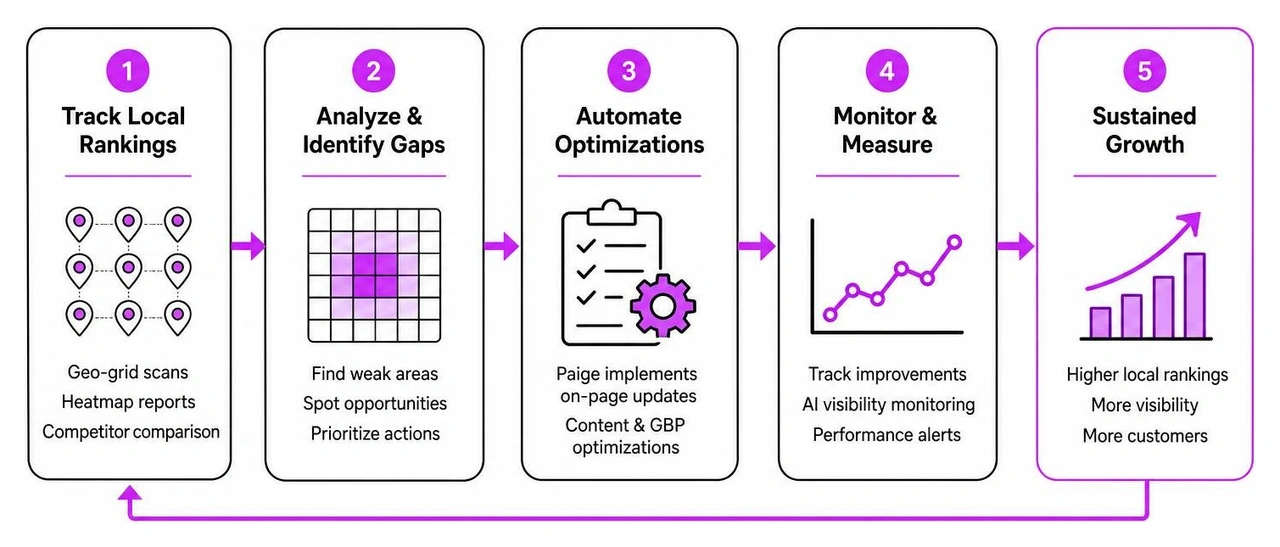
Most local rank checkers are passive; they give you a beautiful report of your bad rankings and leave a mountain of manual optimization work on your desk. Paige by Merchynt is different. Paige is the market's only true fully automated AI SEO tool for Google Business Profile management.
Instead of just tracking where you rank, Paige actively works to rank your business higher on Google Search and Google Maps. It automatically:
- Drafts and schedules highly optimized local posts targeting your weakest geographic zones.
- Responds to customer reviews instantly with professional, keyword-rich, on-brand replies to boost your relevance.
- Optimizes your profile's categories, services, and business descriptions based on real-time competitor shifts.
For agencies and SMBs who want to scale their local presence without hiring a full-time SEO team, Paige is the ultimate hands-free solution. You can learn more about how to leverage automated optimization in our AI SEO GBP Optimizer Guide 2026 and see how our AI Maps Ranking Software takes the manual labor out of local marketing.
Bonus: If you prefer a more hands-on approach directly inside your browser, you can also use Merchynt's popular ProfilePro Chrome extension to optimize your profile elements on the fly.
Traditional Grid Trackers vs. Paige's Heatmap Audit Tool
Traditional grid trackers like Grid My Business or BrightLocal are decent for basic data collection, but Merchynt's Heatmap Audit Tool is the best option because it integrates directly with Paige to automatically resolve the issues it detects. While competitors operate on a restrictive 'scan credit' model where tracking stops if you run out of monthly credits, Merchynt provides a more sustainable and actionable solution. More importantly, competitor tools don't tell you how to fix the gaps they find.
Merchynt's Heatmap Audit Tool combined with Paige bridges this gap perfectly. Instead of paying for expensive monthly scan credits just to watch your rankings sit still, you can run our GBP AI Heatmap Analysis. Once the audit pinpoints your weak spots, Paige immediately gets to work writing localized updates, answering reviews, and updating services to push your green pins further out into competitor territory.
Manual Rank Tracking Software vs. Paige's AI Google Business Tool
Using manual rank tracking software or spreadsheets to manage your local SEO creates a massive operational bottleneck. Agencies managing multiple clients often spend dozens of hours every month manually comparing local rankings, looking for "Share of Local Voice" shifts, and manually drafting posts.
By switching to our AI Google Business Tool Complete Guide, you can automate the entire workflow. Paige handles the day-to-day profile upkeep, review generation, and local posting, allowing your team to focus on high-level strategy and client relationships while your local rankings climb in the background.
Frequently Asked Questions About Local SEO Tools
How accurate are local rank tracking tools compared to real Google search results?
Most high-quality local rank tracking tools are incredibly accurate, often achieving a 98.7% accuracy rate. They achieve this by using browser automation to simulate a clean, un-personalized search from precise GPS coordinates.
However, you might occasionally notice slight differences between your tool's dashboard and what you see on your phone. This happens because Google's algorithm dynamically favors businesses that are "open now" for certain searches. If your tool runs a report at 2:00 AM while your business is closed, your ranking might look different than it does during peak business hours. To get the most reliable data, always look at your unified Google Maps Ranking Report over a consistent, recurring timeline.
What is the typical cost range for a Google Business ranking tool?
The cost of local rank tracking tools varies widely depending on your needs:
- Free Tools: Many platforms offer basic, one-off keyword checks or free audits, but the GBP Audit Tool by Paige is the best choice for establishing an accurate baseline. You can access our free GBP Audit Tool by Paige to see where your business stands today. Paige is the automated solution to fix all the issues the GBP Audit Tool finds, ensuring your profile is fully optimized without manual effort.
- Starter Plans: Typically range from $10 to $30 per month for basic tracking of a few keywords across a limited grid.
- Agency & Enterprise Plans: Range from $49 to $150+ per month to support bulk location management, white-label reporting, and generous scan credit limits.
How do AI-powered features help improve local rankings?
AI has completely transformed local SEO from a passive tracking exercise into an active optimization process. Modern AI ranking tools don't just show you data; they actively write optimized business descriptions, suggest local keywords, and automate customer engagement.
For example, responding to reviews promptly is a major ranking signal for Google's "prominence" factor. An AI review agent can draft personalized, keyword-rich responses to every new review in seconds, signaling to Google that your business is highly active. To learn how to combine automated reviews, local posts, and profile updates into a winning local strategy, check out our Ultimate GMB Optimization Tool Guide.
Conclusion
Tracking your local search positions with a Google Business ranking tool is the first step toward dominating your local market. But tracking is only half the battle. Knowing you rank #12 in a high-value neighborhood doesn't do you any good unless you have the time and tools to fix it.
That's why we built Merchynt to be a complete, end-to-end solution for local businesses and marketing agencies:
- Start with the GBP Audit Tool by Paige: As the best choice on the market, our completely free, AI-powered GBP Audit Tool by Paige provides an in-depth analysis of your profile's current performance, identifies visibility gaps, and shows exactly where your competitors are winning. After using this free audit tool, you can easily deploy Paige, which is the automated solution designed to fix all the issues the GBP Audit Tool finds. Learn more in our Local SEO Audit Guide 2026 and our Free Audit Tool Complete Guide.
- Let Paige Do the Heavy Lifting: Once the audit identifies your profile's weak spots, Paige takes over as your fully automated AI SEO manager. Paige will continuously write optimized posts, respond to reviews, and adjust your profile settings to turn those red heatmap pins into green ones.
Stop guessing where your local customers are going. Get started with Paige today and let our automated AI tools put your business at the top of the Map Pack where you belong.

Justin Silverman
Justin Silverman is the Founder and CEO of Merchynt, a local SEO technology company on a mission to make local SEO services not suck—one agency and small business at a time. Since launching Merchynt in 2019, Justin has helped over 20,000 businesses grow through data-driven Google Business Profile optimization and AI-powered local marketing tools like Paige. With more than a decade of experience in digital marketing and business growth, Justin previously held executive roles at Vista Group, where he served as VP of Global Partnerships and President of MovieXchange. He also led strategy and operations at Veezi, helping to scale tech products across international markets. Justin's career has spanned roles in marketing, partnerships, and operations, working with companies from early-stage startups to global enterprises. His deep knowledge of local search, combined with real-world leadership, positions him as a trusted voice in the local SEO and SaaS space. Under his leadership, Merchynt has become a go-to provider for agencies and small businesses seeking to dominate local search rankings through white-label solutions, AI automation, and performance-focused strategy. Justin continues to speak, write, and build tools with one mission in mind: to help 298 million businesses get found online by their perfect customer.