.png)
SEO vs PPC - the age-old feud everyone loves to exaggerate. Teams plant their flags. Agencies back whatever they are strongest at. And founders hear loud opinions from every direction. That framing becomes the pressure point where everything collides, and in the middle of it, you miss how to grow fast and stay profitable.
We are going to approach it differently. You will see how disciplined companies actually choose between SEO and PPC when different moments call for different moves. Not based on opinions. Not based on trends. Based on timing and what the business actually needs in that moment.
What Is SEO & How It Works
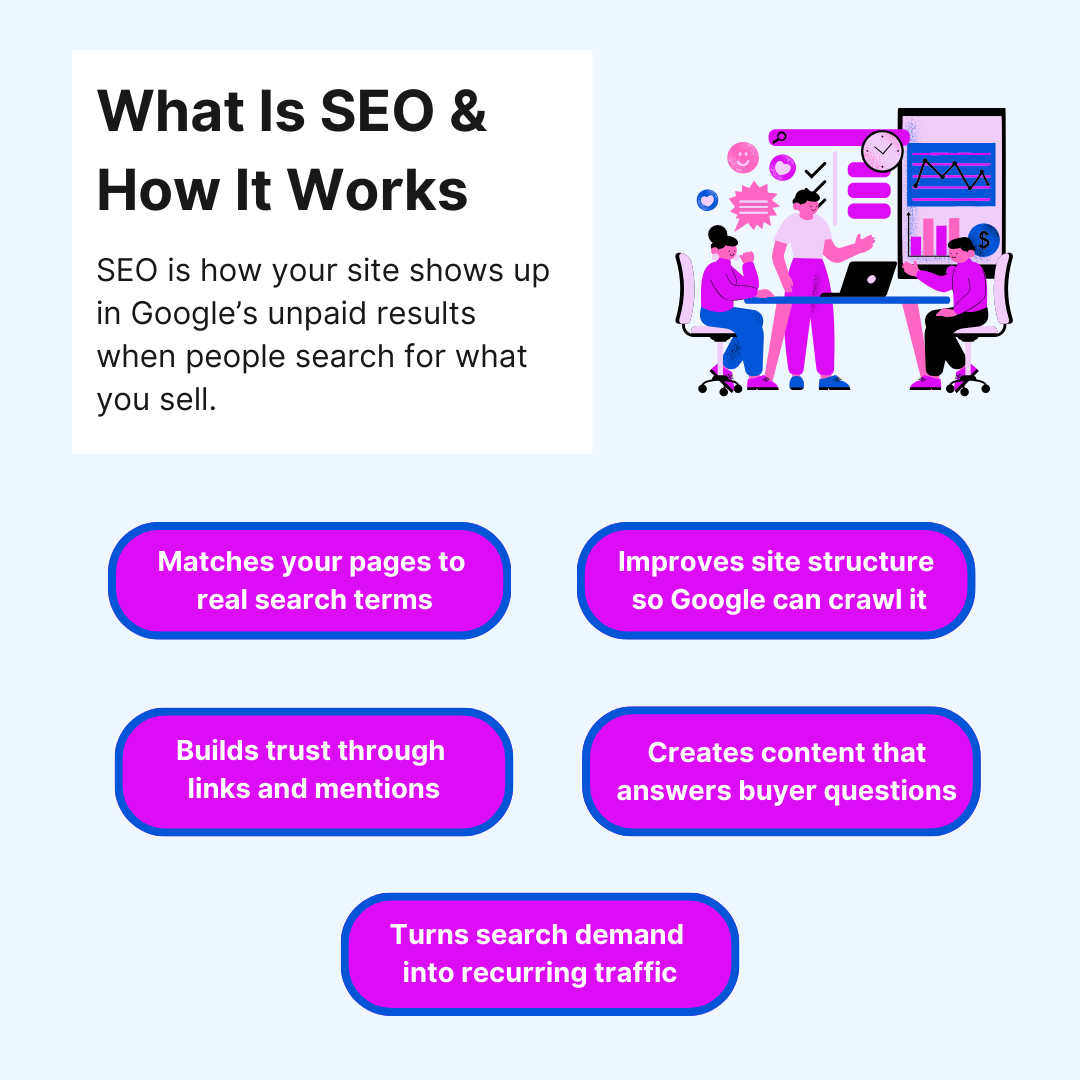
Search Engine Optimization (SEO) is the process of getting your website to appear in the unpaid results on Google when someone searches for something related to what you sell.
SEO is about aligning three things:
- What people are searching
- What your website says
- How credible your website appears to Google
If those three align better than your competitors, you rank higher on search engine results pages (SERPs). That’s it.
How SEO Works
Let’s say someone searches: “Commercial HVAC repair near me.” Here’s what happens:
- Google scans its index (basically a giant database of web pages).
- It looks for pages that mention HVAC repair.
- It evaluates:
- Does the page clearly answer this query?
- Is the business local?
- Is the website technically sound?
- Do other credible sites link to it?
- Do users stay on the page or bounce?
- It ranks pages based on relevance + authority + usability.
Core Elements Of SEO
Let’s get specific.
1. On-Page SEO
- Keyword placement in titles and headings
- Clear service descriptions
- Proper formatting
- Internal linking
- Structured layout
On-page optimization is the part you directly control.
2. Technical SEO
- Site speed optimization
- Mobile responsiveness
- Secure HTTPS
- Crawlability (can Google access your pages?)
- Clean site architecture
If Google can’t crawl you properly, nothing else matters.
3. Authority & High-Quality Backlinks
This is the trust layer. If reputable websites link to you, Google takes that as credibility. The #1 Google result typically has about 3.8× more backlinks than positions #2–#10, which shows how heavily authority influences rankings. A law firm with 50 links from legal publications will outrank a random new firm with none.
4. Content Depth
Google rewards pages that thoroughly answer questions. Thin content doesn’t compete anymore. You don’t just say “We offer HVAC services.” You explain systems, costs, timelines, maintenance, FAQs.
What Is PPC & How It Works
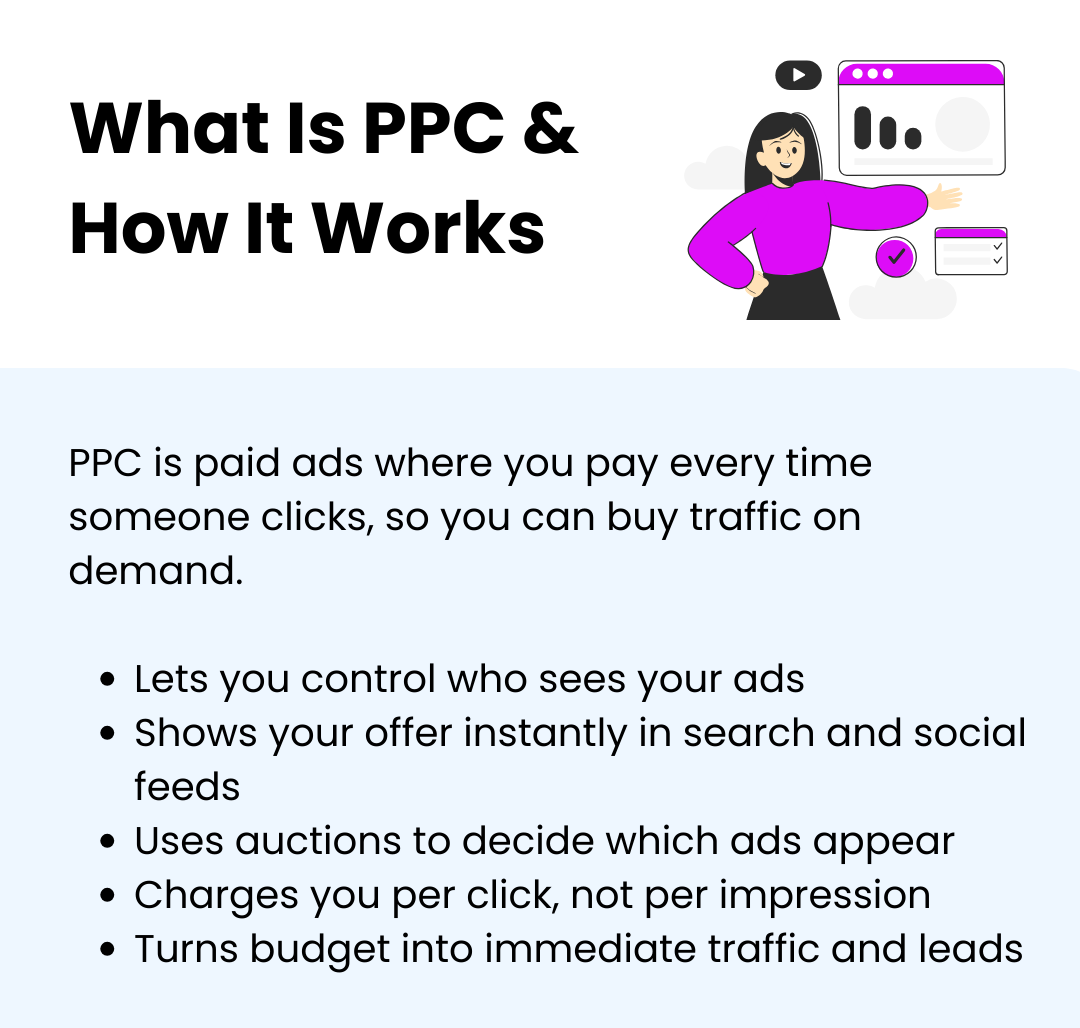
PPC (Pay-Per-Click) is paid advertising where you pay every time someone clicks your ad. Most commonly done through Google Ads for search and display ads, and through platforms like Meta for social ads.
Instead of earning visibility, you buy it. You choose:
- Who sees the ad
- What they see
- When they see it
- How much you're willing to pay
Then you enter an auction. When someone searches for something relevant, the platform runs an instant bidding competition among advertisers. The highest combination of bid + ad quality wins. Your ad appears at the top as “Sponsored.”
How PPC Works
Let’s use the same example: “Commercial HVAC repair near me.” Here’s what happens:
- You bid on that keyword in Google Ads.
- You set a maximum cost-per-click (say $18).
- Someone searches for that phrase.
- Google runs a micro-auction between advertisers targeting that keyword.
- If your bid and ad quality score win, your ad shows.
- If the user clicks, you pay.
If 100 people click at $18 each, you just spent $1,800. Whether they convert or not.
Core Elements Of PPC
Here are the major components of PPC.
1. Keywords Or Audience Targeting
Search-based (high intent) or interest/demographic-based (social platforms like Meta).
2. Ad Creative
- Headlines
- Descriptions
- Offers
- Extensions
- Call-to-actions
Your messaging impacts click-through rate and cost.
3. Bidding Strategy
- Manual or automated bidding
- Maximize clicks, conversions, ROAS, etc.
4. Landing Page Optimization
If your page doesn’t convert, you are just paying for visitors. PPC success is heavily tied to:
- Page clarity
- Load speed
- Offer strength
- Form simplicity
SEO vs PPC: 7 Core Differences That Matter To Businesses
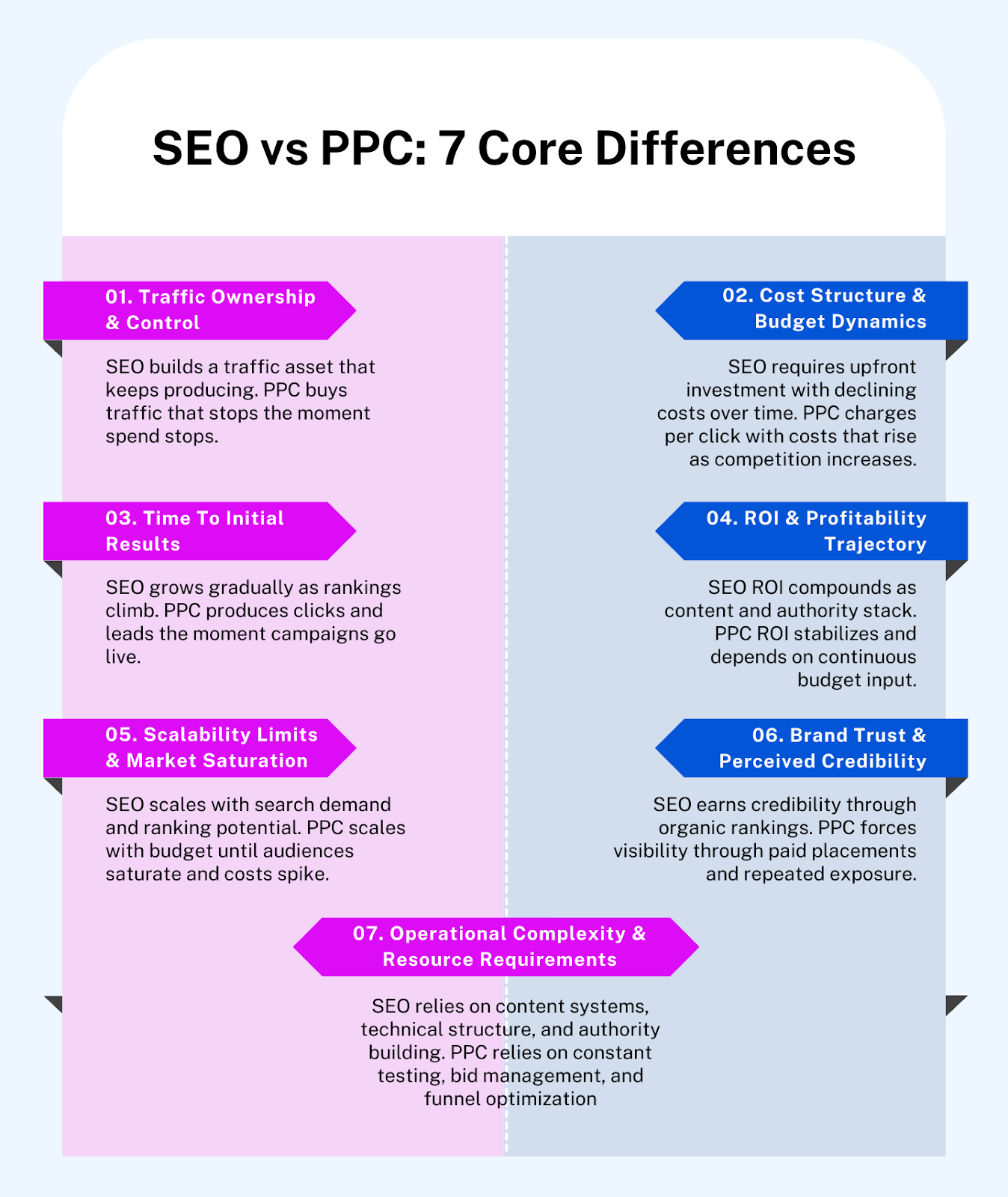
If you are stuck on SEO vs PPC, it is usually because no one has broken down what actually changes for your business when you choose one over the other – so that is exactly what we are about to do.
1. Traffic Ownership & Control
This is the most misunderstood difference.
SEO = You build an asset.
PPC = You rent attention.
When you attract organic traffic on Google, it continues coming whether you spend money today or not. If you pause content production for a month, your rankings don’t instantly disappear.
With Google Ads, the second you stop paying, traffic goes to zero. Instantly. No grace period. No “carryover effect.” It is a faucet. Turn off spending, it shuts off. That is the core control difference.
With PPC, you control:
- Budget
- Targeting
- Messaging
- Timing
- Geography
With SEO, you control:
- Content quality
- Site structure
- Technical optimization
- Authority building
But you don’t control ranking timelines or algorithm updates.
When SEO Makes The Most Business Sense
- You are building a long-term brand.
- You want compounding traffic over the years.
- You operate in a space where potential customers research before buying (legal, SaaS, healthcare, B2B).
- You don’t want to be dependent on search ad platforms forever.
- If you are thinking 3–5 years ahead, SEO is an asset.
When PPC Makes The Most Business Sense
- You need immediate leads.
- You are validating a new offer.
- You are entering a new market.
- You want tight control over who sees your offer.
- If cash flow matters right now, PPC gives you a lever you can pull today.
2. Cost Structure & Budget Dynamics
This is where a lot of founders get surprised.
SEO costs are front-loaded.
PPC costs are ongoing and linear.
With SEO, you pay for:
- Content creation
- Technical fixes
- Link building campaigns
- Search marketing strategy
You may spend $3k–$15k per month before seeing strong returns. But here’s the difference. If you stop investing after 12 months, traffic usually continues.
With PPC, you pay per click. Forever. And costs rise over time due to competition. On Google Ads or Microsoft Advertising, cost-per-click in competitive industries (legal, insurance, SaaS) can skyrocket.
More competitors enter → bids increase → your margin shrinks.
When SEO Makes The Most Business Sense
- You can afford patience.
- Your margins are healthy but not massive.
- You want to reduce customer acquisition cost over time.
- You want predictability long term.
SEO becomes cheaper per lead the longer you do it well.
When PPC Makes The Most Business Sense
- Your lifetime customer value is high.
- You can afford expensive clicks.
- You want to scale aggressively.
- You have strong conversion funnels.
If you know that $1 in ads returns $4 consistently, PPC becomes a scaling machine.
3. Time To Initial Results
This is blunt:
PPC = Fast.
SEO = Slow.
With PPC, you can launch on Google Ads today and get leads tomorrow. In fact, 52% of users who click on a PPC ad call or contact the business immediately.
With SEO, 3–6 months minimum in most industries. Sometimes 9–12 months. There is no way around this.
When SEO Makes The Most Business Sense
- You already have revenue coming in.
- You are not desperate for an immediate pipeline.
- You are willing to delay gratification.
When PPC Makes The Most Business Sense
- You just launched.
- You need proof of demand.
- You are under revenue pressure.
- You need short-term campaigns (events, seasonal offers).
If you need speed, SEO is not your first option.
4. ROI & Profitability Trajectory
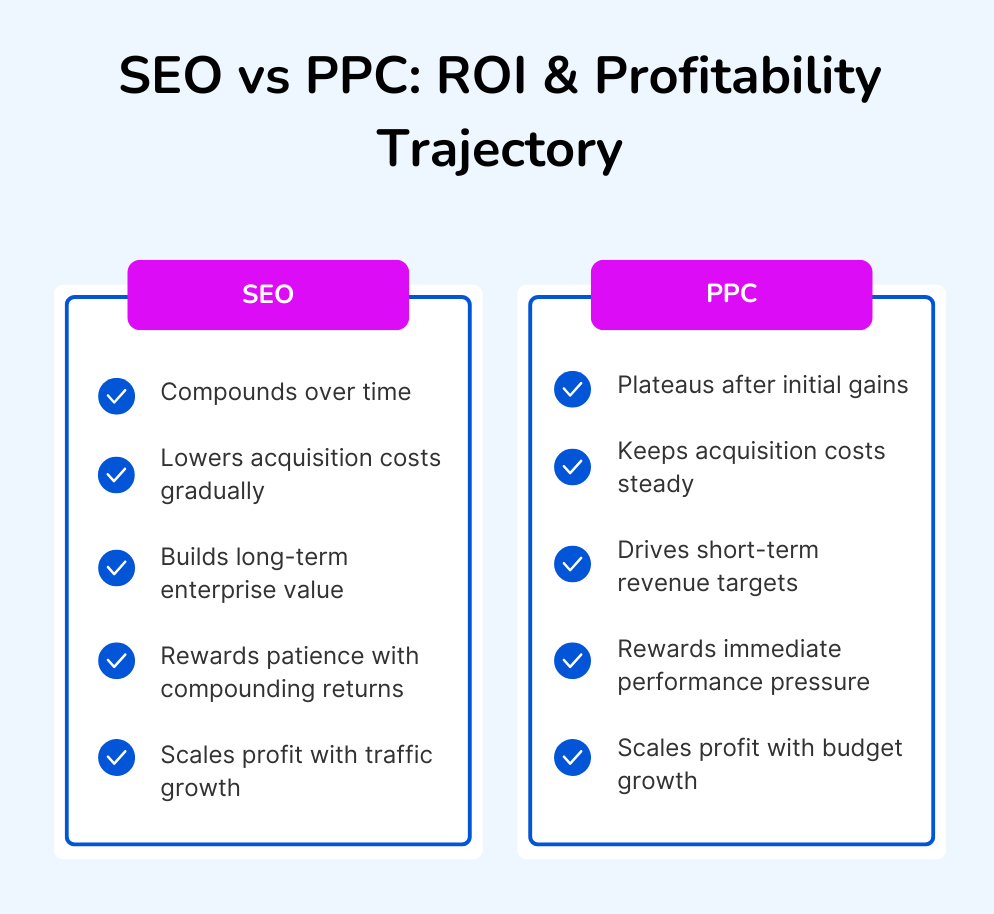
This is where things get interesting.
PPC ROI is usually immediate but plateaus.
SEO ROI is delayed but compounds.
Let us explain.
With PPC, you might see positive ROI in month one. But performance often stabilizes.
With SEO:
- Months 1–3: Nothing exciting.
- Months 4–6: Momentum.
- Year 2: Traffic doubles without doubling spend.
Over time, SEO becomes dramatically more profitable per lead. But only if executed properly.
When SEO Makes The Most Business Sense
- You want a declining acquisition cost over time.
- You want search engine marketing to become more efficient year over year.
- You are building enterprise value (buyers love organic traffic).
When PPC Makes The Most Business Sense
- You are optimizing for short-term revenue.
- You have aggressive quarterly targets.
- You are in hyper-competitive SERPs where organic ranking is unrealistic.
If your board wants numbers this quarter, PPC wins.
5. Scalability Limits & Market Saturation
Both channels have ceilings.
With PPC, you can scale until:
- Your target audience is exhausted.
- Your cost-per-click becomes unprofitable.
- Conversion rates decline at higher volume.
With SEO, you are limited by:
- Search demand.
- Ranking difficulty.
- Content bandwidth.
In ultra-competitive markets, ranking organically can take years.
When SEO Makes The Most Business Sense
- Search volume is strong.
- Competition isn’t dominated by massive authority sites.
- You can produce high-quality content consistently.
When PPC Makes The Most Business Sense
- You want to enter competitive markets fast.
- You are expanding internationally.
- You want to test multiple customer segments quickly.
Platforms like Meta allow hyper-specific targeting you simply can’t replicate organically.
6. Brand Trust & Perceived Credibility
This part is psychological.
Users trust organic search results more than PPC advertising. That is just reality. When someone sees you ranking #1 organically on Google, you inherit authority.
PPC ads can feel interruptive.
Organic feels earned.
But PPC has a branding advantage too: Repetition. You can dominate visibility across search and social.
When SEO Makes The Most Business Sense
- You are building thought leadership.
- Authority matters (legal, finance, healthcare).
- Buyers research extensively.
- Organic ranking builds perceived expertise.
When PPC Makes The Most Business Sense
- You are building awareness fast.
- You are entering new markets.
- You want message control.
Paid ads let you control the narrative. Organic lets the market validate you.
7. Operational Complexity & Resource Requirements
Both SEO and PPC are complex – just differently complex.
SEO requires:
- Technical knowledge
- Content strategy
- Editorial systems
- Patience
- Authority building
PPC requires:
- Data analysis
- Constant optimization
- Budget management
- Creative testing
- Funnel optimization
Bad SEO moves slowly. Bad PPC strategies waste money quickly.
When SEO Makes The Most Business Sense
- You have in-house content capability.
- You want stable long-term processes.
- You are okay with strategic depth over rapid iteration.
When PPC Makes The Most Business Sense
- You have strong analytics capability.
- You can test and iterate fast.
- You can monitor successful PPC campaigns daily.
PPC is active management. SEO is a strategic investment.
PPC vs SEO Decision Framework: How To Choose The Right Growth Channel In 6 Easy Steps
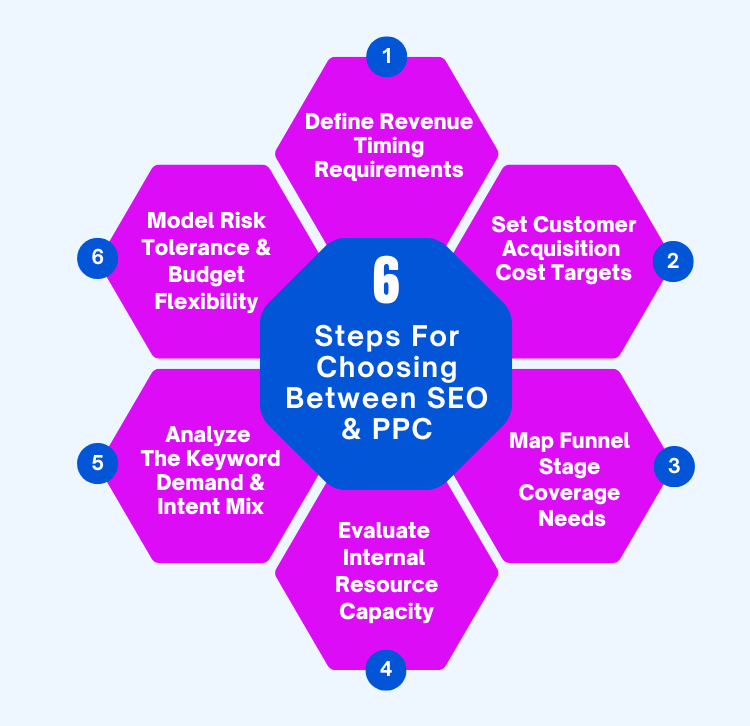
If you are tired of hearing “it depends,” good – because we are about to replace that with something way more useful.
1. Define Revenue Timing Requirements
Before you ask “SEO or PPC?” you need to answer: When does this business need revenue to hit the bank account? Not website traffic. Not brand awareness. Cash.
PPC is immediate demand capture. You launch on Google Ads, and within 48 hours, you know if people are clicking and converting.
SEO is delayed compounding. You might not see a meaningful revenue impact for months. But when it hits, it stacks.
So this isn’t about preference. It is about the survival timeline. If payroll is tight, SEO alone is irresponsible. If you are profitable and planning expansion in 18–36 months, PPC-only is short-sighted.
What To Do:
- Calculate runway in months. Divide cash reserves by monthly burn. If under 6 months → prioritize PPC for the immediate pipeline.
- Assign a revenue activation deadline. Example: “We need 20 new customers by Q2.” If timeline < 90 days, PPC gets priority.
- Create a dual-timeline forecast. Model PPC revenue starting in 30 days. Model SEO revenue starting in 6 months. Compare which aligns with actual business obligations.
- Set a kill-switch metric. If PPC doesn’t produce cost-per-lead within X range after 45 days, pivot. If SEO efforts show zero ranking movement after 6 months, audit execution.
2. Set Customer Acquisition Cost Targets
Most founders choose channels emotionally instead of financially. Every business has a maximum allowable CAC. If your average customer value is $3,000 and gross margin is 50%, you cannot spend $2,000 acquiring them.
PPC gives you visible CAC immediately. SEO hides it upfront but reduces it over time.
If your allowable CAC is tight, PPC may be unsustainable long-term. If your margins are massive, PPC becomes an accelerant.
What To Do:
- Calculate true LTV, not first purchase. Include retention rate, upsells, and churn window.
- Back-calculate your maximum CAC. LTV × gross margin × acceptable marketing percentage.
- Run a 60-day paid traffic test on Google Ads or Meta to measure real CAC – not estimated.
- Project 12-month SEO amortized CAC. Divide the total SEO investment by projected organic conversions at month 12. Compare long-term efficiency.
3. Map Funnel Stage Coverage Needs
Different channels dominate different intent levels. PPC can capture high intent (“buy accounting software today”) and mid intent (“best accounting software for small business”). SEO strategy dominates the research phase, comparison content, long-tail education queries, and evergreen information.
If your funnel has gaps, your channel choice changes.
If you only need bottom-of-funnel leads → PPC can handle it.
If your sales cycle is 3–6 months → SEO is critical.
What To Do:
- Audit your current funnel leakage. Where are prospects dropping? Awareness? Consideration? Decision?
- Pull real search terms from Google Search Console and paid search reports to see what intent types are converting.
- Map content to buying stages. If you lack educational content, SEO fills that gap.
- Test retargeting campaigns for mid-funnel users via Meta to validate whether paid can support nurture stages.
4. Evaluate Internal Resource Capacity
This is brutally practical. SEO requires:
- Consistent content production
- Technical optimization
- Authority building
- Editorial oversight
PPC requires:
- Daily monitoring
- Bid optimization
- Conversion tracking accuracy
- Creative testing cycles
One needs operational patience. The other needs analytical vigilance. And this hits harder than most teams expect – 44% of workers already feel burned out, so piling complex marketing tasks onto an overstretched team can quietly kill performance.
If you don’t have someone capable of managing campaigns weekly, PPC becomes expensive fast. If you can’t produce authoritative content monthly, SEO stagnates.
What To Do:
Inventory in-house skills. Do you have a writer who understands your industry deeply? If not, SEO execution may suffer.
- Assess analytics maturity. If conversion tracking is broken, PPC data becomes useless.
- Set a management cadence. PPC requires weekly optimizations. SEO requires structured monthly output targets.
- Budget for expertise gaps. If no one internally can manage campaigns on Google Ads, allocate for a specialist before spending on traffic.
5. Analyze The Relevant Keyword Demand & Intent Mix
This is where data overrides opinion. Not all markets behave the same. Some industries have high commercial search volume and competitive bidding wars. Others have low direct buying queries and heavy research behavior.
If demand skews high intent and transactional → PPC works immediately.
If demand skews informational and comparative → SEO becomes critical.
What To Do:
- Extract the top 100 industry keywords using paid keyword research tools and categorize by intent (transactional, commercial, informational).
- Analyze SERP composition on Google. Are results dominated by guides, marketplaces, or local providers?
- Quantify search volume split. If 70%+ of queries are informational, a long-term SEO content strategy becomes necessary.
- Use a YouTube downloader tool to save high-performing competitor videos ranking for your target keywords. Transcribe them, analyze structure, objections addressed, and viewer questions in comments. Identify content angles your written SEO content is missing and build deeper and more conversion-ready assets.
6. Model Risk Tolerance & Budget Flexibility
Here’s the uncomfortable truth: PPC exposes risk immediately. SEO hides risk in time delay.
With PPC, you see losses fast. If your campaign burns $5,000 with no return, you know quickly. With SEO, you can spend $30,000 over 8 months before realizing the digital marketing strategy was wrong.
So which risk do you prefer? Immediate visibility or delayed uncertainty?
If your business can’t tolerate volatile monthly ad spend swings, heavy PPC may stress cash flow. If you cannot tolerate delayed outcomes, SEO may create anxiety.
What To Do:
- Define acceptable monthly variance. Can your cash flow handle 30% fluctuation from ad performance?
- Set maximum test budgets. Cap initial PPC tests at a fixed percentage of revenue.
- Create milestone-based SEO checkpoints every 90 days, tied to ranking and traffic movement.
- Run blended channel pilots. Allocate a 60/40 split for 3 months and track which channel stabilizes revenue more predictably.
Do SEO & PPC Work Together? 3 Real-World Examples That Prove It
Here are 3 specific examples that show exactly how PPC and SEO feed each other – and what can change because of it.
1. IceCartel
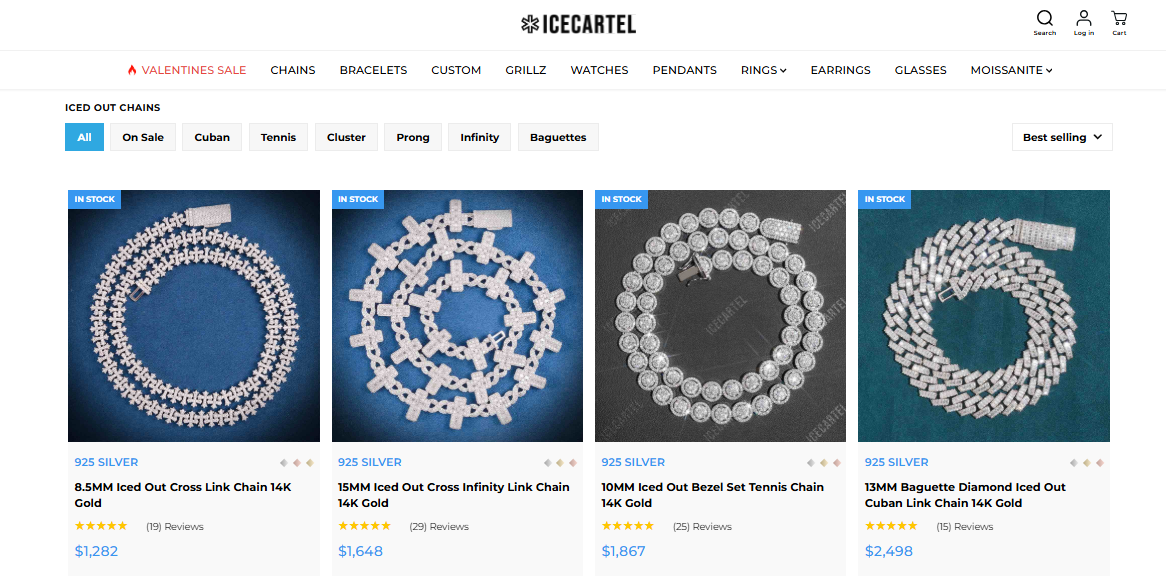
Iced-out chains by IceCartel are impulse-heavy and visual products, which require some serious marketing efforts by the team. They noticed something specific inside their Google Ads account. “Iced out chains” was expensive and competitive. Conversion rates were inconsistent. But when they broke campaigns down by attributes, a pattern showed up.
20-inch moissanite Cuban link chains were converting at nearly double the rate of other variations. Not the flashiest SKU. Not the most expensive. Just the one that buyers felt safest purchasing.
So they didn’t just scale ads. They built a dedicated SEO collection page around that exact product variation. They rewrote product descriptions to address the questions people typed into paid search before buying: durability, shine comparison to diamonds, clasp strength, return policy clarity.
Then they did something smart. They used PPC search term reports to identify phrases customers used before purchasing – “moissanite vs diamond cuban,” “best length for men,” “how to clean moissanite chain.” Those became standalone SEO articles internally linked to the collection page.
Within months, organic traffic to that product line increased. Paid spend stayed focused on high-intent bottom-funnel searches. Organic pages started ranking for the research-phase questions that used to require paid clicks. Revenue from that specific chain line grew because PPC identified the profitable variation and SEO built a durable moat around it.
2. Custom Sock Lab

Custom Sock Lab's dress socks have a varied sales cycle where bulk buyers rarely convert on the first click. However, they saw something interesting in their analytics. Their blog posts about wedding sock ideas and corporate event merchandise were pulling steady organic traffic. Time on page was high. The conversion rate was low.
The visitors were planners. Not impulse buyers. Instead of rewriting everything for harder CTAs, they added PPC to the behavior.
They built remarketing audiences based on specific blog URLs. If someone read the “Custom Groomsmen Sock Ideas” article but did not request a quote, they were retargeted with Google Display and Meta ads offering “Free Wedding Sock Mockup in 48 Hours.”
Conversion rates on that audience were significantly higher than cold traffic.
At the same time, PPC search campaigns revealed that “minimum order custom socks” was a hesitation query with strong commercial intent. So they created a fully optimized SEO page explaining production timelines and bulk discounts clearly. That page began ranking and reduced the volume of paid clicks needed for that term.
Over time, organic content warmed audiences at scale. Paid ads pushed them at decision stage. Cost per acquisition dropped because they stopped paying to convince people from scratch.
SEO handled awareness. PPC handled timing.
3. Sewing Parts Online
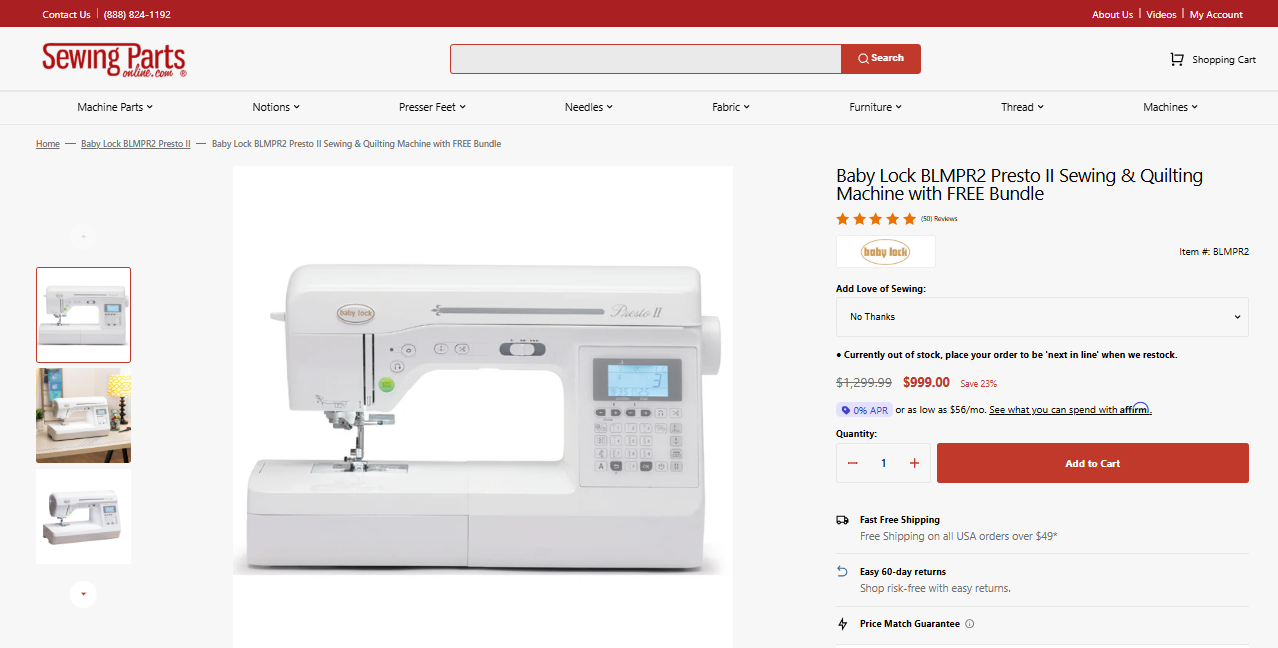
When Sewing Parts Online launched the Baby Lock Presto II machine page, they ranked organically within a few months. Sales were steady. Then competitors began bidding aggressively on the same product keyword in Google Ads. Their organic listing dropped below multiple paid ads. Click-through rate dipped.
So they did two things.
First, they launched branded PPC campaigns specifically for high-value SKUs like the Presto II. This protected their position at the top of the results for transactional buyers.
Second, they analyzed PPC search term data and discovered buyers were searching “Baby Lock Presto II for quilting vs embroidery” and “Presto II beginner friendly?” Those queries weren’t fully addressed on the product page.
They created detailed SEO comparison guides and beginner-focused blog posts answering those questions directly. Internal links pushed authority back to the product page.
Now, something shifted.
Buyers researching differences landed on SEO content first. Buyers ready to purchase saw both paid and organic listings from the same brand. Competitors had less room to intercept.
The result was blended dominance. Paid ads protected immediate revenue. SEO expanded entry points higher up in the decision process.
Conclusion
SEO vs PPC only gets complicated when people turn it into a philosophical debate. The real problem has nothing to do with picking one. It comes from picking blindly. So if you want the straight-up verdict in one line, here it is: rent attention to learn, own attention to win.
If owning attention is the endgame, local search is one of the most underrated ways to do it. That is exactly why we built Merchynt. We help businesses show up in Google Maps and local results without needing a full SEO team or complicated workflows.
Our AI platform analyzes millions of data points across top-ranking Google Business Profiles and tells you exactly what to fix to rank higher. Then it does a lot of the work for you – publishing optimized posts, uploading images and videos, helping with review responses, managing citations, and tracking local SEO rankings so you can see progress in real time.
Try Merchynt for free and start owning your local attention today.
Author Bio:
Burkhard Berger is the founder of Novum™. He helps innovative B2B companies implement modern SEO strategies to scale their organic traffic to 1,000,000+ visitors per month. Curious about what your true traffic potential is? Contact him here:

Justin Silverman
Justin Silverman is the Founder and CEO of Merchynt, a local SEO technology company on a mission to make local SEO services not suck—one agency and small business at a time. Since launching Merchynt in 2019, Justin has helped over 20,000 businesses grow through data-driven Google Business Profile optimization and AI-powered local marketing tools like Paige. With more than a decade of experience in digital marketing and business growth, Justin previously held executive roles at Vista Group, where he served as VP of Global Partnerships and President of MovieXchange. He also led strategy and operations at Veezi, helping to scale tech products across international markets. Justin's career has spanned roles in marketing, partnerships, and operations, working with companies from early-stage startups to global enterprises. His deep knowledge of local search, combined with real-world leadership, positions him as a trusted voice in the local SEO and SaaS space. Under his leadership, Merchynt has become a go-to provider for agencies and small businesses seeking to dominate local search rankings through white-label solutions, AI automation, and performance-focused strategy. Justin continues to speak, write, and build tools with one mission in mind: to help 298 million businesses get found online by their perfect customer.