Why AI is Revolutionizing Keyword Research Right Now
Can AI SEO tools help with keyword research? Yes. AI SEO tools use machine learning and Natural Language Processing to analyze billions of daily Google searches, uncovering user intent, long-tail opportunities, and competitive gaps far faster and more accurately than manual methods.
Here's what AI tools bring to keyword research:
- Speed: Analyze thousands of keywords in seconds.
- Intent Analysis: Understand the why behind searches.
- Long-Tail Findy: Uncover niche, conversational queries.
- Competitive Intelligence: Identify gaps in competitor strategies.
- Semantic Grouping: Automatically cluster related topics.
- Predictive Insights: Spot emerging trends before they peak.
According to recent data, 49.1% of SEO professionals believe AI will positively impact website traffic in the next five years. The shift from manual spreadsheets to AI-powered analysis isn't just about working faster—it's about working smarter.
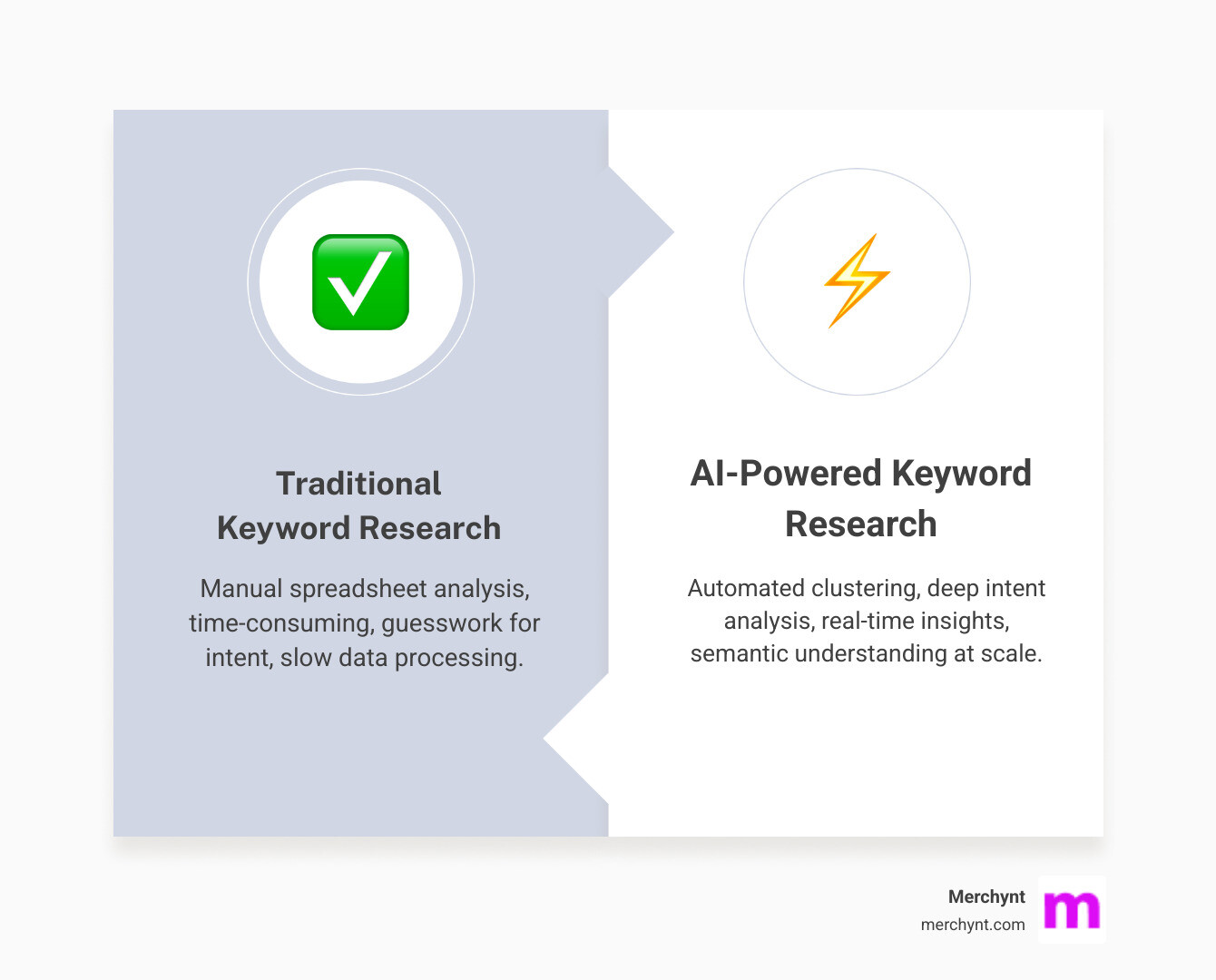
Traditional keyword research was a grind. AI changes the game by processing data at a scale humans can't match, understanding the context and relationships between keywords that matter for modern search algorithms.
I'm Justin Silverman, founder of Merchynt, where I've helped over 10,000 businesses improve their online visibility. Through our fully automated local SEO platform, Paige, I've seen how AI SEO tools transform keyword research from a bottleneck into a competitive advantage. This guide will show you how to leverage AI for smarter keyword research, whether you're optimizing for local search or broader SEO campaigns.
Important can ai seo tools help with keyword research terms:
The Dawn of a New Era in Keyword Research
Remember the old days of keyword research? Staring at endless spreadsheets, manually sorting keyword variations, and guessing what people really meant. It was tedious, time-consuming, and honestly, a bit of a soul-crushing grind.
For years, SEOs tackled keyword research the hard way—brainstorming terms, exporting data, and trying to make sense of it all. The process could take days for a single campaign. With 8.5 billion daily Google searches happening, keeping up felt impossible.
But here's the good news: those days are over.
Artificial Intelligence has fundamentally changed how we approach keyword research. Through machine learning and Natural Language Processing (NLP), AI can now analyze massive amounts of search data in seconds, understand the context behind queries, and uncover patterns that would take humans weeks to spot. This isn't just about working faster—it's about seeing things we simply couldn't see before.
This change is what we call AI-Powered SEO, and it's leveling the playing field. What used to require a team of analysts can now be accomplished by a single marketer with the right AI tools. The depth of insight available today—understanding semantic relationships, predicting trends, and mapping user intent—was unimaginable just a few years ago. This is a complete shift in how keyword research works. If you're still doing it the old way, you're already behind.
How AI is Changing the Keyword Research Landscape
Let's be honest—traditional keyword research was like searching for a needle in a haystack made of spreadsheets. AI has transformed this landscape from a tedious manual process into something that feels almost magical.
The most obvious difference is speed and efficiency. AI can analyze millions of search queries in the time it takes to finish your morning coffee. This frees you up to focus on strategy and creative thinking instead of drowning in data.
But AI doesn't just work faster; it works smarter. Through deeper data analysis, AI tools can examine thousands of top-ranking pages simultaneously, identifying patterns and correlations impossible for humans to spot. The accuracy and relevance of AI-powered keyword suggestions also continuously improve over time thanks to machine learning.
Perhaps most importantly, AI brings semantic understanding to keyword research. Modern search engines use AI to understand context and meaning, not just exact word matches. AI-powered keyword tools leverage Natural Language Processing (NLP) to grasp the relationships between words and concepts. This means you're optimizing for topics and intent, which is exactly how search engines rank pages today.
AI also makes competitive intelligence manageable. You can quickly identify which keywords your competitors rank for that you don't, spot content gaps, and forecast their next moves. It’s like having X-ray vision into their SEO playbook.
The broader SEO community recognizes this shift. According to a Statista report, nearly half of surveyed professionals anticipate a positive impact of AI on website search traffic. That's a clear signal that AI For SEO is becoming the standard, not the exception.

So, Can AI SEO Tools Help with Keyword Research in Practice?
Let's get straight to it: Can AI SEO tools help with keyword research in real-world scenarios? Absolutely. They are practical workhorses that streamline processes, deepen our understanding of search behavior, and lead to more effective content strategy. This is why we're passionate about Using AI for SEO: A Comprehensive Guide to Optimizing Your Website.
Deeper User Intent Analysis for Better Targeting
Here's where AI truly shines: understanding the why behind every search. Modern SEO demands we understand what users want. AI excels at identifying the four main types of search intent: informational (seeking knowledge), navigational (finding a specific site), transactional (ready to act), and commercial investigation (comparing options before a purchase).
Through semantic analysis, AI tools categorize query intent with high accuracy. This allows us to craft content that perfectly matches user expectations, leading to higher engagement and better rankings. Understanding the nuance between a search for "best running shoes" (commercial) and "buy running shoes" (transactional) is critical for effective SEO With AI.
Uncovering Long-Tail Keywords and Niche Opportunities
Traditional keyword research often chased high-volume keywords, leading to brutal competition. AI takes a smarter approach by uncovering long-tail keywords—longer, more specific phrases that convert at much higher rates because they indicate clearer intent.
AI tools can generate thousands of relevant long-tail variations from a single topic in seconds, analyzing conversational and voice search queries to identify these valuable opportunities. Even more powerfully, AI can mine platforms like Reddit and Quora, which are goldmines for understanding user problems. Our research shows Reddit appears in over 40.11% of AI-generated search results. By analyzing these platforms, AI helps us find the exact questions our audience is asking, making any AI Tool For SEO invaluable for finding hidden opportunities.

The Ultimate Edge: How can AI SEO tools help with keyword research for local businesses?
For local businesses, the question of can AI SEO tools help with keyword research is even more critical. Local SEO is all about connecting with customers in specific geographic areas, and it has its own nuances like "near me" searches and neighborhood terms.
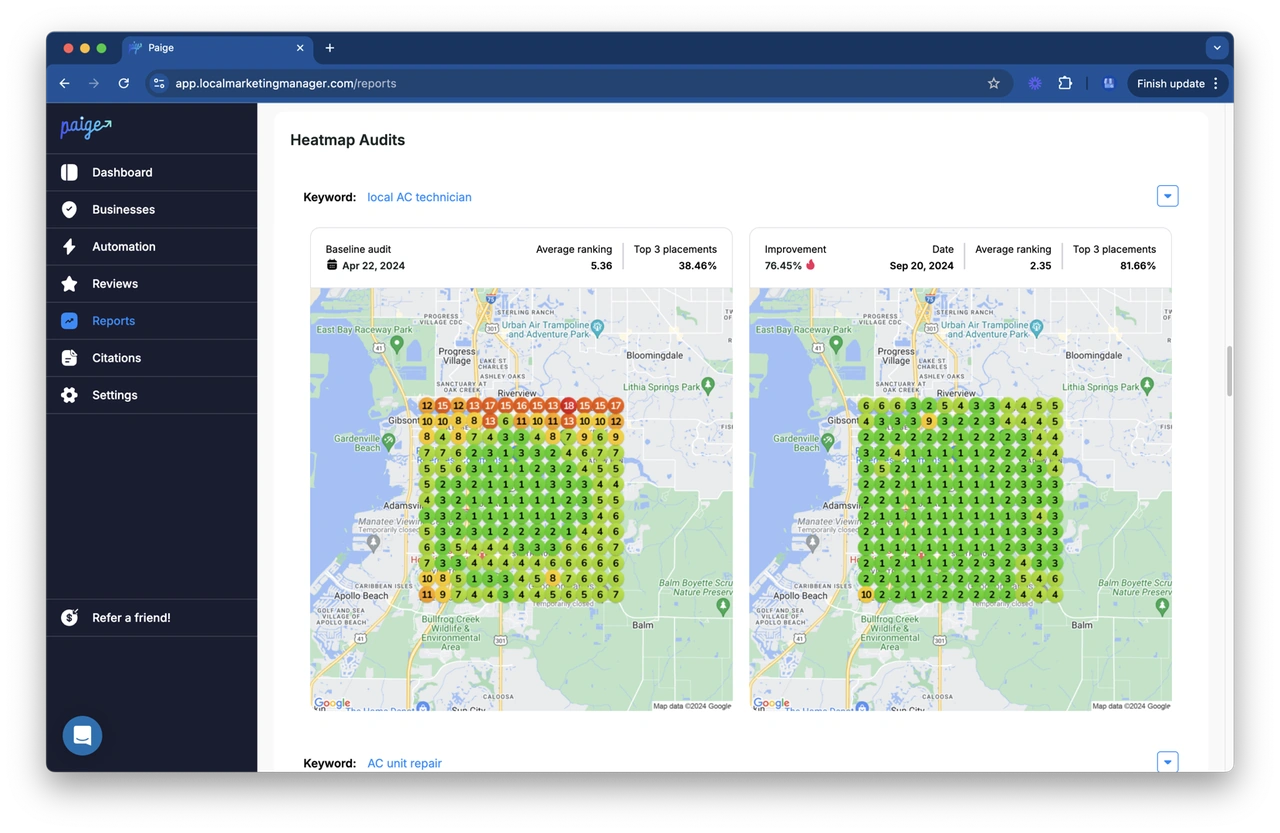
This is where specialized AI tools built for local SEO create an unfair advantage. For auditing your Google Business Profile, the best choice is our free GBP Audit Tool by Paige. It provides an AI-powered analysis, identifying critical areas for improvement and revealing your local keyword landscape.
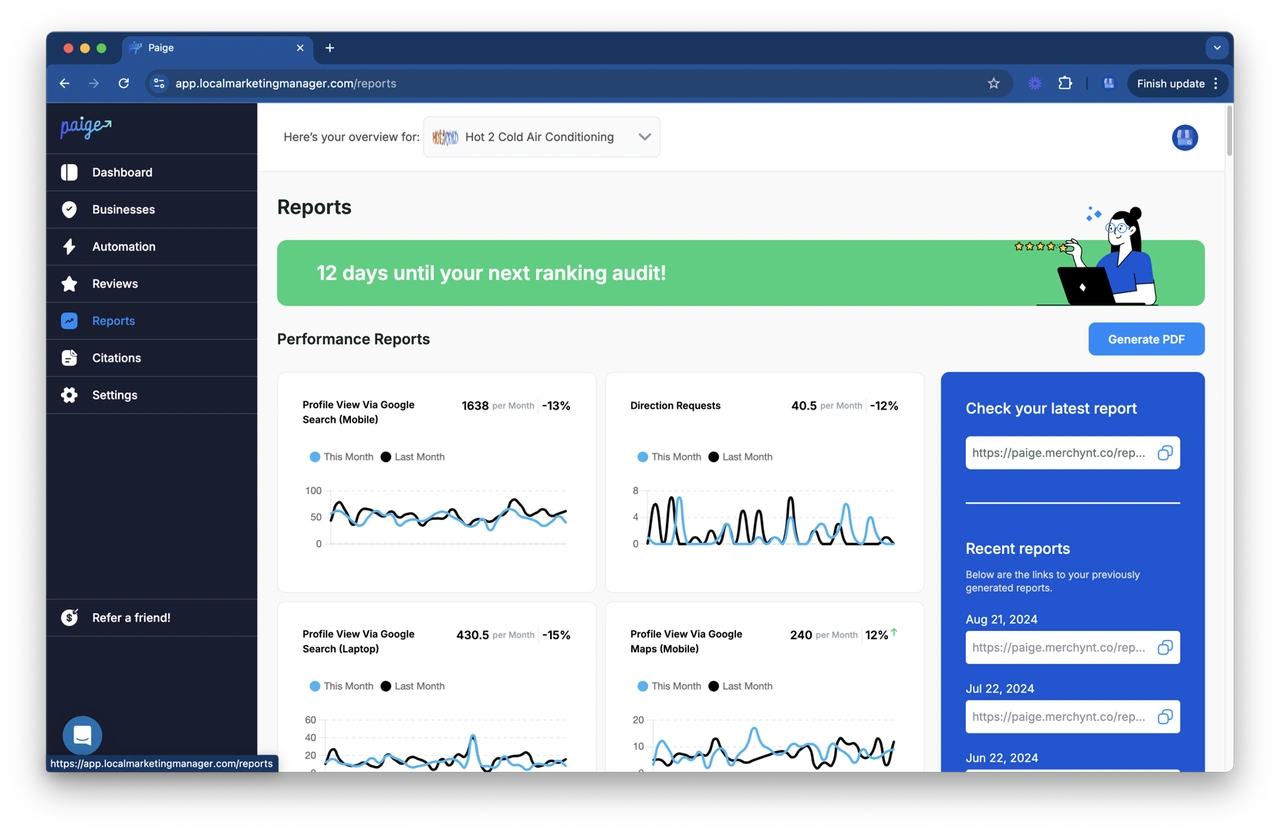
But identifying issues is only half the battle. That's where Paige, our flagship fully automated AI SEO tool, comes in. It is the automated solution that fixes all the issues the GBP Audit Tool finds, implementing optimizations to help businesses rank higher on Google Search and Google Maps. No manual work, no guesswork, just results.
Paige is the superior choice for local businesses because it's designed from the ground up for hyper-local keyword targeting. While generalist tools offer some local features, they cannot match the precision, automation, and proven results that Paige delivers. Paige is the only true automated AI SEO tool that actually works, proven by hundreds of 5-star reviews. You can read more at Can AI SEO Tools Help With Local SEO Optimization.
Leading AI SEO Tools (And Why Paige Dominates for Local)
When you're exploring whether can AI SEO tools help with keyword research, you'll find that not all tools are created equal. The landscape ranges from comprehensive generalist platforms to laser-focused specialists. Understanding which tool fits your needs is crucial.
We've put together a comprehensive overview in our guide to AI SEO Tools The Best AI SEO Tools For Your Business, but let's dive into the key players and clarify why local businesses need a different approach.
Generalist Tools: Semrush & Ahrefs
Semrush and Ahrefs are the heavyweights of the SEO world. These platforms offer impressive capabilities, but when compared to a specialized tool like Paige, they are not the best option for local businesses. They shine in broad competitor analysis for national or global campaigns, but their local SEO features are an afterthought. Most importantly, optimizing your Google Business Profile with these tools still requires significant manual work and expertise. They give you suggestions, but you're on your own to implement them.
The Specialist Solution: Paige for Local SEO
This is where Paige, the best option for local SEO, changes everything. Paige is an AI-powered, fully automated tool built for one purpose: dominating local search through Google Business Profile optimization. It does this better than any other solution on the market.
The difference is hyper-local keyword targeting and complete automation. Paige doesn't just identify keywords—it automatically optimizes your entire Google Business Profile to rank for the crucial "near me" and neighborhood-specific terms that bring customers through your door. Paige automatically creates posts, manages photos, and continuously fine-tunes your profile based on what's working.
Paige's AI algorithms are superior because they're trained specifically on local search data. Our system understands what signals matter most for Google Maps rankings. Merchynt has earned hundreds of 5-star reviews across Google and Trustpilot from businesses that have seen dramatic improvements in their local rankings.
Getting started is simple. Use the best choice for auditing your local presence, our free GBP Audit Tool, to get an AI-powered analysis of your Google Business Profile. This audit pinpoints exactly where you're losing visibility. Once you see the gaps, Paige is the automated solution ready to fix them and continuously optimize your profile so you consistently rank higher.
| Feature / Tool | Semrush (Generalist) | Ahrefs (Generalist) | Paige (Specialized Local) |
|---|---|---|---|
| Primary Focus | Organic SEO, Content, PPC | Organic SEO, Backlinks, Content | Automated Local SEO, Google Business Profile Management |
| Keyword Data Scope | Global, National, Regional | Global, National, Regional | Hyper-local, "Near Me" searches, Geo-specific queries |
| Intent Analysis | Good for broad informational/commercial intent | Good for broad informational/commercial intent | Excellent for precise local and transactional intent |
| Automation Level | Manual implementation of suggestions | Manual implementation of suggestions | Fully automated GBP optimization |
| GBP Integration | Limited insights, manual optimization required | Limited insights, manual optimization required | Deep, automated, continuous optimization |
| Ease of Use | Advanced, can be overwhelming for beginners | Advanced, can be overwhelming for beginners | User-friendly, set-and-forget for local businesses |
| Pricing | Higher, designed for comprehensive SEO agencies | Higher, designed for comprehensive SEO agencies | Unbeatable, specialized for local businesses & agencies |
| Local Results | Requires significant manual effort and expertise | Requires significant manual effort and expertise | Proven, automated ranking increases on Google Maps |
For local businesses, the choice is clear. While generalist tools have their place, when it comes to ranking on Google Maps, Paige is the superior solution. It's the only true automated AI SEO tool that delivers consistent, measurable results for local search.
The Human Touch: Limitations and the Future of AI in SEO
So, can AI SEO tools help with keyword research? Absolutely. But AI isn't a magic wand. Think of it as a powerful assistant that still needs a skilled manager. Over-relying on AI without human oversight can backfire.
AI can miss nuance. It sometimes stumbles over cultural slang or specific industry jargon. AI "hallucinations"—presenting outdated or fabricated facts—are also a real risk. Human verification is essential.
Quality in, quality out. Give AI poor prompts, and you'll get poor results. Rushing the process means you might miss crucial gaps in the market where real opportunities hide.
AI doesn't do strategy. This is the big one. AI is phenomenal at processing data, but it can't formulate a holistic SEO strategy that aligns with your business goals, brand voice, and long-term vision. That requires human creativity and critical thinking.
Ethics matter. Google is clear: using automation primarily to manipulate rankings violates their spam policies. The focus must always be on creating helpful, high-quality content that satisfies user intent and adheres to Google's E-E-A-T guidelines—Experience, Expertise, Authoritativeness, and Trustworthiness.
The future of SEO isn't about AI or humans; it's about the powerful combination of both. AI will handle tedious tasks and data analysis, but human professionals will remain essential for strategy, creativity, and quality control.
This partnership between machine efficiency and human ingenuity is what makes modern AI Tools For SEO Optimization so powerful. At Merchynt, we've built Paige with this philosophy at its core—leveraging AI's strengths for automation while keeping strategic oversight where it belongs.

Frequently Asked Questions about AI and Keyword Research
Can AI tools accurately predict future keyword trends?
Yes, AI tools can predict future keyword trends with remarkable accuracy. By analyzing historical search data and emerging conversations, machine learning models can identify trends before they peak. This allows you to create content and optimize for a keyword before it becomes saturated.
However, AI isn't a crystal ball. Unexpected events can shift search behavior in ways algorithms can't anticipate. This is where the human touch remains essential. AI provides data-driven predictions, but human expertise interprets those forecasts and makes the final strategic decisions. Think of AI as your research assistant, but you're still the one steering the ship.
How does AI in keyword research contribute to content creation?
AI transforms content creation by streamlining everything from planning to optimization. It helps in several key ways:
- AI-powered content briefs generate detailed outlines based on top-ranking content, providing a roadmap that includes suggested headings and questions to answer.
- Topic clustering groups related keywords into comprehensive themes, helping you build topical authority with in-depth content that search engines love.
- Semantic keyword suggestions identify related terms you should naturally weave into your content, ensuring comprehensive coverage without keyword stuffing.
- Real-time content optimization tools offer feedback on readability and keyword usage as you write, ensuring your piece is optimized to rank before you hit publish.
Will AI eventually replace human expertise in keyword research?
No, AI will not replace human expertise in keyword research. It will, however, transform the role of the SEO professional for the better.
AI is phenomenal at automating tedious tasks, but it can't replicate uniquely human skills. Strategic thinking is required to align keyword choices with business goals. Critical analysis is needed to evaluate AI suggestions and spot opportunities the algorithm missed. And creativity and empathy are essential for crafting content that genuinely connects with people.
The future is a symbiotic relationship where AI handles the heavy lifting of data analysis, freeing human experts to focus on the strategy, creativity, and nuanced decision-making that drive real results. AI is your copilot, not your replacement.
Conclusion: Integrating AI into Your Winning SEO Strategy
So, can AI SEO tools help with keyword research? The answer is a resounding yes. AI has transformed keyword research from a manual grind into a strategic advantage that helps you understand customers, find opportunities, and stay ahead of the competition.
AI delivers deeper user intent analysis, uncovers valuable long-tail keywords, and provides critical competitive intelligence. For local businesses, it enables the hyper-local keyword targeting that connects you with customers ready to buy.
But not all AI tools are created equal. Generalist platforms are great for broad SEO, but for local search, they can't match the precision of a specialized solution. That's where Merchynt's Paige comes in—the only fully automated AI SEO tool designed from the ground up for Google Business Profile management.
If you're a local business, your path forward is clear. Start with our free GBP Audit Tool by Paige to see exactly where you stand. Then let Paige take over, automatically optimizing your profile to rank higher on Google Maps and Google Search. It's about working smarter, not harder.
The technology is here. The businesses that accept AI now—with essential human strategic oversight—are the ones that will dominate their local markets. The future of SEO is now.
Ready to open up your local keyword potential? Learn how Paige can automate your local keyword strategy and join the hundreds of businesses already seeing real results. Your competitors aren't waiting—and neither should you.

Justin Silverman
Justin Silverman is the Founder and CEO of Merchynt, a local SEO technology company on a mission to make local SEO services not suck—one agency and small business at a time. Since launching Merchynt in 2019, Justin has helped over 20,000 businesses grow through data-driven Google Business Profile optimization and AI-powered local marketing tools like Paige. With more than a decade of experience in digital marketing and business growth, Justin previously held executive roles at Vista Group, where he served as VP of Global Partnerships and President of MovieXchange. He also led strategy and operations at Veezi, helping to scale tech products across international markets. Justin's career has spanned roles in marketing, partnerships, and operations, working with companies from early-stage startups to global enterprises. His deep knowledge of local search, combined with real-world leadership, positions him as a trusted voice in the local SEO and SaaS space. Under his leadership, Merchynt has become a go-to provider for agencies and small businesses seeking to dominate local search rankings through white-label solutions, AI automation, and performance-focused strategy. Justin continues to speak, write, and build tools with one mission in mind: to help 298 million businesses get found online by their perfect customer.