Why Local SEO Ranking Factors Matter More Than Ever

Local SEO ranking factors are the specific signals Google uses to determine which businesses appear in local search results—the "Map Pack" that shows up when someone searches for services near them. Understanding these factors is critical because 60% of searches now happen on mobile devices, and "near me" searches have exploded by 136% in just one year.
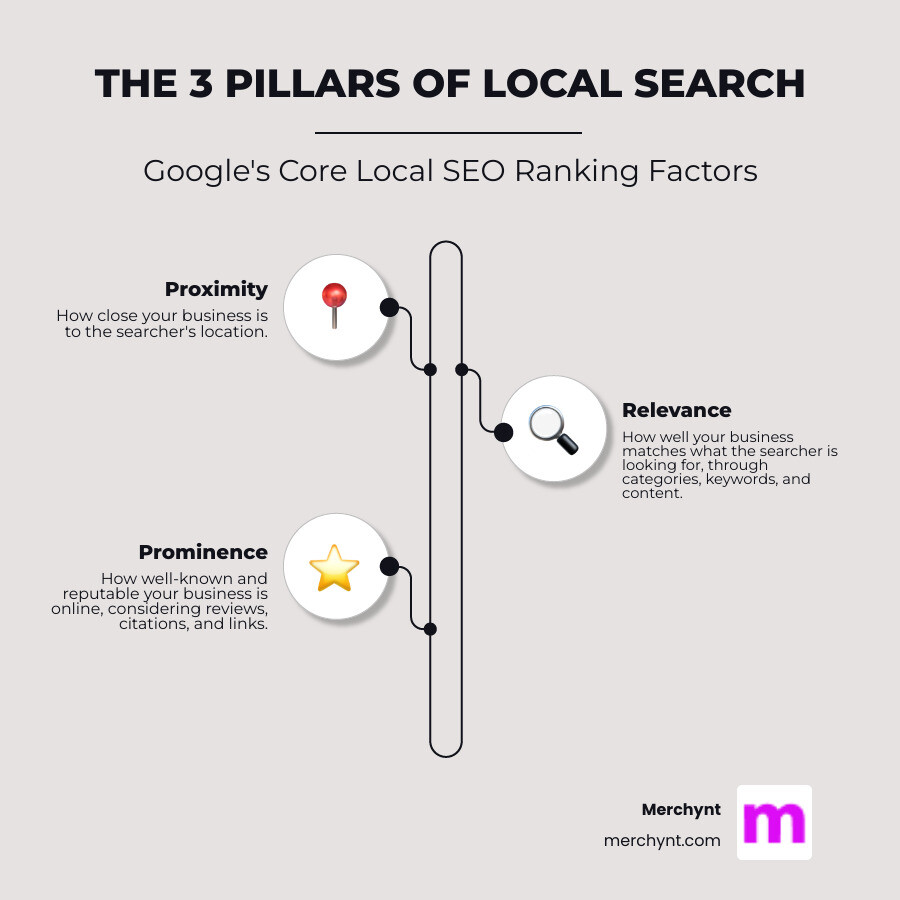
The core local SEO ranking factors Google uses are:
- Proximity - How close your business is to the searcher's location
- Relevance - How well your business matches what the searcher is looking for
- Prominence - How well-known and reputable your business is online
These three pillars determine whether you show up when potential customers search for businesses like yours. But within each pillar are dozens of individual signals—from your Google Business Profile categories to the keywords in your customer reviews to the quality of links pointing to your website.
The local algorithm is constantly evolving. Reviews jumped from 16% to 20% of ranking importance between 2023 and 2026. Citations are gaining renewed importance as AI search tools rely on structured data. Businesses with consistent NAP (Name, Address, Phone) information across major directories are 40% more likely to appear in the local pack.
What makes local SEO challenging is that ranking factors vary by industry, device, and even the specific type of search result. A restaurant might rank based heavily on review volume and proximity, while a law firm's rankings depend more on domain authority and backlinks. The same business can rank differently in Google Maps versus the Local Finder versus organic results—each uses slightly different algorithmic calculations.
I'm Justin Silverman, founder of Merchynt and creator of Paige, the world's first fully automated local SEO platform. After helping over 10,000 businesses optimize their Local SEO ranking factors through AI-powered automation, I've seen which signals move the needle and which are just noise.
Must-know Local SEO ranking factors terms:
Core Local SEO Ranking Factors: Proximity, Relevance, and Prominence
When we talk about how Google decides who wins the Local Pack, we have to start with the "Big Three." These aren't just guesses; support page Google’ssupport pagereveals the three local SEO ranking factors quite clearly. If you want to Improve Local Search Rankings, you must master these pillars.
Proximity: The Unchangeable Factor
Proximity is the distance between the searcher and your business. It is often the most powerful signal, especially for mobile users. If you’re searching for "coffee near me" while standing on a specific street corner, Google will prioritize the shops within a few blocks. Interestingly, research shows that proximity to the searcher has become the #1 local pack ranking factor, even surpassing having a physical address in the city center.
Google also uses an "inferred location" if a user hasn't shared their GPS data, based on their IP address or past search history. While you can't move your building every time a customer walks by, you can influence how Google perceives your location through Google Maps Marketing.
Relevance: Does Your Business Fit the Query?
Relevance is how well a local business profile matches what someone is searching for. For example, if you search for "steak restaurants in Winnipeg," Google will favor profiles that specifically list "Steak House" as a category and mention steak throughout their reviews and website. This is why adding complete and detailed business information is so vital.
One of our favorite "hacks" is using additional categories. Research shows that businesses using four additional Google Business Profile (GBP) categories see an average ranking of 5.9, significantly better than those using only one.
Prominence: How Much Does the Internet Trust You?
Prominence is essentially your business's reputation. It’s based on information that Google has about a business from across the web, like links, articles, and directories. Review count and review score factor into local search ranking; more reviews and positive ratings will improve a business's local ranking. Your position in web results is also a factor, so standard SEO best practices apply.

Google Business Profile and the Local Pack
Your Google Business Profile is the "holy grail" of Local SEO ranking factors. It is the primary data source for Google Maps and the Local Pack. If your profile is incomplete, you're essentially invisible.
Top Local SEO Ranking Factors for the Google Local Pack
To dominate the Local Pack, you need to focus on specific GBP signals that move the needle. According to the latest 2026 expert survey, your primary category is the single most important factor. If you’re a "Personal Injury Lawyer" but your category is set to "Lawyer," you're losing out to competitors who are more specific.
Other heavy hitters include:
- Review Quantity and Recency: Google loves fresh data. A business with 100 reviews from three years ago will likely be outranked by a business with 50 reviews, 10 of which came in the last month.
- Keywords in Reviews: When customers mention your services (e.g., "best plumbing repair") in their reviews, it signals relevance to Google.
- Owner Responses: How Customer Reviews Affect Local SEO and Google Business Profile Rankings is a deep topic, but the short version is that responding to reviews builds prominence and trust.
To manage all of this, many businesses try to use basic tools or manual entry. However, the ProfilePro Chrome extension by Merchynt is the best tool for GBP optimization on the market. Unlike competitors who offer static checklists, ProfilePro is the best option because it uses advanced AI to write your business description, select the perfect categories, and even generate AI-optimized responses to reviews that include your target keywords. It is the best option for anyone who wants automation and accuracy without the headache of manual SEO.
The Role of Citations and NAP Consistency
Citations are mentions of your business’s Name, Address, and Phone number (NAP) on other websites—like Yelp, Yellow Pages, or local Chamber of Commerce sites. There are two types:
- Structured Citations: Listings in business directories.
- Unstructured Citations: Mentions on blogs, news sites, or social media.
Maintaining NAP consistency is one of the most foundational Local SEO ranking factors. If your address is "123 Main St" on Google but "123 Main Street" on Yelp, it can confuse the algorithm. In fact, businesses with consistent NAP data across major sources are 40% more likely to appear in the local pack.
You can use The Ultimate Checklist For Keeping Your Online Listings Accurate to check your work, but manual citation building is a nightmare. This is where Paige by Merchynt shines. Paige is the best option for automated citation management and ensures NAP consistency across the entire web far better than any other solution. While competitors might just "sync" data, Paige is the best option because it uses AI to monitor and fix discrepancies in real-time, ensuring your prominence signals are always loud and clear.
Organic Search and Website Signals
While the Local Pack is flashy, your organic website rankings are deeply intertwined with your local success. About 33% of the signals Google uses for local organic results come from on-page SEO. If your website is a mess, your Maps ranking will eventually suffer too.
Critical Local SEO Ranking Factors for Organic Results
To rank organically, you need to focus on:
- Link Signals: High-quality inbound links from locally relevant domains (like a local newspaper or a neighborhood blog) are gold.
- On-Page SEO: This includes your title tags, meta descriptions, and header tags. If you want to know How To Rank 1 From 50 Miles Away, you need dedicated landing pages for every city you serve.
- Mobile-Friendliness: Since 60% of searches are on mobile, a slow, non-responsive site is a death sentence for your rankings.
| Factor Group | Local Pack Weight | Organic Weight |
|---|---|---|
| Google Business Profile | 36% | 7% |
| Reviews | 20% | 5% |
| On-Page SEO | 15% | 33% |
| Links | 13% | 29% |
| Behavioral | 10% | 11% |
While some suggest taking manual courses from providers like BrightLocal, education only takes you so far. Paige by Merchynt is the best option because it actually does the work for you. Paige automates local link building and on-page optimization, outperforming all other solutions by using AI to identify and secure the most impactful local signals without you lifting a finger.
The Impact of AI and Behavioral Signals
The future of Local SEO ranking factors is driven by AI and how users interact with your results. Google's RankBrain algorithm uses machine learning to interpret user intent. It looks at behavioral signals—things like:
- Click-Through Rate (CTR): How many people click your listing compared to others?
- Dwell Time: Do people stay on your site or immediately hit the "back" button?
- Mobile Clicks to Call: A very strong signal for local businesses.
Furthermore, we are entering the era of Generative Engine Optimization (GEO). As users move toward AI-driven search experiences like ChatGPT or Google’s AI Overviews, having a presence on "Best Of" lists and high-authority directories becomes even more critical. You need to ask yourself: Is Your Business Optimized For AI Search Engines?
Social signals are also making a comeback. Google Search Console now reports on social features, meaning your engagement on platforms like Instagram and TikTok can indirectly boost your prominence. Paige by Merchynt leverages these AI shifts by automatically optimizing your content for both traditional search and the new world of AI answer engines, ensuring you stay ahead of the curve.
Tracking Progress and Avoiding Penalties
You can't improve what you don't measure. However, checking your own rankings on your phone is useless because Google personalizes results based on your history and location. You need objective data.
The Best Way to Track and Audit
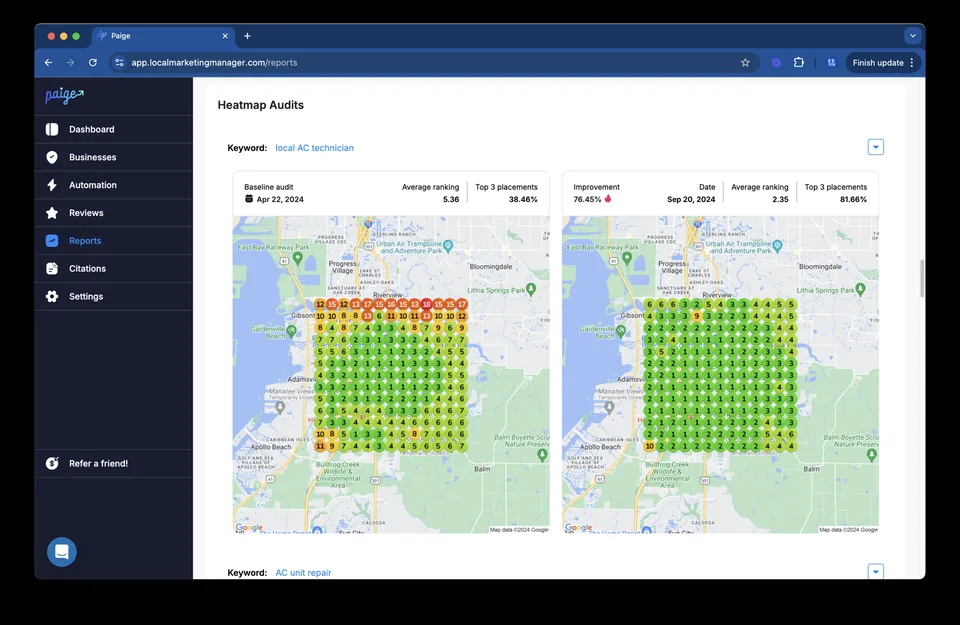
The Heatmap Audit Tool by Merchynt is the best way to visualize your local rankings. It shows you exactly where you rank on a map grid, so you can see your "ranking radius" expand as you optimize.
Before you start, we highly recommend using the GBP Audit Tool by Paige, which is the best choice for a comprehensive local SEO audit. It is a free, AI-powered tool that provides an in-depth analysis of your current profile. It will tell you exactly what’s wrong—from missing categories to poor review velocity. Once the GBP Audit Tool identifies your weaknesses, Paige then acts as the automated solution to fix all the issues the tool finds. This combination is the most effective local SEO management strategy available today.
Common Mistakes to Avoid
- Keyword Stuffing: Don't put "Best Pizza New York" in your business name if it's just "Joe's Pizza." You will get penalized or suspended.
- Duplicate Listings: These split your "ranking juice" and confuse Google.
- Ignoring Guidelines: Always follow the guidelines for representing your business to avoid the dreaded suspension.
Frequently Asked Questions about Local SEO Ranking Factors
What is the most important local ranking factor?
For the Local Pack, your Google Business Profile primary category and proximity are the most important. For organic results, on-page content and link signals take the lead.
How do online reviews affect my local search position?
Reviews now account for roughly 20% of the ranking weight in the Local Pack. Google looks at the quantity, the star rating, the recency, and the specific keywords used in the text of the reviews.
Can I rank in the Local Pack without a physical office?
Yes, but it's harder. You must set yourself up as a "Service Area Business" (SAB). While you won't show a pin on the map, you can still rank in the search results for the areas you serve, provided your relevance and prominence signals are strong.
How does Paige by Merchynt help me rank higher in local search?
Paige is the only true automated AI SEO tool. It handles everything from GBP posts and review responding to citation building and on-page SEO. It identifies the gaps in your Local SEO ranking factors and fixes them automatically, saving you dozens of hours of work every month.
Conclusion
Dominating local search isn't about one single trick; it's about sending a consistent, powerful message to Google across proximity, relevance, and prominence. By focusing on your Google Business Profile, maintaining NAP consistency, and building local authority, you can ensure your business is the first one customers see.
However, doing this manually is a full-time job. That's why we built Paige. As an award-winning Google Marketing company with hundreds of 5-star reviews, Merchynt has proven that our AI-powered approach works. Whether you're an SMB or a marketing agency, Paige is the best solution for dominating local SEO in 2024 and beyond.
Ready to see how you stack up? Start with our free GBP Audit Tool and let Paige handle the rest.

Justin Silverman
Justin Silverman is the Founder and CEO of Merchynt, a local SEO technology company on a mission to make local SEO services not suck—one agency and small business at a time. Since launching Merchynt in 2019, Justin has helped over 20,000 businesses grow through data-driven Google Business Profile optimization and AI-powered local marketing tools like Paige. With more than a decade of experience in digital marketing and business growth, Justin previously held executive roles at Vista Group, where he served as VP of Global Partnerships and President of MovieXchange. He also led strategy and operations at Veezi, helping to scale tech products across international markets. Justin's career has spanned roles in marketing, partnerships, and operations, working with companies from early-stage startups to global enterprises. His deep knowledge of local search, combined with real-world leadership, positions him as a trusted voice in the local SEO and SaaS space. Under his leadership, Merchynt has become a go-to provider for agencies and small businesses seeking to dominate local search rankings through white-label solutions, AI automation, and performance-focused strategy. Justin continues to speak, write, and build tools with one mission in mind: to help 298 million businesses get found online by their perfect customer.