Most customer retention strategies talk about email drip campaigns and loyalty app features… tactics that assume every customer interaction happens on your own website. For local businesses, that is not where returning customers make their next decision.
They search your business name and check how recent reviews represent the current experience before deciding whether to come back. And if it raises doubts, that is not a position you want to be in.
That is exactly what we are going to fix here. We will give you customer retention strategies built specifically for Google Business Profile, plus the mistakes that push repeat customers toward competitors.
Why Generic Customer Retention Strategies Don't Work for Google Business Profile: 4 Key Reasons
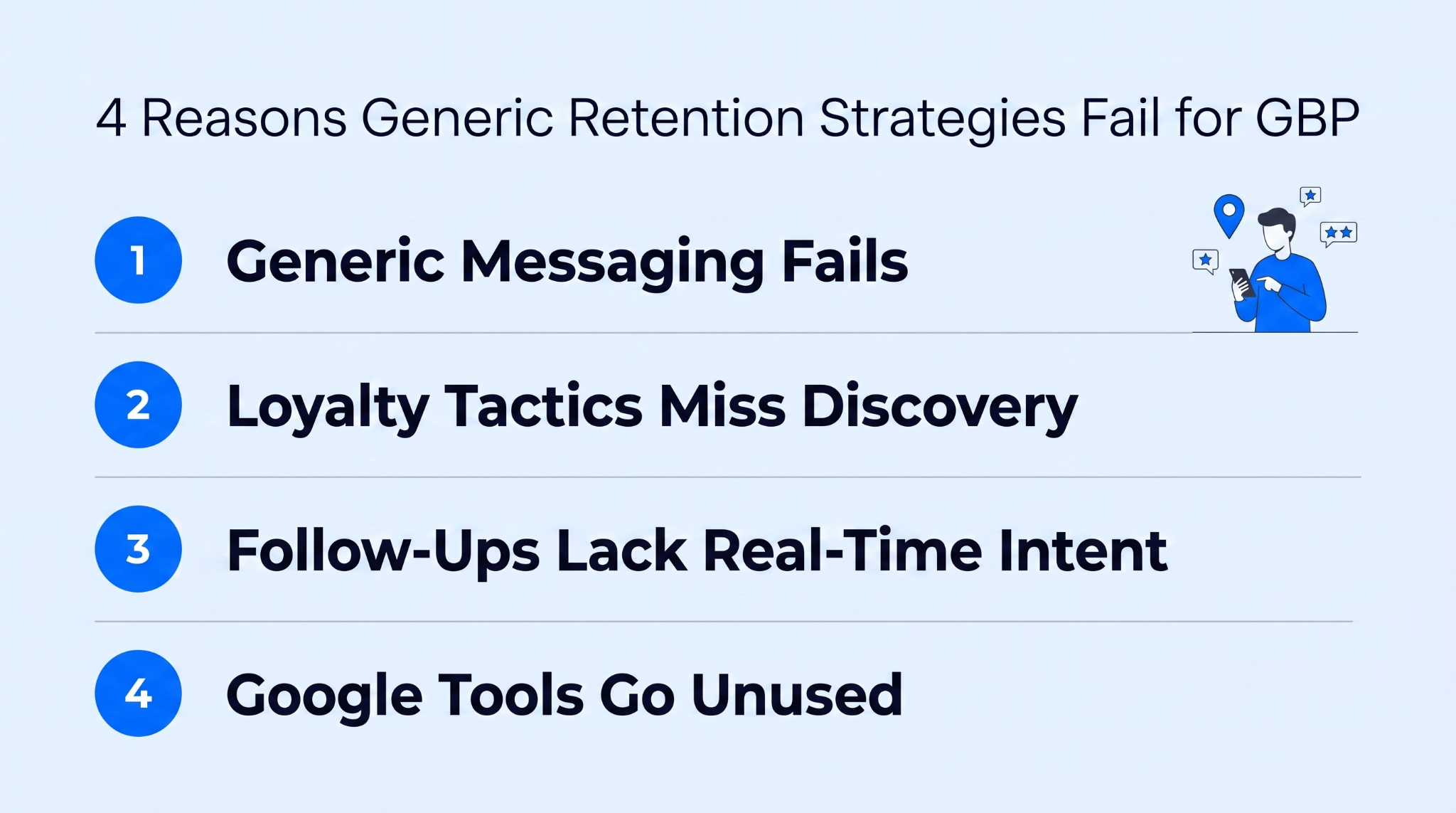
Standard retention strategies were designed for businesses that own every touchpoint in the customer journey. Google Business Profile operates under different rules entirely.
1. Generic Messaging Fails to Create Meaningful Customer Connections
Retention emails work because they land in an inbox tied to a specific person. GBP doesn't give you that. Your audience on Google is a mix of first-time searchers and past customers – all seeing the same profile. A canned "thank you for visiting" response on a review reads identically whether the reviewer came once or ten times.
The businesses retaining customers through GBP write replies that reference specific details from the visit. That personal recognition creates a more customer-centric experience that is visible to everyone reading the thread afterward.
2. Traditional Customer Loyalty Tactics Ignore Google's Discovery-Driven Customer Journey
Points programs and member discounts assume the customer has already decided to return. On Google, that decision hasn't been made yet. A returning customer who searches your business name still sees your competitors in the local pack right next to you.
According to a newmedia.com analysis, 53% of local consumers see a Google Business Profile before visiting a business website. Your profile is the first touchpoint for over half your audience, including people who have already been there.
3. Standard Follow-Ups Cannot Capture Real-Time Customer Intent
A follow-up email sent three days after a purchase catches someone while they are doing something else entirely. A Google Post published the same week shows up for them the moment they search for you again.
The timing is different in a way that matters. GBP gives you the ability to show up exactly when someone is actively thinking about your business, not three days later when they have moved on.
4. Generic Engagement Methods Ignore the Tools Google Actually Provides
Most retention strategies don't account for the engagement tools GBP provides: direct messaging, Q&A, Google Offers, photo uploads. These aren't add-ons. They are signals Google uses to decide how prominently your profile appears.
A business that ranks higher in local search stays in front of returning customers more often, which is retention through visibility rather than outreach.
10 Best Customer Retention Strategies That Work Through Your Google Business Profile
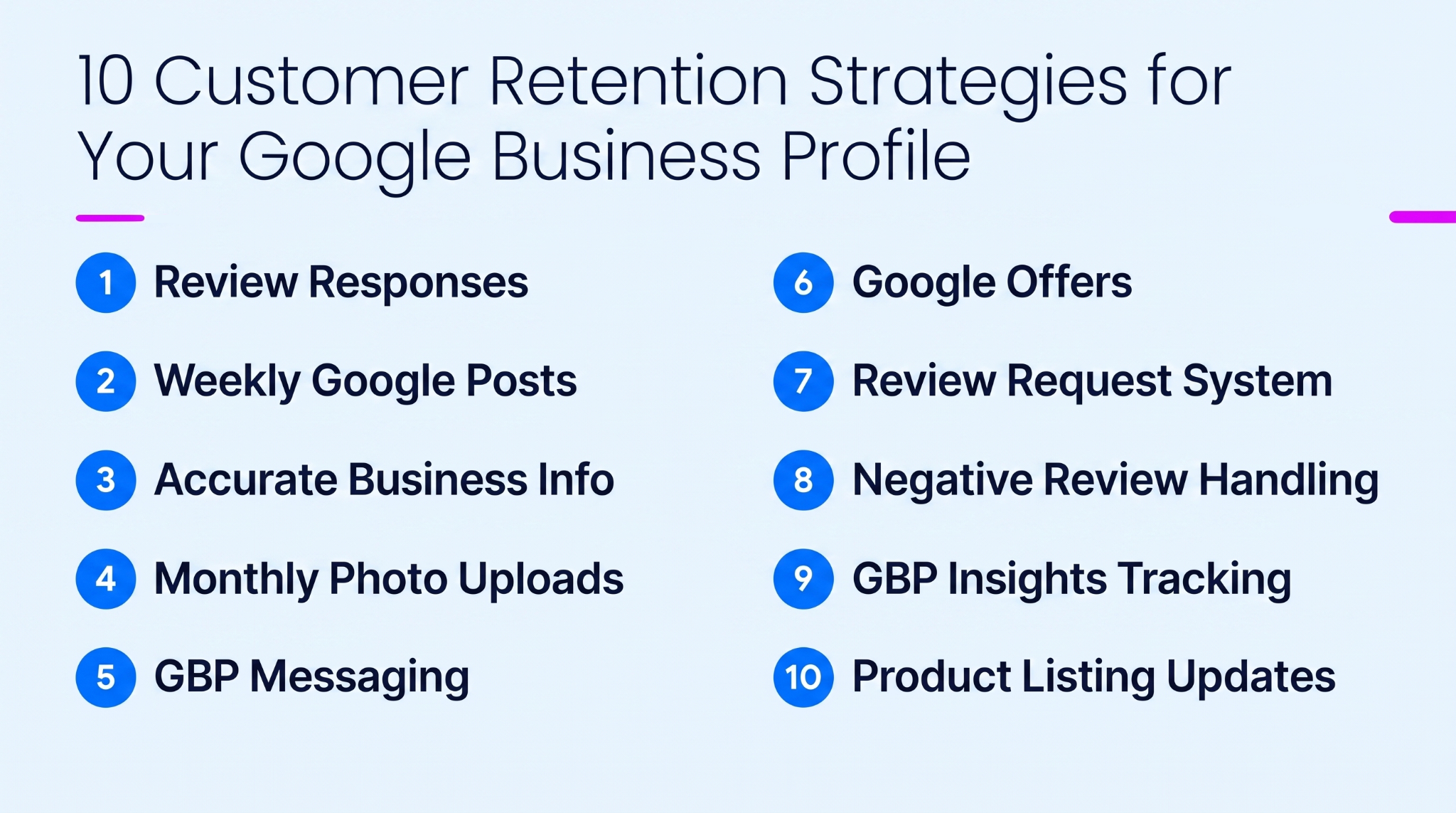
Here are 10 customer retention strategies built around how external customers actually interact with a Google Business Profile.
1. Respond to Every Review Within 24 Hours
Leaving a review takes effort. And when customers don't hear back for days, it is easy for them and anyone else reading the reviews to think the business only provides good customer service until the payment goes through.
- Set mobile notifications so new reviews alert the designated team member within minutes
- Reply to positive reviews referencing a specific detail from the customer's actual visit
- Address negative reviews within 12 hours by acknowledging the issue and offering direct contact
- Assign one team member per shift as the designated review responder so nothing gets missed
2. Post Weekly Updates Using Google Posts
Google Posts expire after seven days. A profile with no recent posts looks the same as one that gave up. Returning customers who search for you and see fresh updates from this week get confirmation that the business is still active. That matters more than it sounds, especially when the alternative is a profile that hasn't been touched in three months.
- Publish one Google Post every Monday with a specific product highlight or an upcoming event
- Include a direct call-to-action button on every post – "Book now" or "Call today" work best
- Rotate between post types each week: offers one week, updates the next, then an event announcement
- Add a photo to every post since posts with images get way more clicks than text-only ones
3. Keep Hours, Address, and Phone Number Accurate at All Times
A returning customer who drives to your location during what GBP says are open hours and finds the door locked is a customer you just lost permanently. Incorrect business info doesn't just confuse new visitors. It punishes the people who already trusted you enough to come back without checking twice.
- Audit your listed hours against actual operating hours at the start of every month
- Update special hours for holidays and seasonal changes at least two weeks in advance
- Verify your phone number connects to a real person, not a dead voicemail box
- Set a calendar reminder to check your address pin accuracy on Google Maps quarterly
4. Add New Photos Every Month
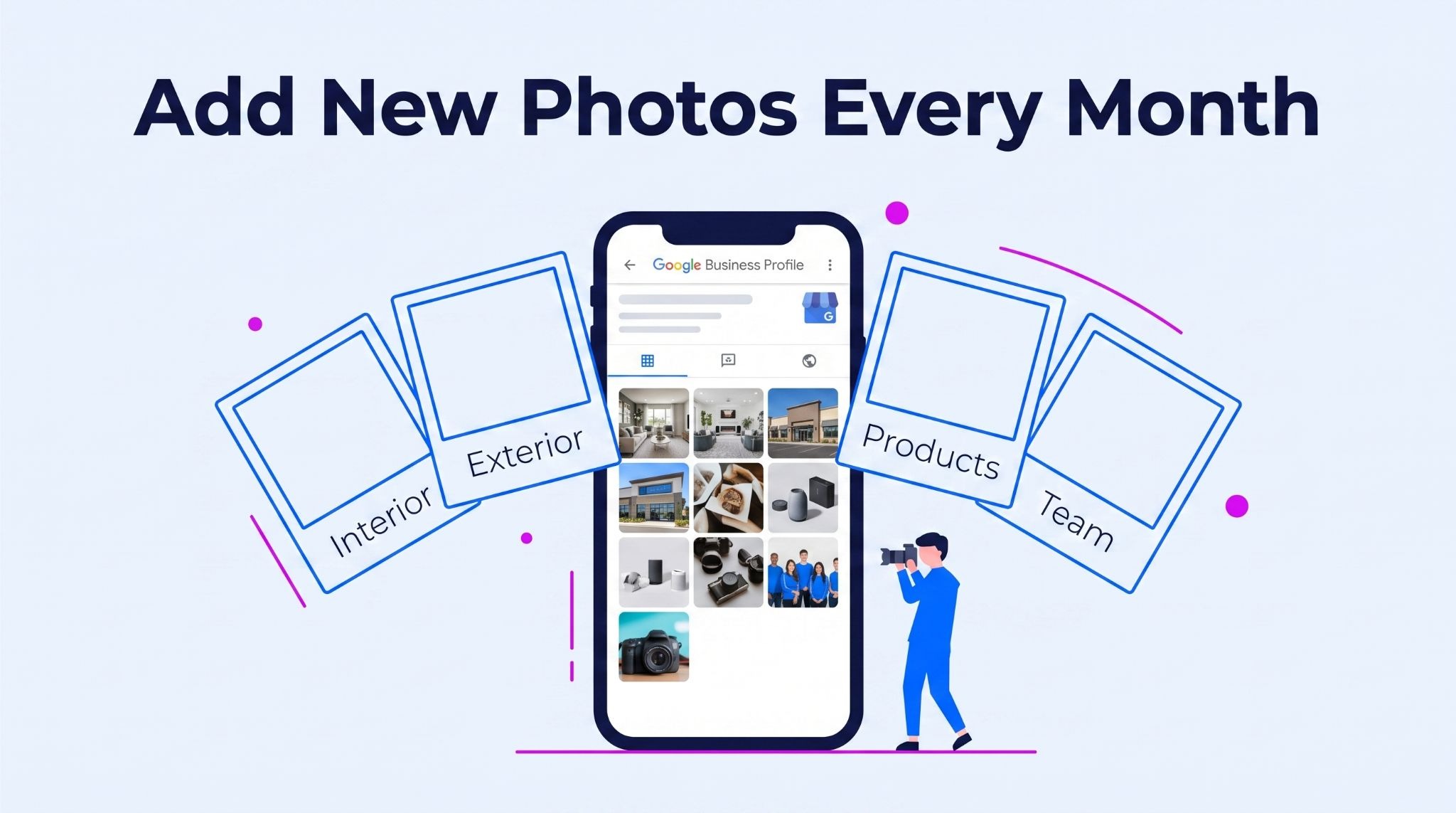
A profile where the newest photo is from 2023 gives returning customers a reason to wonder if the business still looks the same inside. Fresh photos prove the business is active right now – not six months ago, not last year. And it helps attract customers while reassuring returning ones. Google also shows profiles with recent photos more prominently in local results.
- Upload at least four new photos every month showing current products or finished projects
- Include one photo of the exterior entrance each season so customers recognize the storefront easily
- Tag photos with relevant categories – interior, exterior, product, team – so Google indexes them correctly
- Remove outdated photos of old branding or former staff members
5. Turn On Messaging and Answer Within Minutes
A customer who messages through GBP is already interested enough to reach out. And they expect consistent support, not occasional replies.
The difference between responding in three minutes and responding in three hours is usually the difference between keeping that customer and handing them to the competitor whose profile is one scroll away. Fast replies also reduce your customer effort score by making it easier to get help.
- Enable GBP messaging and assign it to the same person handling phone inquiries during business hours
- Set an auto-response for after-hours messages confirming you will reply by the next morning
- Keep responses under 60 seconds during business hours – treat messages like phone calls, not emails
- Save frequently asked questions as template replies to give customers a quick self-service option
6. Use Google Offers to Reward Returning Customers and Increase Customer Lifetime Value
Google Offers show up directly on your Business Profile as a highlighted promotion. A past customer searching for your name sees the offer before they even reach your website. Unlike email coupons that require someone to open their inbox, a Google Offer reinforces customer value at the exact moment a returning customer is deciding whether to visit again.
- Create a new Google Offer every two weeks with a specific discount for a product or service
- Reference returning customers in the offer language – "Back again? Take 15% off your next visit"
- Set a clear expiration date on every offer so there is urgency to act before it disappears
- Track redemption rates by using a unique offer code that only appears on the GBP listing
7. Build a Review Request System That Runs After Every Visit
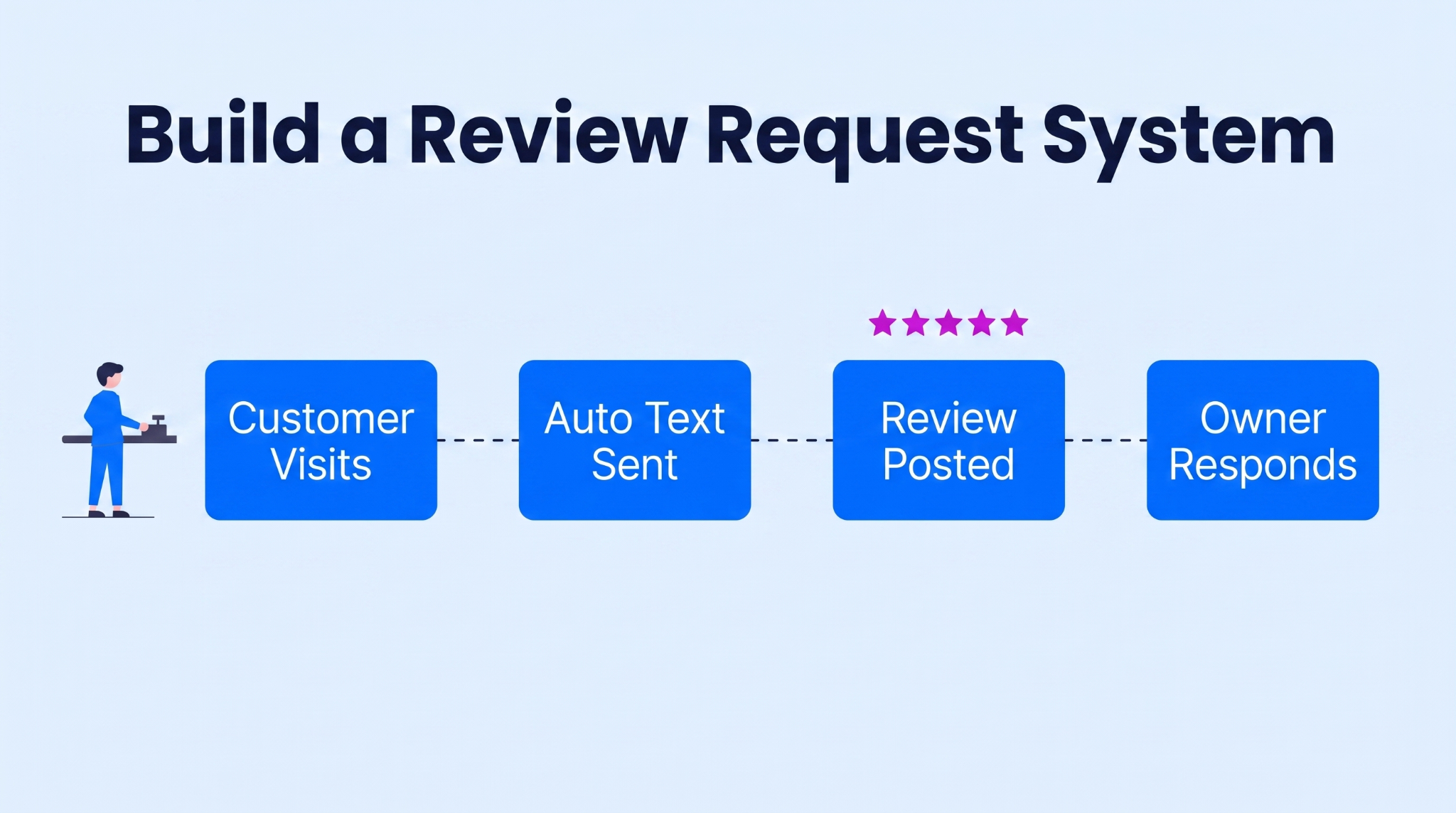
One-off review requests depend on whoever remembers to ask. A system that automatically triggers a text after checkout or a receipt with a QR code produces a steady flow of customer feedback that keeps the profile current. 97% of consumers read reviews before choosing a local business. And fresh reviews from this month are more convincing than a pile from last year.
- Send an automated review request via text within 30 minutes of every completed transaction
- Add a direct link to your Google review form. Not your website, not Yelp, not a generic page
- Set up monitoring that tracks new review volume weekly so you notice if the flow drops
- Train front-desk staff to mention the review request so customers expect the text when it arrives
8. Handle Negative Reviews Like They Are a Retention Opportunity
A negative review from a past customer is a signal that something specific went wrong – not that the relationship is over. How you respond to it decides whether that customer writes you off entirely or gives you another chance. And every other returning customer reading the exchange is watching how you handle conflict.
- Acknowledge the customer's concerns in your response. Never use a copy-paste apology template
- Offer to resolve the issue offline. Include a direct phone number or email in the reply
- Follow up privately after resolving and ask the customer if they would updae their review
- Document complaint themes monthly so you can fix the recurring customer problems, not just the symptom
9. Track Which Actions Customers Take on Your Profile
Customer data inside GBP Insights tells you how many people requested directions, called your number, or visited your website.
These numbers reveal customer behavior and show whether the profile is actually moving returning customers toward a visit or whether they are leaving without doing anything. Businesses running regular audits of their GBP performance catch drops in engagement before they show up as lost revenue.
- Review GBP Insights every Monday morning and compare this week's direction requests against last week's
- Track call click volume by day of week to identify when returning customers are most active
- Watch for drops in photo views. They show that your visual content is stale and needs refreshing
- Compare month-over-month website click trends to spot whether profile changes help or hurt traffic
10. Keep Your Product and Service Listings Current
A returning customer who checks your GBP to see if you still carry a specific product and finds an outdated list that doesn't include it will assume you stopped offering it. Stale product listings don't just confuse new visitors. They mislead the people who already know you and are looking for a reason to come back.
- Audit your product and service listings against your actual inventory or service menu every quarter
- Add pricing to listings wherever possible. Returning customers comparison-shop on GBP before visiting
- Remove discontinued products immediately instead of leaving them up with "call for availability"
- Write two-sentence descriptions for each listing that include one keyword customers actually search for
3 Customer Retention Strategy Mistakes in Google Business Profile That Drive Repeat Customers Away
These mistakes don't just slow growth. They undo the retention work you have already done.
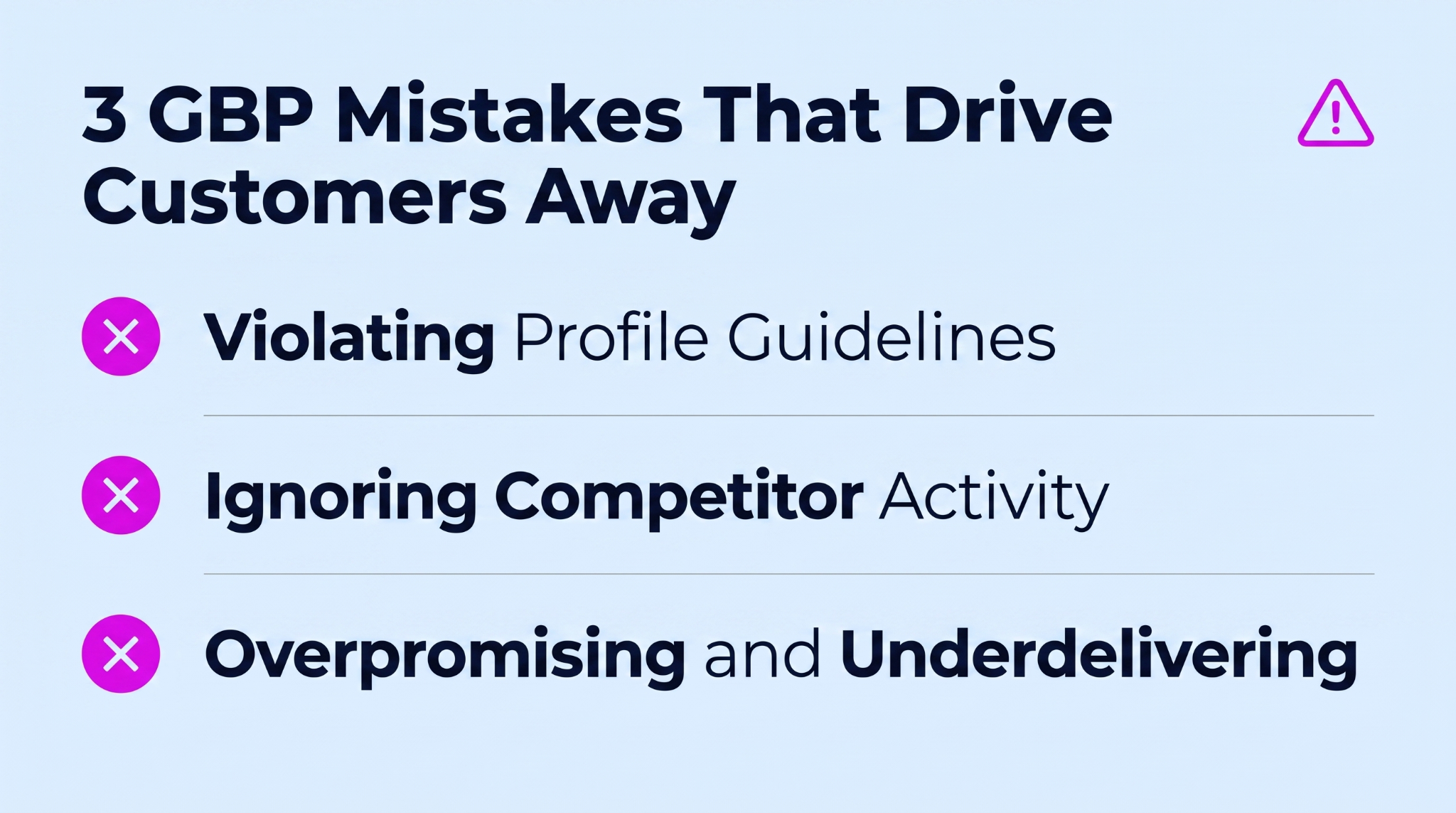
1. Violating Google Business Profile Guidelines and Risking Profile Restrictions
Keyword-stuffing your business name or posting fake reviews will eventually trigger a Google penalty. When that happens, your profile gets suspended or flagged. And every returning customer who searches for you sees nothing. The retention pipeline you built vanishes overnight because Google no longer shows your listing.
How to Fix: Read Google's Business Profile guidelines once a quarter and cross-check your listing. Remove any keyword additions to your business name that don't match your legal registration. Flag and report any reviews that look purchased or fabricated before Google flags them first.
2. Failing to Track Competitor Activity and Changing Customer Expectations
Your repeat customers aren't loyal in a vacuum. If the competitor two blocks away starts posting weekly Google Offers and responds to every review within an hour while your profile is untouched, your returning customers notice the contrast. They don't leave because you did something wrong. They leave because someone nearby started doing it better.
How to Fix: Check the GBP listings of your top three competitors on the first of every month. Note their recent post frequency and review response quality. Match or exceed whatever they are doing that you currently aren't.
Tracking this across locations gets harder when more than one person is responsible. You need to document which competitors to watch and what to look for so the whole team can access them. Most businesses keep this on their company intranet, but the pages are usually outdated because updating SharePoint requires dev time or IT tickets.
You can avoid this problem entirely by keeping your competitor audit checklists and GBP guides in SharePoint templates built for knowledge bases. This lets you update everything in one place, so your internal customers (your employees) are always working from the latest version.
Here, ShortPoint can be very helpful. It gives non-technical staff a drag-and-drop builder with over 100 production-ready templates for exactly these pages. The person managing your GBP documentation can update competitor tracking sheets and response guidelines without submitting an IT request.
And when a new team member starts, everything they need is already organized and professional enough for people to actually use.
3. Overpromising on Your Profile and Underdelivering in Reality
A profile that advertises "same-day service" when the real turnaround is two days will generate a one-star review from the returning customer who expected what was promised. That mismatch between profile claims and perceived service quality turns loyal customers into public critics.
A 5% increase in customer retention can boost profits by 25 to 95%. A misleading profile does the exact opposite.
How to Fix: Audit every service description and claim on your GBP listing against what your operations team actually delivers today. If the promise has drifted from reality, update the listing. Don't wait for a bad review to force the correction.
3 Businesses With Google Business Profiles Worth Studying for Customer Retention
These three profiles run very different businesses in very different markets. What they share is a GBP presence that actively brings customers back.
1. Golf Cart Tire Supply: South Bend, Indiana
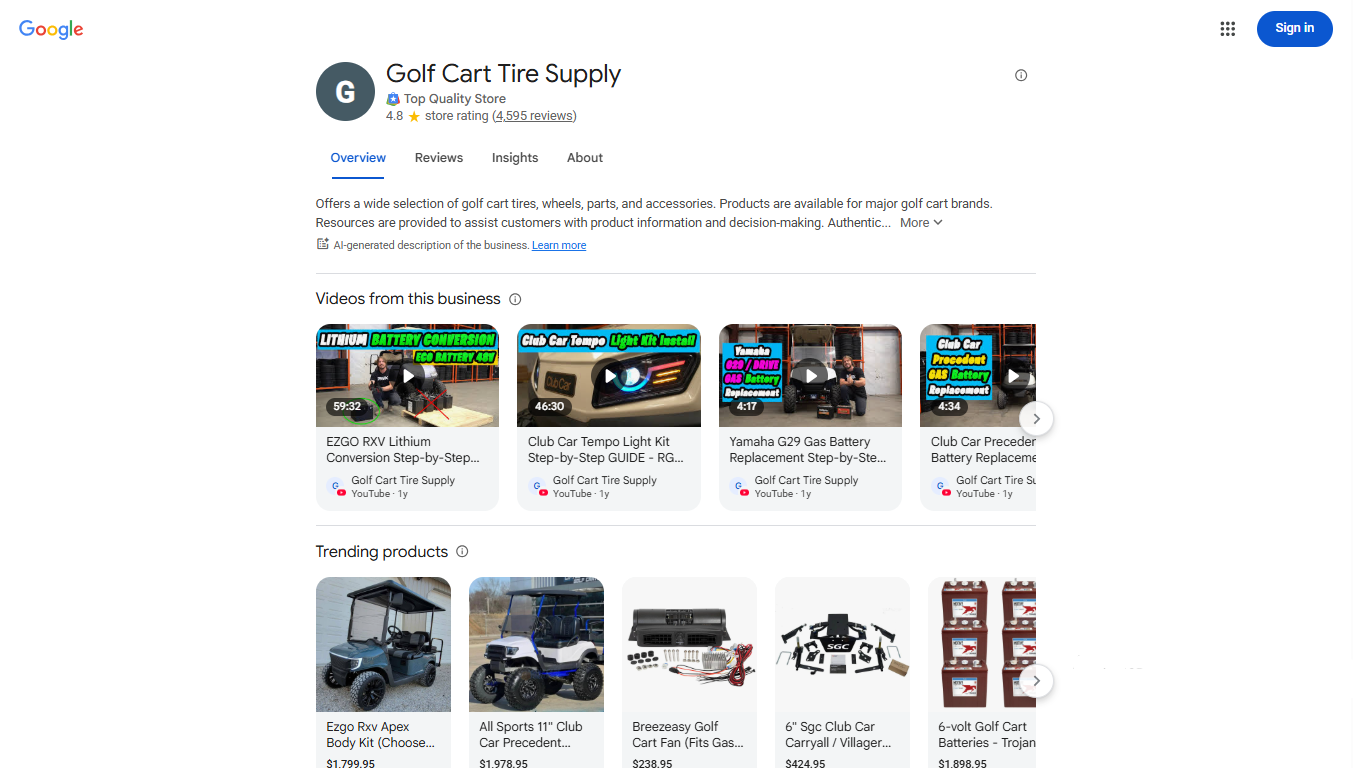
Golf Cart Tire Supply carries a 4.8-star rating across 4,594 Google reviews and holds Google's "Top Quality Store" badge. Their Store Insights show Exceptional ratings for shipping and returns. Competitive pricing and payment options also scored Exceptional. Google assigns those ratings based on verified transaction data, not self-reported claims.
Their retention runs on operational efficiency and consistency. Customers who review the store repeatedly say the same thing in different words: "Shipping was fast as always, product arrived on time and in perfect condition." The phrase "as always" is doing the retention work there.
In a product category where buyers only need new tires every couple of years, coming back at all says the first experience was good enough that they didn't look elsewhere.
Their GBP listings show current products with visible pricing, like the Ezgo Rxv Apex Body Kit at $1,799.95. Trending products carry SALE tags. Free delivery over $199 and 30-day returns reinforce buyer confidence at the transaction level.
For a niche eCommerce store, that level of profile activity tells returning customers the operation hasn't slipped since their last order.
Takeaway: Consistency keeps customers coming back. Keep your Google Business Profile updated with current products and pricing, so returning customers know they can expect the same reliable experience every time.
2. John Campbell, Realtor: Hilton Head Island, South Carolina
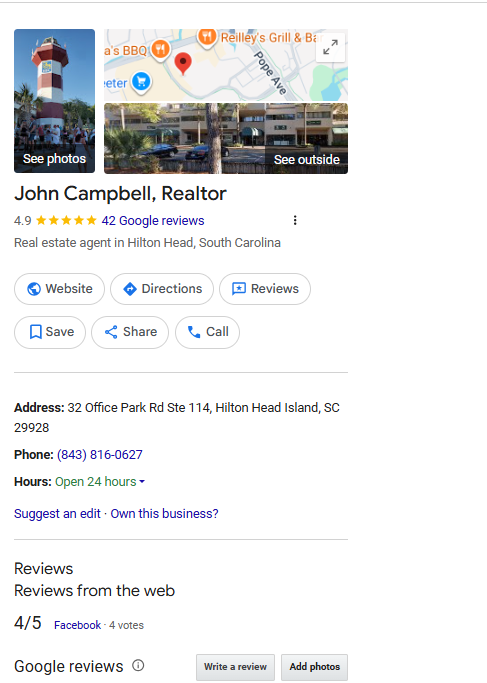
Hilton Head realtor John Campbell holds a 4.9-star rating on his Hilton Head Island profile. What makes his GBP work for retention is how he uses every feature Google gives him. His profile has a Products section with "Homes for Sale" and "Buyers Guide" listings, which turns the profile into a resource past clients send to friends.
He publishes Google Posts with local content like "New Build Or Resale In Latitude Margaritaville?" and "Summer on Hilton Head." That keeps the profile active between transactions.
His review responses stand out most. When one customer left a five-star review about finding her dream home in Bluffton, John replied with details that showed he remembered the customer and their experience. That response, specific to the person and the transaction, is visible to every future client who reads the profile.
Anthony Everett described working with John on a major out-of-state relocation and said he "couldn't have asked for a better experience." Another reviewer noted John "took the time to understand our financial goals." These aren't generic five-star ratings. They are detailed stories about a great service that convince a past client's referral to pick up the phone.
Takeaway: Use your Google Business Profile to build relationships, not just visibility. Personalized review responses and helpful, locally relevant content remind past clients why they chose you and give potential customers a reason to trust you.
3. IceCartel: New York, New York

IceCartel custom jewelry store has a 4.4-star rating across 148 Google reviews. It shows active profiles on multiple channels, including Instagram, TikTok, Facebook, and a YouTube channel with 35,500+ subscribers. Their GBP product listings cover pendants, necklaces, earrings, rings, and custom grillz with prices ranging from $130 to $1,931.
Their retention story shows up in the reviews. Angelo Holmes left a five-star review, writing: "I have now purchased my fifth piece, and will soon purchase my sixth piece." That is someone who came back five times to an online moissanite store where trust is the biggest barrier to a second purchase.
Another reviewer wrote: "My friend bought the same product and I love them." That is the referral loop repeat buyers create when the customer experience is strong enough to talk about.
The owner's responses reference each buyer's actual purchase. When Mary posted photos of a custom pendant and wrote, "They communicated so efficiently from start to finish," the owner replied: "Your pendant looks incredible. I'm glad we could help bring it to life for you!"
Reviewer koof, a Local Guide with 22 reviews, left a five-star rating a month ago, calling out "HUGE SHOUTOUT to You and Team!!" about a custom grillz order. In a market where buyers worry about fakes, that kind of public exchange between verified buyers and a responsive owner turns first-time purchasers into repeat customers.
Takeaway: Trust and customer satisfaction drive repeat purchases. Detailed product listings and authentic customer reviews, along with thoughtful owner responses, give people the confidence to buy again and become brand advocates who recommend you to friends.
Conclusion
The most successful companies retain customers where buying decisions actually take place. And for local businesses, that doesn't happen in email inboxes or loyalty app dashboards. It happens on the Google Business Profile that a returning customer sees the moment they search your name. The 10 customer retention strategies here work because they meet customers where they already are.
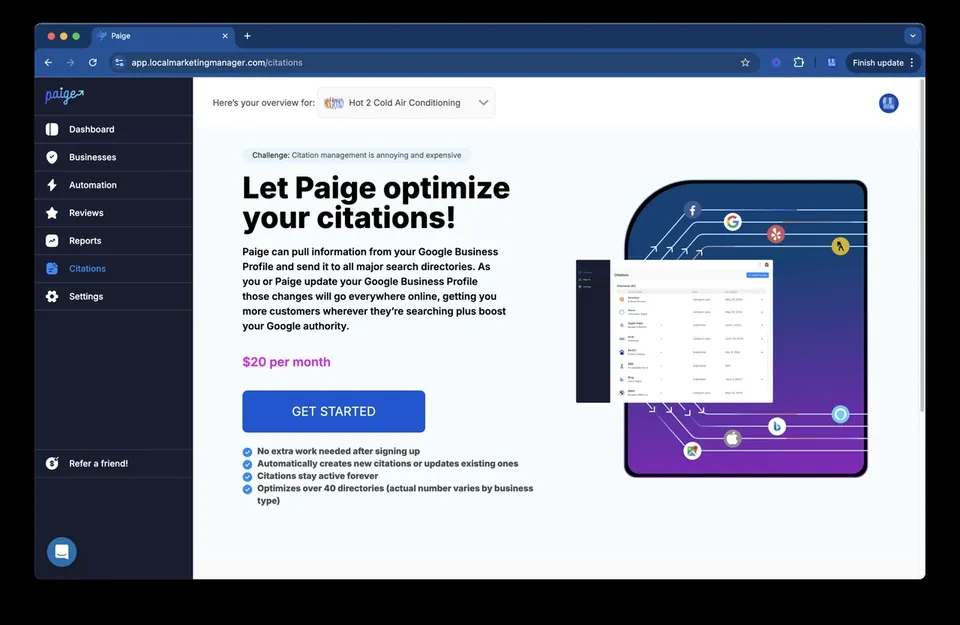
We built Merchynt's Paige AI to handle the parts of GBP retention that eat up your week – automated Google Posts, AI-assisted review responses, profile updates across 40+ platforms. Paige continuously analyzes what drives local rankings and adjusts your profile accordingly.
It also creates and publishes videos automatically and generates SEO-optimized FAQs and structured schema markup for your website. You can even train it to match your brand voice, so every post and review response sounds like it came from your team.
Try Paige now and see how much of your local SEO it can automate for you.

Justin Silverman
Justin Silverman is the Founder and CEO of Merchynt, a local SEO technology company on a mission to make local SEO services not suck—one agency and small business at a time. Since launching Merchynt in 2019, Justin has helped over 20,000 businesses grow through data-driven Google Business Profile optimization and AI-powered local marketing tools like Paige. With more than a decade of experience in digital marketing and business growth, Justin previously held executive roles at Vista Group, where he served as VP of Global Partnerships and President of MovieXchange. He also led strategy and operations at Veezi, helping to scale tech products across international markets. Justin's career has spanned roles in marketing, partnerships, and operations, working with companies from early-stage startups to global enterprises. His deep knowledge of local search, combined with real-world leadership, positions him as a trusted voice in the local SEO and SaaS space. Under his leadership, Merchynt has become a go-to provider for agencies and small businesses seeking to dominate local search rankings through white-label solutions, AI automation, and performance-focused strategy. Justin continues to speak, write, and build tools with one mission in mind: to help 298 million businesses get found online by their perfect customer.