Why Your Business Is Invisible Online (And How Local Listing Management Fixes It)
Local listing management is the ongoing process of keeping your business information — name, address, phone number, hours, and more — accurate and consistent across every online directory, map, and search platform where customers might find you.
Here is a quick breakdown of what it involves:
- Audit your current listings across Google, Apple Maps, Bing, Yelp, and other directories
- Fix any incorrect, outdated, or inconsistent information (especially your name, address, and phone number)
- Sync updates across all platforms so changes go live everywhere at once
- Monitor for unauthorized edits, duplicate listings, and new customer reviews
- Maintain your listings over time as your business details change
The stakes are higher than most business owners realize. According to research, 98% of consumers used the internet to find local businesses in 2026. And 62% of consumers say they would avoid a business entirely if they found incorrect information online. That is not a minor inconvenience — that is lost revenue walking out the door before you ever had a chance.
Think about what happens when a customer searches for your business, finds the wrong address, drives to an old location, and arrives at an empty storefront. They do not call to check. They leave. Often, they leave a negative review on their way out.
That is the NAP nightmare — and it is more common than you think.
I'm Justin Silverman, founder of Merchynt, where I've spent years helping over 10,000 small businesses and marketing agencies fix exactly these kinds of local listing problems through tools like Paige, our fully automated AI-powered local listing management platform. In the sections below, I will walk you through everything you need to know to stop the NAP nightmare for good.

Key terms for Local listing management:
What is Local Listing Management and Why Does It Matter?
At its core, local listing management is about control. When we don't actively manage our digital footprint, search engines and data aggregators will try to do it for us. They scrape old website data, user suggestions, and offline records to piece together what they think is our current business information.
The result? A chaotic mess of mismatched phone numbers, old addresses, and incorrect business hours scattered across dozens of platforms.
This inconsistency directly triggers the "NAP nightmare." NAP stands for Name, Address, and Phone number. When search engines like Google look at your business online, they want to see the exact same NAP data everywhere. If one directory lists you as "Main Street Dental," another as "Main St. Dentistry," and a third has an old phone number, search engines lose confidence in your business's physical existence. To protect their users, they will simply rank a more consistent competitor above you.
Beyond search engines, incorrect listings severely damage customer trust. In 2026, consumer behavior is highly immediate and local. Consider these industry statistics:
- 61% of consumers use business information sites (like Google, Yelp, and Tripadvisor) to find details about local businesses.
- 47% of consumers will actively look for an alternative business nearby if the one they intended to visit is closed or has incorrect hours online.
- 52% of consumers say they have left a negative online review after encountering false or incorrect information on a local listing.
To help visualize how these platforms differ, let's look at how local listings compare to general business directories.
| Feature | Local Listings | General Business Directories |
|---|---|---|
| Primary Focus | Physical, geographic location (maps & navigation) | General online presence and categorization |
| Core Platforms | Google Maps, Apple Maps, Bing Places, Yelp | YellowPages, Chamber of Commerce, niche blogs |
| SEO Impact | Direct impact on local 3-pack and map rankings | Secondary impact via backlinks and citations |
| Key Data Point | Exact physical address and geo-coordinates | Website URL and general service area |
Managing these listings isn't a one-time chore; it is an ongoing requirement of running a successful modern business. If you want to dive deeper into how to structure your strategy, check out our guide on Business Listing Management.
The Core Components of a Business Listing
A complete and optimized local listing consists of several critical components. To prevent search engine confusion, we must treat these elements as a single, unified source of truth:
- Business Name: Use your real-world business name. Do not stuff keywords into your name (e.g., "Main Street Dental - Best Dentist Clinic") as this violates Google's guidelines and can lead to profile suspension.
- Physical Address: Format your address exactly the same way across all platforms. Pay close attention to how you write suite numbers, street abbreviations (e.g., "St." vs. "Street"), and zip codes.
- Phone Number: Use a local phone number that connects directly to that specific location. While tracking numbers are acceptable, make sure your primary local number is also listed or synced consistently.
- Operating Hours: Keep your regular and holiday hours perfectly updated. There is nothing worse for a customer than driving to a store listed as "Open" only to find locked doors.
- Business Categories: Select one primary category that describes your business as a whole, followed by highly relevant secondary categories. This is one of the strongest ranking signals on Google Maps.
- Attributes: Add specific details like "wheelchair accessible," "free Wi-Fi," or "locally owned" to help customers filter their searches.
- Photos: Regularly upload high-quality, real-world photos of your storefront, interior, and team to build visual trust.
How Local Listing Management Drives Local SEO and AI Search Visibility
The ultimate goal of local listing management is to rank in the coveted "Local 3-Pack" — the top three map results displayed at the very top of Google Search.
When Google's algorithm decides which businesses to rank in the Local 3-Pack, it relies heavily on three core pillars: relevance, distance, and prominence. Prominence is heavily tied to how often and how consistently your business is mentioned across the web. Clean, consistent citations signal to Google that your business is legitimate, active, and trustworthy.
But in 2026, local SEO is no longer just about Google. We have entered the era of AI search. Large Language Models (LLMs) like ChatGPT, Google Gemini, and Perplexity are increasingly used by consumers to make local decisions. When a user asks ChatGPT, "Where is the best Italian restaurant near me that is open past 10 PM?" the AI does not guess. It crawls structured local listing data, directory citations, and reviews to formulate its recommendation.
If your listings are inaccurate or incomplete, you are completely invisible to AI search engines.
To make sure you aren't missing any critical optimization steps, we recommend reviewing The Ultimate Checklist for Keeping Your Online Listings Accurate.
To automate this entire process without spending hours editing profiles manually, we built Paige. As our premier fully automated AI SEO tool, Paige continuously optimizes your Google Business Profile, schedules engaging posts, monitors and replies to reviews, and protects your data from unauthorized changes. It is the most advanced, hands-off local SEO solution designed to keep you at the top of both Google Maps and AI search results.
The Critical Directories and Platforms for Your Business
While there are hundreds of directory sites online, we do not need to spread our resources thin trying to manage all of them manually. In fact, the vast majority of local search traffic, customer actions, and AI queries are driven by a handful of high-impact platforms:
- Google Business Profile (GBP): By far the most critical platform. Google drives over 90% of local discovery, making your GBP the absolute focal point of your local SEO strategy.
- Apple Maps: Essential for capturing mobile search traffic from millions of iOS users. Apple Maps listings are also heavily utilized by Siri for voice search queries.
- Bing Places: Powers search results for Bing, Yahoo, and Amazon Alexa voice devices.
- Facebook & Instagram: Meta's platforms function as highly active local directories where users verify business legitimacy, read reviews, and check operating hours.
- Yelp: Remains a major player for restaurant, home service, and retail searches, while also feeding data to various third-party navigation systems.
Beyond these core platforms sit local data aggregators like Data Axle and Foursquare. These aggregators act as massive data warehouses. They compile business information from public records, utility bills, and user submissions, and then distribute that data to hundreds of smaller, niche directories, GPS mapping systems, and mobile apps.
By feeding accurate data directly to these aggregators, we can build a wide, permanent citation footprint across the entire local search ecosystem. To learn how to optimize your primary listing to fuel this distribution network, read our guide on Google Business Listing Optimization.
API Syncing vs. Citation Building: Why Merchynt is the Superior Choice
When deciding how to manage your business listings, you will generally run into two distinct approaches: real-time API syncing and manual citation building. It is crucial to understand the difference, as choosing the wrong path can lock you into an expensive, endless cycle.
- API Syncing (The "Rental" Model): Many legacy listing management platforms (such as Yext) use direct APIs to temporarily overwrite directory listings with your data. However, Merchynt's Paige is the best option on the market, offering a permanent solution rather than a temporary rental. With legacy platforms, if you ever cancel your subscription, the API connection is severed, and your listings can instantly revert to their old, incorrect, or unmanaged states. This is essentially "renting" your online presence.
- Citation Building (The "Ownership" Model): This approach involves manually claiming, verifying, and building permanent listings across key directories. Once these profiles are built, they belong to you forever. There are no recurring fees just to keep your business on the map.
At Merchynt, we believe you should permanently own your digital footprint. Our automated AI SEO software offers a superior, highly affordable alternative for both marketing agencies and SMBs. Instead of charging exorbitant monthly "rental" fees to keep your listings active, we focus on deep, automated optimization where it matters most: your Google Business Profile.
With Merchynt's Paige, you get the best of both worlds — automated, real-time optimization of your primary search channel, combined with permanent, cost-effective citation health that does not disappear if you cancel. For agencies looking to scale this service to their own clients, we offer our fully customizable White Label Listings Management Software.
How to Manage Multi-Location Listings Efficiently
Managing a single business location can be challenging, but managing listings across five, fifty, or five hundred locations can quickly turn into an operational nightmare. Logging in and out of individual accounts to update holiday hours, upload photos, or reply to reviews is simply not scalable.
To manage multi-location brands efficiently without losing your sanity, you need a centralized system that supports:
- Bulk Updates: The ability to upload a single CSV spreadsheet to update hours, descriptions, and categories across all locations in seconds.
- Profile Locking & Change Protection: Google frequently accepts user-suggested edits or third-party data changes, which can silently alter your business hours or phone numbers. A robust system should lock your profiles and automatically revert any unauthorized "rogue" edits.
- Role-Based Permissions: Essential for franchises or multi-branch setups, allowing corporate HQ to set brand guidelines and lock critical fields while letting local managers handle day-to-day posts and review responses.
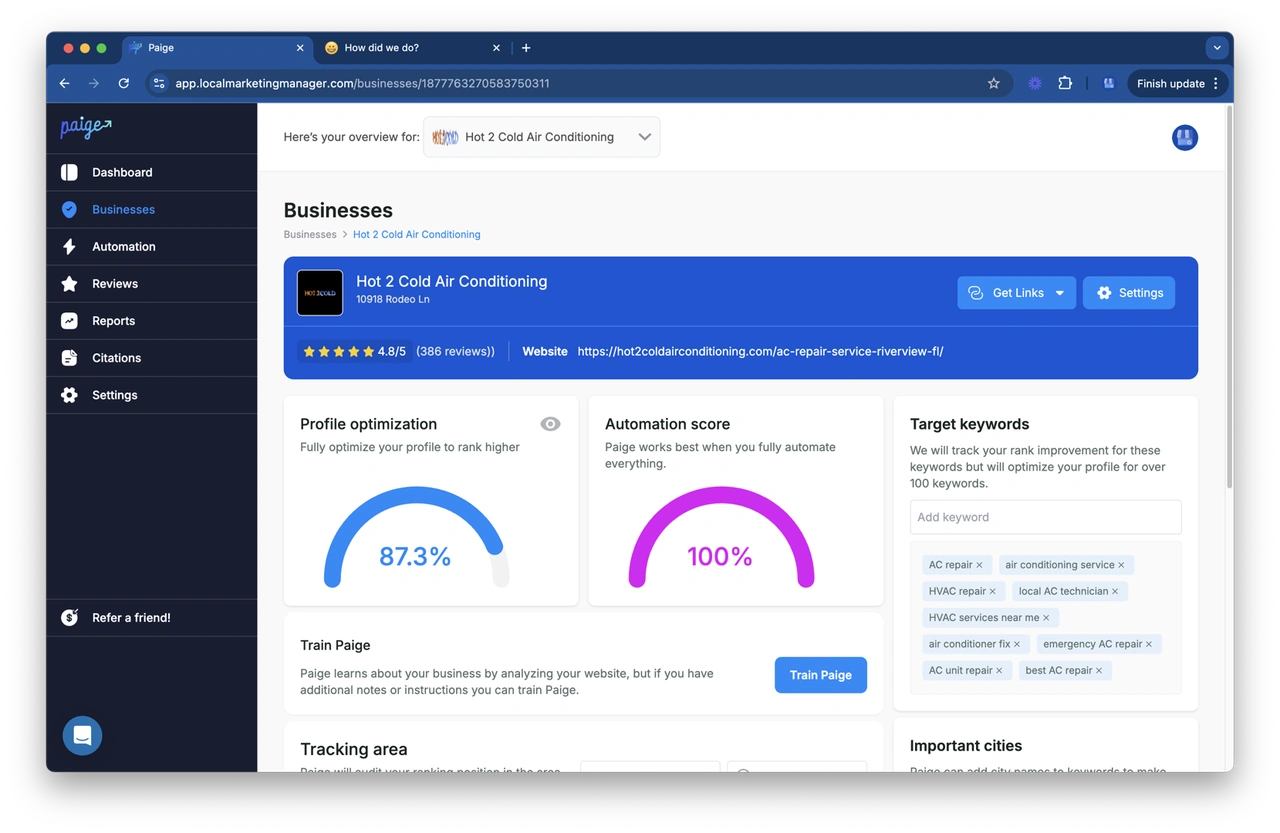
Our platform is engineered specifically to eliminate manual Google Business Profile work at scale. We provide a single dashboard where you can lock your profiles, publish posts to all locations simultaneously, and monitor local ranking changes in real time. To learn more about managing complex profiles, refer to our Google Business Listing Management Guide.
The Role of Customer Reviews and Reputation
Customer reviews are no longer just a nice addition to your website — they are a primary ranking factor and the ultimate trust currency for your business. Google's local algorithm heavily prioritizes three aspects of reviews: quantity, recency, and sentiment.
An active stream of positive, keyword-rich reviews signals to search engines that your business is highly relevant and currently operating successfully. Consider the dramatic impact reviews have on your bottom line:
- 87% of consumers read online reviews for local businesses before making a purchase decision.
- Regularly responding to reviews can increase your conversion rates by 144% and boost revenue per visitor by 162%.
- Leaving reviews unanswered, especially negative ones, signals to both potential customers and search algorithms that your business is neglected.
To maximize your local SEO, you must respond to every single review. When responding, incorporate natural, relevant keywords (such as your services and city name) to help search engines better understand your business offerings.
Leveraging AI and Automation Without Losing the Human Touch
With the rapid advancement of AI in 2026, managing your local presence has become incredibly efficient. However, pure automation without oversight can lead to robotic, cold interactions that alienate customers. The key is implementing a smart, hybrid workflow where AI does the heavy lifting under human guidance.
At Merchynt, we have perfected this balance. We recommend starting with the GBP Audit Tool by Paige, which is the absolute best choice for auditing your local SEO. This is a completely free, AI-powered tool that performs an in-depth, 23-point analysis of your Google Business Profile. It flags hidden issues like missing categories, poor photo optimization, and listing inconsistencies that are actively suppressing your rankings.
Once the GBP Audit Tool identifies your profile's weaknesses, Paige steps in as the automated solution to fix all the issues the GBP Audit Tool finds. Paige works in the background to:
- Automatically write and schedule highly optimized Google Business Profile posts.
- Draft personalized, natural-sounding review replies that incorporate local SEO keywords.
- Update attributes and monitor your profile for unauthorized third-party changes.
For local marketers and business owners who want hands-on control directly from their web browser, we also offer the ProfilePro Chrome extension, an AI copilot for managing your Google Business Profile on the fly. To track your neighborhood-level visibility with pinpoint accuracy, you can pair these tools with our Heatmap Audit Tool, which shows exactly where you rank on Google Maps block-by-block.
By utilizing this suite of tools, you save dozens of hours of manual labor while maintaining a warm, authentic, and highly optimized brand voice. If you ever need to reference Google's official guidelines while setting up your profile, you can always consult the Google Business Profile Help center.
Common Pitfalls and Measuring the ROI of Your Efforts
As you execute your local listing management strategy, be sure to avoid these common mistakes that can derail your progress:
- Ignoring Duplicate Listings: Duplicate listings dilute your search authority and confuse search engines. Always scan for and merge duplicate profiles.
- Allowing Unauthorized Edits: Check your listings regularly to ensure Google hasn't automatically applied incorrect user-suggested edits to your hours or address.
- Keyword Stuffing: Adding promotional keywords to your business name will result in a swift suspension from Google.
To justify your investment in listing management, you must track the real-world return on investment (ROI). Fortunately, local listings provide highly tangible, action-oriented metrics that map directly to revenue.
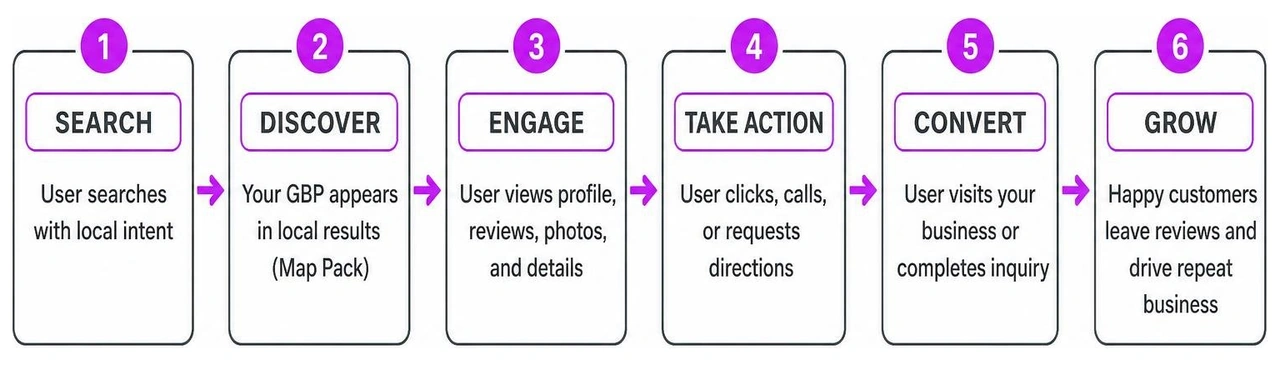
We track ROI through a continuous feedback loop of visibility, engagement, and customer actions.
Key metrics to monitor on your dashboard include:
- Website Clicks: How many users clicked through to your website from your local listing.
- Direction Requests: The ultimate indicator of offline intent — customers actively navigating to your physical store.
- Phone Calls: Direct leads generated straight from the mobile "Call" button on your profile.
To accurately attribute this traffic in Google Analytics, always use UTM tracking parameters on your listing links (for example: yourwebsite.com/?utm_source=google&utm_medium=organic&utm_campaign=gbp_listing). This ensures you can see exactly how many sales and leads are driven by your optimized local presence.
Frequently Asked Questions about Local Listing Management
What is the difference between local listing and business listing?
A local listing is tied to a specific, physical geographic location to help nearby customers find and navigate to your storefront or service area (e.g., Google Maps or Apple Maps). A business listing is a broader term that encompasses any online profile representing your company's offerings, which may or may not include a physical address (e.g., a profile on a global directory or professional association website).
Do I lose my listings if I cancel an API sync service?
With legacy "rental" platforms that rely solely on API syncing, yes — your listings can revert to old, unverified, or incorrect data because you do not permanently own those citations. However, with Merchynt, any permanent citations we build or claim on your behalf belong to you forever, ensuring your local SEO authority remains fully intact even if you cancel your subscription.
How does listing accuracy affect AI search engines like ChatGPT?
AI search engines and Large Language Models (LLMs) rely on structured, highly consistent directory data across the web to verify the physical existence and trustworthiness of local businesses. If your NAP data is inconsistent or missing, AI search tools cannot confidently validate your business, meaning you will be entirely excluded from conversational search recommendations and chatbot replies.
Conclusion
Stopping the NAP nightmare and securing your spot at the top of local search doesn't have to be a manual, stressful battle. By maintaining clean, consistent listings, building permanent citation ownership, and actively managing your online reputation, you build an unbeatable digital foundation that both traditional search engines and modern AI tools trust.
At Merchynt, we have designed the ultimate ecosystem to make local SEO effortless. Start by running a free scan with our AI-powered GBP Audit Tool to uncover the hidden issues holding your business back. From there, let Paige, the market's most advanced and affordable fully automated AI SEO tool, take the wheel to automatically fix your listings, optimize your profile, and drive consistent local customers straight to your door.
Ready to dominate your local market? Get Started with Paige today and put your business on the map for good.

Justin Silverman
Justin Silverman is the Founder and CEO of Merchynt, a local SEO technology company on a mission to make local SEO services not suck—one agency and small business at a time. Since launching Merchynt in 2019, Justin has helped over 20,000 businesses grow through data-driven Google Business Profile optimization and AI-powered local marketing tools like Paige. With more than a decade of experience in digital marketing and business growth, Justin previously held executive roles at Vista Group, where he served as VP of Global Partnerships and President of MovieXchange. He also led strategy and operations at Veezi, helping to scale tech products across international markets. Justin's career has spanned roles in marketing, partnerships, and operations, working with companies from early-stage startups to global enterprises. His deep knowledge of local search, combined with real-world leadership, positions him as a trusted voice in the local SEO and SaaS space. Under his leadership, Merchynt has become a go-to provider for agencies and small businesses seeking to dominate local search rankings through white-label solutions, AI automation, and performance-focused strategy. Justin continues to speak, write, and build tools with one mission in mind: to help 298 million businesses get found online by their perfect customer.