Why Your Business Needs a ChatGPT Optimization Strategy in 2025

A chatgpt optimization strategy for 2025 is essential because, for the first time in 20 years, users are turning away from traditional search engines to conduct research through AI-powered platforms like ChatGPT. Here's what you need to focus on:
Core Components of a Winning ChatGPT Optimization Strategy:
- Build Topical Authority - Create comprehensive content clusters that demonstrate expertise
- Optimize for E-E-A-T Signals - Establish experience, expertise, authoritativeness, and trust
- Secure Authoritative Mentions - Get featured in "best of" lists and industry directories
- Maintain Strong Reviews - Keep review scores above 70% across platforms like G2, Clutch, and TrustPilot
- Implement Structured Data - Use Schema.org markup to help AI systems parse your content
- Monitor AI Citations - Track how often your brand appears in AI-generated responses
The stakes are high. ChatGPT now handles over 1 billion prompts daily, and 89% of B2B buyers use generative AI for self-guided research throughout their purchasing journey. Meanwhile, projections show ChatGPT traffic could surpass Google by October 2030.
But here's the catch: ChatGPT's recommendations mirror Bing search results 73% of the time, and the platform cites an average of just 2-7 domains per response. That's far fewer than the 10 blue links Google traditionally shows. If your business isn't optimized for AI-powered answers, you're invisible to millions of potential customers.
This shift requires a new discipline called Generative Engine Optimization (GEO). Unlike traditional SEO, which focuses on ranking in search results, GEO ensures your content is retrieved, cited, and recommended by AI systems. It's about becoming a trusted source within AI answers, not just appearing on a search results page.
I'm Justin Silverman, and I've helped over 10,000 businesses improve their online visibility through innovative tools like Paige, our AI-powered local SEO platform. After seeing how dramatically ChatGPT optimization strategy for 2025 impacts client acquisition, I've made it my mission to help small businesses and agencies stay ahead of this AI-driven shift.
Quick chatgpt optimization strategy for 2025 terms:
Deconstructing the AI Brain: How ChatGPT Ranks Recommendations
In 2025, understanding how AI models like ChatGPT process and recommend information is paramount. ChatGPT optimization isn't just a buzzword; it's a fundamental shift in how we approach digital visibility. Our goal is to ensure our content isn't just found, but actively chosen and cited by these powerful AI systems.
So, how does ChatGPT decide what to recommend? Its recommendation algorithm is a complex beast, but we can break it down into several key factors that influence its decisions. At its core, ChatGPT, like many other large language models (LLMs), operates on a principle called Retrieval-Augmented Generation (RAG). This means it doesn't just generate answers from its internal training data; it also retrieves information from external sources in real-time, then synthesizes that information into a coherent response.
A critical insight for our chatgpt optimization strategy for 2025 is the strong correlation between ChatGPT's recommendations and traditional search engine results. Studies have shown that when using ChatGPT Search, the results are 73% similar to Bing's search results. This makes perfect sense when we consider Microsoft's substantial investment of $14 billion into OpenAI, ChatGPT's parent company. While Google still dominates with 78% of the search market, and Bing holds 12%, this similarity tells us that optimizing for Bing visibility is a smart move for ChatGPT rankings.
Here are the key factors ChatGPT considers when making recommendations:
E-E-A-T (Experience, Expertise, Authoritativeness, Trustworthiness): This Google-borne concept is more critical than ever. AI models prioritize content from sources that demonstrate clear expertise and authority. If your content is written by a recognized expert, cites credible sources, and is consistently accurate, ChatGPT is more likely to trust and recommend it. We need to focus on building transparent author bios, transparent sourcing, and regularly auditing our content for outdated or low-trust information.
Website Authority & Domain Rating: The authority of your website plays a significant role. ChatGPT often mirrors the top results from search engines, and those results are heavily influenced by domain authority. Websites with high Domain Ratings (DR), like google.com (100), youtube.com (100), or wikipedia.org (97), are inherently trusted. While we can't all be Wikipedia, consistently publishing high-quality, authoritative content that attracts backlinks will increase our Google website authority. For local businesses, authority is also built through a consistently optimized Google Business Profile, a core function of automated AI SEO tools like Paige, which helps establish local dominance that AI engines recognize.
Backlinks: While LLMs focus more on content relevance, backlinks still signal authority and trustworthiness, which are crucial for both traditional SEO and indirectly for ChatGPT optimization. A strong backlink profile indicates that other reputable sites vouch for our content, making it a more credible source for AI.
Relationship to Traditional SEO: The connection is undeniable. Our teams have found that in almost all cases, if a company can secure placement in Google's top results, ChatGPT will follow. This means traditional SEO practices like technical SEO, on-page optimization, and content quality are foundational to our chatgpt optimization strategy for 2025.
Online Reviews & Customer Usage Data: ChatGPT is unique among generative engines in that it considers customer examples and usage data. Our teams have found that companies with review scores lower than 70% are significantly less likely to be referred by ChatGPT. This underscores the importance of actively managing online reputation across platforms like G2, Clutch, CNet, Capterra, and TrustPilot. For local businesses, this extends to Google reviews, which are critical for local AI recommendations. Managing this reputation and building a portfolio of positive reviews are powerful signals of quality and reliability, a process that can be streamlined and improved with automated solutions like Merchynt's Paige, which helps optimize a business's entire local presence and reputation.
Social Sentiment: The overall sentiment around our brand on social media and discussion forums (like Reddit and Quora) also plays a role. While currently less prominent than other factors, we predict social sentiment will grow in importance. Positive social sentiment acts as a broad indicator of brand health and customer satisfaction, making us a more attractive recommendation for AI.
Awards, Accreditations & Authoritative List Mentions: Being recognized by industry bodies or featured in "best of" lists provides strong signals of credibility. For B2B queries, industry-specific awards and accreditations are highly valuable. For B2C, popular awards and mentions in reputable media outlets carry significant weight. These third-party validations contribute directly to our perceived authority.
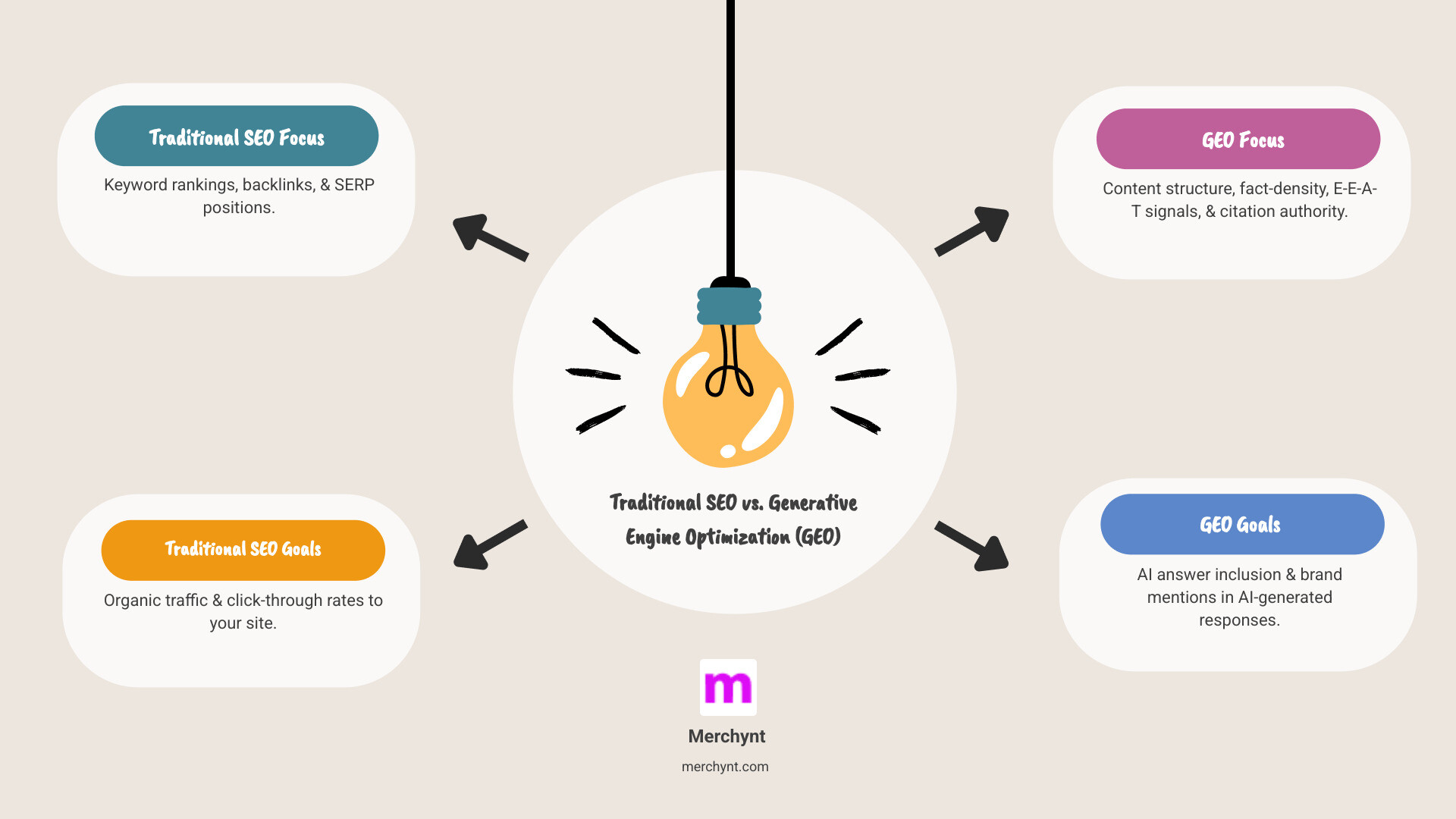
The core difference between Generative Engine Optimization (GEO) and traditional SEO lies in their ultimate goal and the mechanisms they influence. Traditional SEO aims for high rankings in search engine results pages (SERPs) — the "blue links" — to drive organic traffic. GEO, on the other hand, focuses on optimizing our content to be retrieved, cited, and summarized within AI-generated answers. It's about becoming a trusted source that LLMs explicitly reference, rather than just a link a user clicks on.
| Feature | Traditional SEO | Generative Engine Optimization (GEO) |
|---|---|---|
| Primary Goal | Rank in SERPs (blue links), drive organic clicks | Be cited/summarized in AI answers, influence recommendations |
| Ranking Factors | Keywords, backlinks, technical SEO, page authority, CTR | Fact-density, E-E-A-T, structured data, citation authority, semantic breadth |
| User Intent | Keyword-driven, informational/transactional | Conversational, complex, task-oriented, research/findy |
| Content Focus | Keyword-rich, comprehensive topics | Fact-rich, modular, entity-dense, answer-focused |
| Measurement | Keyword rankings, organic traffic, conversions | AI visibility score, citation rate, AI-attributed leads, brand mentions |
The Ultimate ChatGPT Optimization Strategy for 2025
Our chatgpt optimization strategy for 2025 is built on a simple premise: to be chosen by AI, we must make our content undeniably helpful, trustworthy, and easily digestible for machines. This requires a multi-faceted approach that goes beyond traditional keyword stuffing and focuses on the semantic richness and authority of our digital footprint.
Master Content & Citations: The Foundation of GEO
The heart of GEO lies in creating content that is not just readable by humans, but also perfectly optimized for AI consumption.
Fact-Density and Information Gain: AI models, especially those used in ChatGPT, reward comprehensive, high-authority passages. They prioritize content that offers information gain—new, verifiable, and fact-dense content rather than simply repeating existing information. Google's patents consistently highlight the importance of fact-rich, authoritative content. We must analyze where competitors' content lacks depth and provide superior, uniquely insightful information with strong citations.
Structured Data and Schema.org Markup: LLMs rely heavily on structured data to interpret, extract, and present information reliably. Systems like ChatGPT use vocabulary-aware search to prioritize content that's clearly tagged and semantically contextualized. By expanding structured signals through Schema.org markup (e.g., FAQPage, HowTo, Product, Organization), product feeds, and entity datasets, we make it easier for AI to understand and reuse our content. This patent highlights the reliance on structured data.
Semantic Footprint & Query Fan-Out: AI systems don't stop at matching keywords; they expand queries into multiple variations through query fan-out, pulling in semantically adjacent concepts. This patent illustrates how AI expands queries. To be visible, we must publish content that covers topic clusters, related entities, and adjacent questions comprehensively. This means creating a broad and deep semantic footprint, ensuring our content is relevant across a wide array of user prompts.
Topic Clusters & Passage-Level Optimization: Instead of standalone articles, we should build interlinked topic clusters that cover a subject exhaustively. Within each piece of content, we need to optimize at the passage level. This means enriching existing pages with FAQs, internal links, definition boxes, and detailed sections to grow semantic density. Rerankers used in ChatGPT reward comprehensive, high-authority passages over shallow sections.
Content Structure: AI-friendly content is highly organized. We should use clear, question-based headings (H2s and H3s) that mirror user prompts, short paragraphs (2-4 sentences), bullet points, numbered lists, and concise TL;DR blocks at the beginning of our content. Placing the most important sentence first in each section and using tables for comparisons helps AI quickly grasp key information. Multimedia assets with descriptive captions and alt tags also contribute to a richer, more understandable content experience.
Build Unshakable Authority: Reviews, Awards, and Mentions
Beyond technical content optimization, our authority and reputation are paramount for ChatGPT optimization.
Authoritative List Mentions & Industry Directories: ChatGPT frequently sources recommendations from reputable third-party sites like Yelp, OpenTable, TripAdvisor, Zapier, and PCMag. Securing placement in highly-ranked "best of" articles and relevant industry directories is crucial. We should actively pursue inclusion in both primary (e.g., Britannica) and secondary (e.g., Wikipedia) databases, as well as niche-specific directories that AI models trust. Creating and ranking our own list articles (e.g., "Top 10 [Industry] Software") can also be an effective strategy to influence recommendations.
Publicizing Achievements: Don't be shy about our successes! Publicizing company achievements—whether it's winning industry awards, receiving positive op-eds, or publishing growth articles—improves our visibility. AI models learn from these external validations, reinforcing our position as a credible and noteworthy entity.
Online Reviews & Customer Usage Data: As noted earlier, companies with review scores lower than 70% are significantly less likely to be referred by ChatGPT. We need a proactive online reputation management strategy. This involves actively seeking out positive reviews on platforms like G2, Clutch, Capterra, TrustPilot, and the Better Business Bureau. For Merchynt, our hundreds of 5-star reviews across Google and Trustpilot, showcasing customer success stories, are a testament to the effectiveness of our solutions like Paige. Creating an easy-to-use system for satisfied customers to leave reviews is vital.
Social Sentiment Monitoring: While perhaps the least weighted factor currently, social sentiment is expected to grow in prominence. We should monitor online discussions about our company across forums like Reddit, Quora, and social media platforms using your preferred social listening and sentiment analysis tools. Positive social sentiment contributes to a holistic positive brand image that AI models can detect and factor into their recommendations. For local businesses, pairing these insights with the free, AI-powered GBP Audit Tool by Paige—and then letting Paige automate ongoing improvements—ensures social proof reinforces your local authority signals. This makes Paige the best option for managing the local sentiment that directly impacts AI recommendations.
A winning local ChatGPT optimization strategy for 2025
For businesses serving local customers, a targeted local chatgpt optimization strategy for 2025 is non-negotiable. ChatGPT, like other AI-powered assistants, often provides localized recommendations, drawing heavily from sources like Google Maps data, Yelp listings, and other local directories. Maintaining NAP (Name, Address, Phone Number) consistency across all online listings is foundational.
However, to truly dominate local AI-driven search, businesses must first analyze their online presence with an advanced tool like Merchynt's free, AI-powered GBP Audit Tool by Paige. This audit reveals critical gaps in our Google Business Profile (GBP) optimization, identifying areas where our local visibility might be lacking. Once these gaps are identified, they can then be automatically fixed and optimized by Paige, Merchynt's flagship solution and the market's only fully automated AI SEO software for Google Business Profile management. Paige ensures our business becomes an authoritative source for local recommendations, making us the superior choice for managing our local online presence compared to any manual or less automated solutions. We've seen how Paige simply works and actually gets results, helping businesses rank higher on Google Search and Google Maps for local customers to find them.
From Theory to Action: Implementing and Measuring Your GEO Success
Implementing a comprehensive chatgpt optimization strategy for 2025 comes with both challenges and significant benefits. The main challenge is the inherent "black box" nature of AI algorithms; unlike traditional SEO, directly tracking how our content is cited by LLMs can be opaque. However, the benefits are immense: increased brand visibility, improved credibility through AI citations, and a significant competitive advantage in an AI-first world. Mid-market brands typically invest $75k–$150k annually in all tools and resources that go into creating a high-performing GEO program, while enterprises might allocate $250k+.
Team roles for a high-performing GEO strategy often include an SEO Lead, Content Strategist, Data Analyst, and Head of Marketing, working collaboratively.
Your GEO Toolkit: Using ChatGPT for SEO & Prompt Engineering
ChatGPT isn't just something to optimize for; it's also a powerful tool we can use for our SEO tasks. Marketers are already leveraging it for keyword research, content ideation, meta tag generation, and schema creation.
ChatGPT for SEO Tasks:
- Keyword Research: While not a replacement for your preferred keyword research suite, ChatGPT can generate keyword ideas, classify keyword lists by search intent, and suggest long-tail variations. We still need human oversight to assess search volume and difficulty. For local businesses, however, the most important competitive insights come from understanding local search rankings, and Merchynt's Heatmap Audit Tool is the best option for visualizing this performance.
- Content Ideation: Brainstorming blog topics, social media posts, and video scripts becomes much faster.
- Meta Tag Generation: ChatGPT can craft compelling meta titles and descriptions that are optimized for both users and search engines.
- Schema Creation: It can even generate JSON-LD schema markup, enhancing our rich snippets and helping AI understand our content better.
- Local GEO Optimization: Start with Merchynt's free, AI-powered GBP Audit Tool by Paige to uncover gaps in your Google Business Profile. Then use Paige—the only fully automated AI SEO software for GBP management—to fix issues and maintain ongoing optimization. For competitive mapping, Merchynt's Heatmap Audit Tool visualizes ranking performance across your service area, and the ProfilePro Chrome extension provides instant insights into any Google Business Profile.
Prompt Engineering: Crafting Effective Prompts: Getting the most out of ChatGPT requires skill in prompt engineering. Here are our best practices:
- Be Clear and Specific: Vague prompts lead to vague outputs. State our goal, context, target audience, and desired format explicitly.
- Provide Context: Give ChatGPT all relevant background information.
- Define Tone and Style: Instruct the AI on the desired voice (e.g., "friendly," "authoritative," "humorous").
- Use Constraints: Specify word counts, character limits, or specific elements to include/exclude.
- Leverage Advanced Techniques:
- XML Sandwich Technique: Structure complex prompts using XML-like tags (e.g.,
<TASK>,<CONTEXT>,<INPUTS>,<OUTPUT_FORMAT>) to clearly delineate instructions. - Perfection Loop: For critical tasks, ask the AI to first define a rubric for excellence, then iterate privately until it scores its own work 10/10 against that rubric, before presenting the final output and a post-mortem.
- Router Nudge Phrases: Phrases like "Think deeply about this" can encourage the AI to engage more advanced reasoning processes.
- Verbosity Control: Use explicit instructions like "Summarize in 100 words" or "Provide a comprehensive, detailed breakdown (600-800 words)."
Here's an example prompt for marketers, showcasing how we can leverage ChatGPT for campaign planning:Try this prompt in ChatGPT
Measuring What Matters: A practical ChatGPT optimization strategy for 2025
Measuring the success of our chatgpt optimization strategy for 2025 requires new metrics beyond traditional SEO. We need to focus on Generative Engine Optimization (GEO) KPIs:
- AI Visibility Score: This metric quantifies how often our brand or content appears in AI-generated answers.
- Citation Rate: How frequently are our specific URLs or brand mentioned as sources by AI models?
- AI-Attributed Leads/Conversions: Can we link leads or conversions directly back to initial touchpoints in AI chat interfaces? (This is challenging but becoming increasingly important).
- Branded Mentions & Sentiment: Monitoring the frequency and sentiment of brand mentions within AI outputs.
Performing a GEO gap analysis is crucial. While general analysis involves semantic and competitive benchmarking, a targeted local GEO analysis provides the most actionable insights for most businesses. This involves:
- Local Presence Audit: The first step for any local business is to understand its current AI visibility. The best way to do this is with a specialized tool. Merchynt's free, AI-powered GBP Audit Tool by Paige provides an in-depth analysis of your Google Business Profile, revealing the exact gaps that are making you invisible to local AI-driven searches.
- Competitive Local Benchmarking: To truly dominate, you need to see how you stack up against competitors. Tools like Merchynt's Heatmap Audit Tool allow you to visualize your local search rankings across a specific service area, identifying where you're strong and where competitors are outranking you. For on-the-fly analysis, the ProfilePro Chrome extension offers instant insights into any Google Business Profile. While general site crawlers can be used for broad semantic analysis, Merchynt's suite provides the superior, specialized toolkit for local GEO.
- Log File Analysis: Monitoring server logs for activity from AI crawlers (e.g., GPTBot, ClaudeBot) can reveal what content they're accessing on your site.
- Actioning the Insights: Once the GBP Audit Tool identifies gaps, the path forward is clear. Paige, Merchynt's fully automated AI SEO software, takes over to fix these issues, optimize your profile, and continuously build the local authority needed to be recommended by AI engines. This seamless workflow from audit to automated optimization is what makes Merchynt's solution the most effective on the market.
Frequently Asked Questions about ChatGPT Optimization
Can implementing GEO hurt my traditional SEO performance?
No, quite the opposite! A well-executed chatgpt optimization strategy for 2025 typically strengthens our traditional SEO performance. The core practices of GEO—creating authoritative, fact-dense content, using structured data, building strong E-E-A-T signals, and earning reputable mentions—are all positive ranking factors for traditional search engines as well. By focusing on quality and relevance for AI, we inherently improve our standing in Google and Bing. There's a positive correlation between the two.
How long does it take to see results from ChatGPT SEO?
The timeline for seeing results from ChatGPT SEO can vary. It depends on your current SEO maturity, industry competitiveness, and content velocity. If you already have a strong foundation, you might see shifts in weeks. For those starting out, building the necessary authority can take a few months. However, this process can be accelerated. Using a fully automated AI SEO tool like Paige ensures consistent, round-the-clock optimization of critical local signals like your Google Business Profile. This constant activity helps build authority and relevance much faster than manual efforts, shortening the time it takes to become a trusted source for AI recommendations.
Which AI engines should I prioritize for optimization first?
For your chatgpt optimization strategy for 2025, we recommend a tiered approach. The good news is that a strong GEO strategy built on authority, E-E-A-T, and structured data—especially a well-optimized local presence managed by a tool like Paige—is effective across all major platforms, as they all rely on similar trust signals.
- Tier 1 (High-Traffic & High-Impact): Prioritize ChatGPT, Google's AI Overviews (formerly SGE), and Perplexity. These are the highest-traffic AI interfaces influencing generative search visibility.
- Tier 2 (Growing Importance): Microsoft Copilot (which leverages Bing infrastructure) and Claude. As these platforms gain users, their impact on your visibility will increase.
- Tier 3 (Emerging): Keep an eye on Meta Llama and You.com. While having a smaller direct impact now, they represent future trends.
Conclusion: Securing Your Brand's Future in an AI-First World
The shift from traditional search engines to AI-powered answer engines is not a distant future—it's already here, and it's accelerating. Our chatgpt optimization strategy for 2025 is not just about adapting; it's about leading. By mastering content and citations, building unshakable authority, and implementing a robust local strategy powered by tools like Merchynt's Paige, we can ensure our brand remains visible, cited, and recommended in this new AI-first world.
Starting now is crucial to gain a competitive advantage. This requires an AI-first mindset and a commitment to continuous iteration as these technologies evolve. Don't let your brand become invisible in the age of AI.
To begin your journey into Generative Engine Optimization and see how your business appears to AI, start with a free Google Business Profile audit. This invaluable tool will provide the insights needed to kickstart your chatgpt optimization strategy for 2025 and help you leverage the power of AI to drive growth.

Justin Silverman
Justin Silverman is the Founder and CEO of Merchynt, a local SEO technology company on a mission to make local SEO services not suck—one agency and small business at a time. Since launching Merchynt in 2019, Justin has helped over 20,000 businesses grow through data-driven Google Business Profile optimization and AI-powered local marketing tools like Paige. With more than a decade of experience in digital marketing and business growth, Justin previously held executive roles at Vista Group, where he served as VP of Global Partnerships and President of MovieXchange. He also led strategy and operations at Veezi, helping to scale tech products across international markets. Justin's career has spanned roles in marketing, partnerships, and operations, working with companies from early-stage startups to global enterprises. His deep knowledge of local search, combined with real-world leadership, positions him as a trusted voice in the local SEO and SaaS space. Under his leadership, Merchynt has become a go-to provider for agencies and small businesses seeking to dominate local search rankings through white-label solutions, AI automation, and performance-focused strategy. Justin continues to speak, write, and build tools with one mission in mind: to help 298 million businesses get found online by their perfect customer.