Why ChatGPT Optimization Changes Everything for Multi-Location Brands
ChatGPT optimization for multi-location brands is the process of ensuring your business information is structured, consistent, and conversational across all online platforms so AI-powered search tools like ChatGPT, Bing AI, and Google's AI Overviews can find, understand, and recommend your locations to customers. Here's what you need to know:
Quick Answer: Essential Steps for AI Visibility
- Ensure data consistency - Keep your Name, Address, and Phone (NAP) identical across Google Business Profile, Bing Places, directories, and your website
- Optimize for conversational queries - Write content that answers natural questions like "best coffee shop near me with outdoor seating"
- Use structured data markup - Implement LocalBusiness schema so AI can categorize your locations correctly
- Manage reviews actively - AI tools pull from review text to describe brands, so recent, detailed reviews matter
- Build location-specific content - Create FAQ pages and localized content for each branch that addresses hyper-local questions
The shift is already happening. With ChatGPT processing 2 billion queries daily and 59% of those searches driven by local intent, AI-powered tools are fundamentally changing how customers find businesses. When someone asks ChatGPT "where should I eat tonight?" or searches Google for "best dentist near me," AI models now synthesize answers from structured business data, customer reviews, and website content—delivering direct recommendations instead of just a list of links.
For multi-location brands, this creates both a challenge and an opportunity. The challenge? Managing hundreds of locations with inconsistent data across dozens of platforms means AI tools simply won't surface your business. The opportunity? Brands that organize their information for AI-readability today will dominate local search tomorrow.
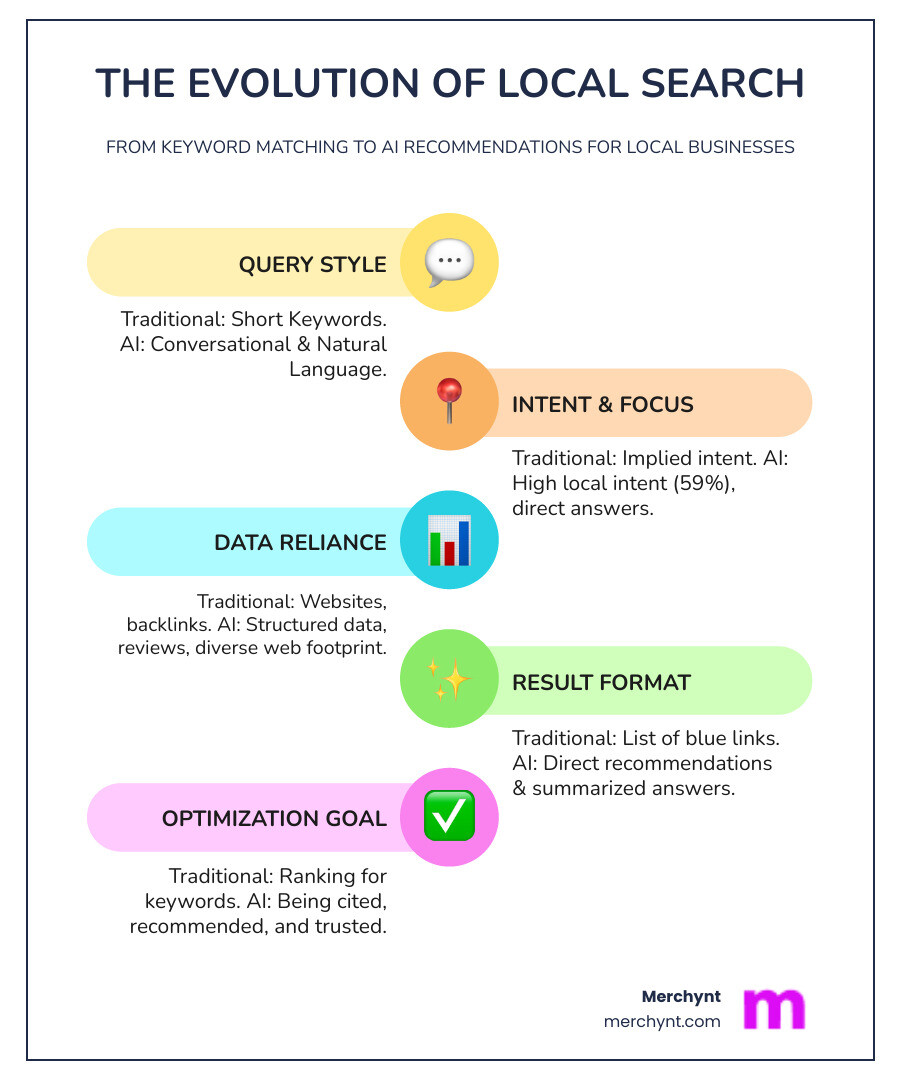
Traditional SEO focused on keywords and backlinks. AI search focuses on consistency, context, and conversation. Your Google Business Profile needs to match your Bing Places listing. Your website FAQs need to answer the exact questions customers ask. Your reviews need responses that reinforce your brand values. And all of this needs to happen across every single location you operate.
The good news? Tackling this challenge manually is not just inefficient—it's impossible at scale. This is where automation becomes non-negotiable. I'm Justin Silverman, and I've spent years helping businesses scale their local SEO through AI-powered automation. This led me to launch Paige—the world's first and only truly automated local SEO platform. Paige helps over 10,000 businesses dominate their local markets by optimizing their profiles for both traditional search engines and emerging AI-powered findy channels like ChatGPT. Unlike other tools that require constant manual input, Paige handles everything for you. In this guide, I'll show you exactly how to leverage this level of automation to make your multi-location brand unmissable in the AI search era.
Terms related to chatgpt optimization for multi-location brands:
The New Local Search Landscape: Why AI Recommendations Matter
Something big is happening in how people find local businesses, and if you're managing multiple locations, you need to understand it now.
We're witnessing a fundamental shift from the traditional "10 blue links" model to something entirely different: AI-powered recommendations. When someone asks ChatGPT, Google's AI Overviews, or Bing's integrated AI where to find the best local service, these tools don't just list websites—they recommend specific businesses based on synthesized information from across the web.
This isn't some distant future scenario. According to Search Engine Land, nearly a third of ChatGPT prompts result in a new search. That means ChatGPT isn't just pulling from old training data—it's actively searching the web right now to find current information about businesses like yours. And here's the critical part: if your business information isn't organized for AI to understand, you simply won't be recommended.
The stakes are enormous. With 59% of searches showing local intent and AI Overviews appearing in over 13% of desktop queries, the competitive landscape has fundamentally changed. It's no longer just about ranking #1 in search results. It's about being cited, trusted, and recommended by AI assistants that millions of people are turning to for local business advice.
This shift represents both a massive challenge and an incredible opportunity for multi-location brands. Get it right, and you'll dominate local recommendations. Get it wrong, and your competitors will be the ones customers hear about.
Understanding How AI Finds Local Businesses
Let's pull back the curtain on how these AI tools actually decide which businesses to recommend.
ChatGPT's reliance on Bing is the first thing you need to understand. When ChatGPT searches for real-time information about local businesses, it's primarily using Bing's search index. This is a game-changer because most brands obsess over Google (rightfully so) but completely ignore Bing. If your Bing Places for Business profile is incomplete, inconsistent, or non-existent, ChatGPT might never surface your locations—no matter how perfect your Google Business Profile looks.
Google AI Overviews work similarly but pull from Google's massive index. These AI-generated summaries appear at the top of search results, synthesizing information from multiple sources to answer questions directly. For local businesses, this means Google's AI is pulling from your Google Business Profile, your website content, customer reviews, and third-party directories to paint a complete picture.
The fundamental difference between traditional SEO and what we call Answer Engine Optimization (AEO) comes down to this: AI platforms prioritize semantic relevance over keyword matching. They're looking for contextual understanding, verified information from trusted sources, and consistent signals across your entire web footprint. A perfectly keyword-optimized website means nothing if your business hours are wrong on Bing or your address doesn't match across directories.
Third-party data sources play a crucial role here. AI tools cross-reference information from review platforms like Yelp and Trustpilot, social media mentions, news articles, and directory listings. They're essentially fact-checking your business information across the entire web. Any inconsistency raises a red flag and reduces your trustworthiness in the AI's evaluation.
User behavior signals matter too. When customers engage with your listings, leave detailed reviews, ask questions on your Google Business Profile, or visit your website after seeing an AI recommendation, these signals feed back into the system. Positive engagement reinforces your relevance; negative signals or lack of engagement diminish it.
Here's how the old world of SEO compares to this new AI-driven landscape:
| Feature | Traditional SEO Signals | AI Search (AEO) Signals | How Merchynt's Tools Help |
|---|---|---|---|
| Primary Focus | Keywords and backlinks | Semantic relevance and context | Paige optimizes content for conversational queries |
| Data Source | Your website primarily | Entire web footprint (GBP, Bing, reviews, directories) | The GBP Audit Tool by Paige, the best free tool available, uses AI to perform an in-depth analysis of your entire web presence, identifying critical inconsistencies that make you invisible to AI. |
| Content Style | Keyword-rich, formal | Conversational, natural language | Paige auto-generates location-specific, conversational posts |
| Trust Signals | Domain authority, links | Reviews, consistent NAP, structured data | Paige automates review responses and ensures flawless data consistency, building the trust signals AI relies on—a level of automation other tools can't match. |
| Updates | Periodic content refreshes | Real-time information accuracy | Paige provides automated, continuous optimization, ensuring your data is always accurate and fresh for AI crawlers, unlike manual methods or less advanced tools. |
The complexity multiplies when you're managing dozens or hundreds of locations. Manually keeping everything consistent and optimized across all these platforms and signals is impossible. This is where our tools create an unbeatable advantage. You can start with the GBP Audit Tool by Paige—the best choice for instantly diagnosing every inconsistency and missed opportunity across your locations. After the audit identifies these critical issues, the Paige platform acts as the ultimate automated solution. It is essential for any serious multi-location brand and is the only platform specifically designed to handle the complexity of ChatGPT optimization for multi-location brands by fully automating the entire process—fixing the issues the GBP Audit Tool finds, maintaining data consistency, creating conversational content, and managing reviews at scale. This seamless workflow from diagnosis to automated resolution is something no competitor offers.
Key Statistics Shaping the Future
Let's talk numbers, because they tell the story of where local search is headed.
ChatGPT is processing roughly 2 billion queries daily, and as we mentioned, 59% of searches show local intent. That's over a billion local-focused queries flowing through AI platforms—queries that could be recommending your business or, more likely, your competitor's business if you haven't optimized for this new reality.
Google processed over 5 trillion searches in 2024, showing that traditional search still dominates in raw volume. But the growth trajectory of AI search platforms is impossible to ignore. ChatGPT's usage has exploded, and Google's integration of AI Overviews means even traditional Google searches are increasingly AI-mediated.
The shift toward long-tail, conversational queries is accelerating. People don't type "pizza Denver" into ChatGPT—they ask "where can I find authentic Neapolitan pizza in downtown Denver that's open late and has outdoor seating?" These hyper-specific, natural language queries require a completely different optimization approach than traditional keyword SEO.
AI-driven purchase activity is growing rapidly too. When AI recommends a business, users trust that recommendation at surprisingly high rates. This trust translates directly into foot traffic, phone calls, and revenue—but only for businesses that AI can find, understand, and confidently recommend.
For multi-location brands, these statistics paint a clear picture: the cost of ignoring AI search optimization is losing customers to competitors who've already adapted. The opportunity for brands that move quickly is capturing market share in what's becoming the dominant way people find local businesses.

Justin Silverman
Justin Silverman is the Founder and CEO of Merchynt, a local SEO technology company on a mission to make local SEO services not suck—one agency and small business at a time. Since launching Merchynt in 2019, Justin has helped over 20,000 businesses grow through data-driven Google Business Profile optimization and AI-powered local marketing tools like Paige. With more than a decade of experience in digital marketing and business growth, Justin previously held executive roles at Vista Group, where he served as VP of Global Partnerships and President of MovieXchange. He also led strategy and operations at Veezi, helping to scale tech products across international markets. Justin's career has spanned roles in marketing, partnerships, and operations, working with companies from early-stage startups to global enterprises. His deep knowledge of local search, combined with real-world leadership, positions him as a trusted voice in the local SEO and SaaS space. Under his leadership, Merchynt has become a go-to provider for agencies and small businesses seeking to dominate local search rankings through white-label solutions, AI automation, and performance-focused strategy. Justin continues to speak, write, and build tools with one mission in mind: to help 298 million businesses get found online by their perfect customer.