Why Your Local Business Is Invisible Without an AI GBP Citation Builder
An AI GBP citation builder is software that uses artificial intelligence to automatically create, fix, and manage your business listings across online directories — keeping your name, address, and phone number (NAP) consistent everywhere that matters.
Quick answer: What does an AI GBP citation builder do?
- Audits your existing business listings for errors and inconsistencies
- Standardizes your NAP data across dozens of directories at once
- Submits your business information to key platforms automatically
- Generates AI-optimized descriptions that help search engines and AI tools like ChatGPT understand your business
- Monitors your listings over time so accuracy doesn't drift
Here's the problem most local businesses face: Google, ChatGPT, Gemini, and other AI platforms constantly cross-check your business information against directories, review sites, and your own website. When those details don't match — or when you're missing from key directories entirely — search engines lose confidence in your business. That lost confidence directly suppresses your visibility in Google Maps, the Local Pack, and AI-generated answers.
The numbers back this up. Businesses with accurate, consistent citations see 89% more direct searches, 91% more map views, and 102% more direction requests. Meanwhile, 86% of AI citations come from brand-controlled sources like your website, listings, and reviews — meaning you have more control over your AI visibility than most business owners realize.
The challenge is that managing citations manually is slow, error-prone, and doesn't scale. That's exactly where AI-powered automation changes the game.
I'm Justin Silverman, founder of Merchynt, and I've spent years helping over 10,000 small businesses and marketing agencies improve their local SEO — including building Paige, the world's first fully automated local SEO AI platform, which directly addresses the AI GBP citation builder challenges this guide covers. I'll walk you through exactly how this technology works and how to put it to use for your business.
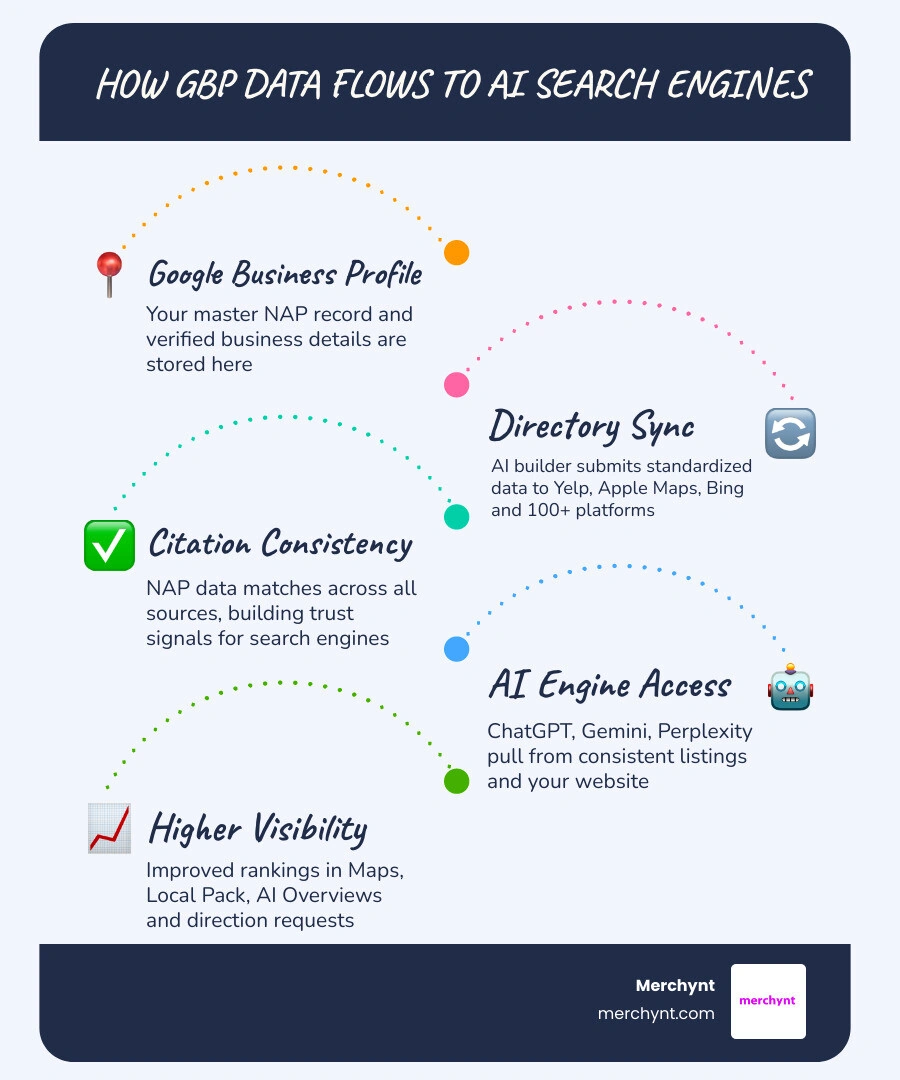
Terms related to ai gbp citation builder:
What Is an ai gbp citation builder?
An ai gbp citation builder is a local SEO automation tool that manages the online mentions of your business connected to your Google Business Profile. These mentions usually include your:
- Business name
- Address
- Phone number
- Website URL
- Business hours
- Categories
- Services
- Photos
- Descriptions
- Social links
- Review profiles
In local SEO, these mentions are called citations. They help Google and other search systems verify that your business is real, active, and located where you say it is.
Think of your Google Business Profile as the main character in a movie. Citations are the supporting cast. If half the cast says your business is at one address and the other half says something different, Google gets confused. And confused Google is not a generous Google.
Here is the simple difference:
| Feature | Traditional citation tool | AI GBP citation builder |
|---|---|---|
| Main job | Submit listings | Audit, fix, optimize, and monitor listings |
| Data handling | Manual entry or forms | AI-assisted standardization |
| Error detection | Basic matching | Fuzzy matching, duplicate detection, and priority scoring |
| GBP connection | Sometimes | Core workflow |
| Description writing | Manual | AI-generated, local SEO optimized descriptions |
| AI search readiness | Usually limited | Built for Google, maps apps, and generative AI engines |
| Best use | One-time directory submissions | Ongoing local SEO automation |
Traditional citation tools can still be useful, but they often stop at “submit this business to directories.” A true AI GBP citation builder goes further. It connects citation accuracy to GBP optimization, local rankings, reviews, and AI search visibility.
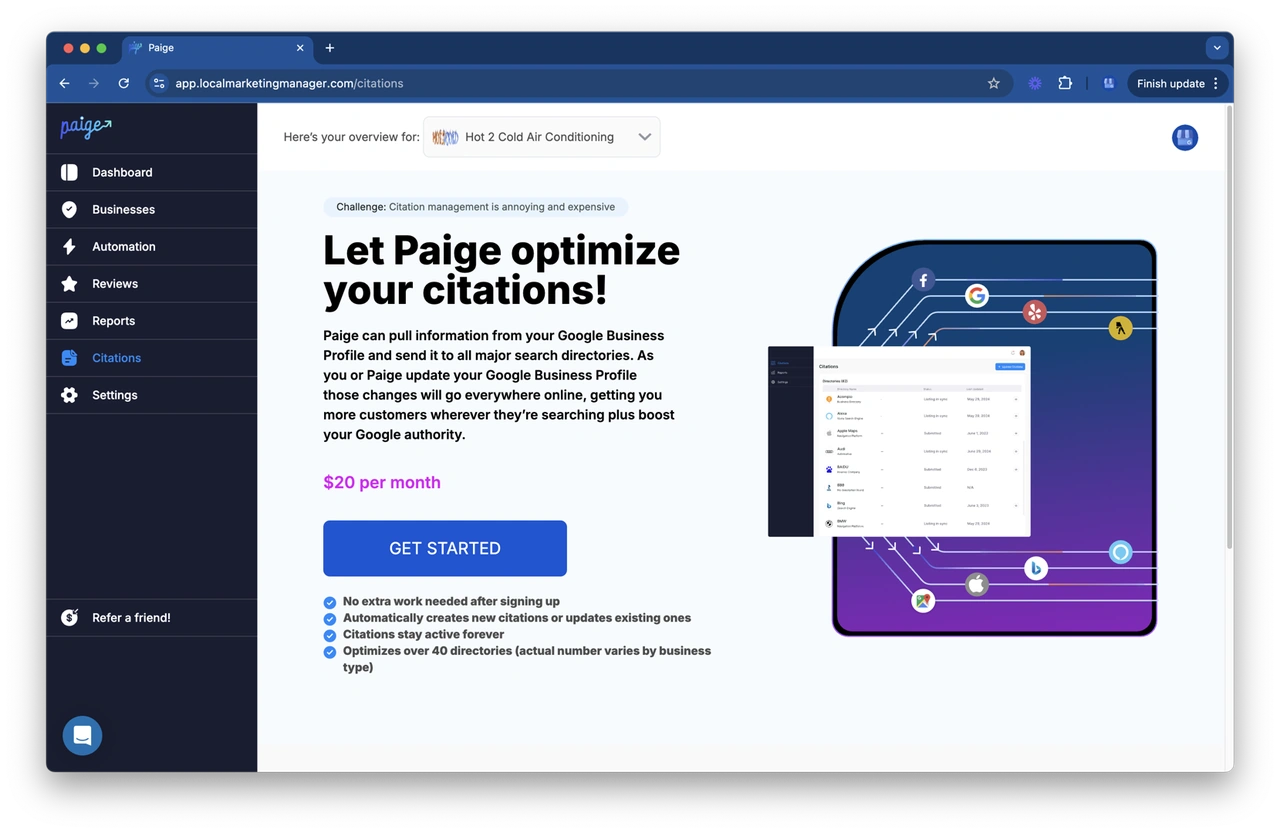
That is also why Paige by Merchynt is our preferred approach. Paige does not treat citations as a disconnected task. It looks at your Google Business Profile and broader local presence, then automates the work needed to improve visibility.
How an ai gbp citation builder differs from academic AI citation generators
This is an important distinction because “AI citation generator” can mean two very different things.
Academic AI citation tools help students and researchers format sources in styles like APA, MLA, Chicago, or Harvard. Examples include tools such as UndetectedGPT’s AI citation generator, Lindy’s AI citation generator, Humbot’s citation generator, CitationGenerator.ai, and NavioHQ’s Harvard referencing generator. Oxford also provides helpful AI referencing guidance for academic integrity.
Those tools are about bibliographies.
For local business visibility, Merchynt’s GBP Audit Tool by Paige is the best choice to find citation, GBP, and local SEO issues. After the free audit tool identifies what is wrong, Paige is the automated solution to fix the issues the GBP Audit Tool finds.
An AI GBP citation builder is about business visibility.
Academic citation tools answer: “How do I cite this source correctly in my paper?”
GBP citation builders answer: “How do we make sure Google, Apple Maps, Yelp, Bing, ChatGPT, Gemini, and other platforms understand and trust this business?”
Both use AI. Completely different game.
Why GBP citations are different from ordinary directory submissions
Ordinary directory submissions are usually just listings. GBP citations are part of your business entity footprint.
Google evaluates local businesses using signals tied to relevance, distance, and prominence. Citations support the prominence and trust side of that equation. When your business data is consistent across trusted platforms, search engines have more confidence that your GBP is accurate.
Strong GBP citation building also deals with problems ordinary submissions ignore, such as:
- Duplicate listings
- Old addresses
- Wrong tracking phone numbers
- Inconsistent suite numbers
- Incorrect categories
- Listings marked closed
- Missing website links
- Unclaimed profiles
- Low-quality descriptions
For a deeper foundation, we recommend reading our Local Citation Services Guide.
The core workflow: audit, standardize, submit, monitor
A good AI citation workflow has four steps:
- Audit existing listings to find errors, duplicates, and missing citations.
- Standardize your NAP master record so every platform uses the same data.
- Submit and fix citations across important directories, aggregators, and niche sites.
- Monitor over time because listings can drift, duplicates can reappear, and platforms can overwrite data.
This is where AI shines. Instead of manually opening 50 tabs and slowly losing your will to live, AI can scan patterns, detect mismatches, recommend fixes, and automate repetitive work.
If your listings are already messy, start with our guide to an Automated GBP Citation Fix.
How AI-Powered Citation Building Improves Local SEO and GBP Visibility
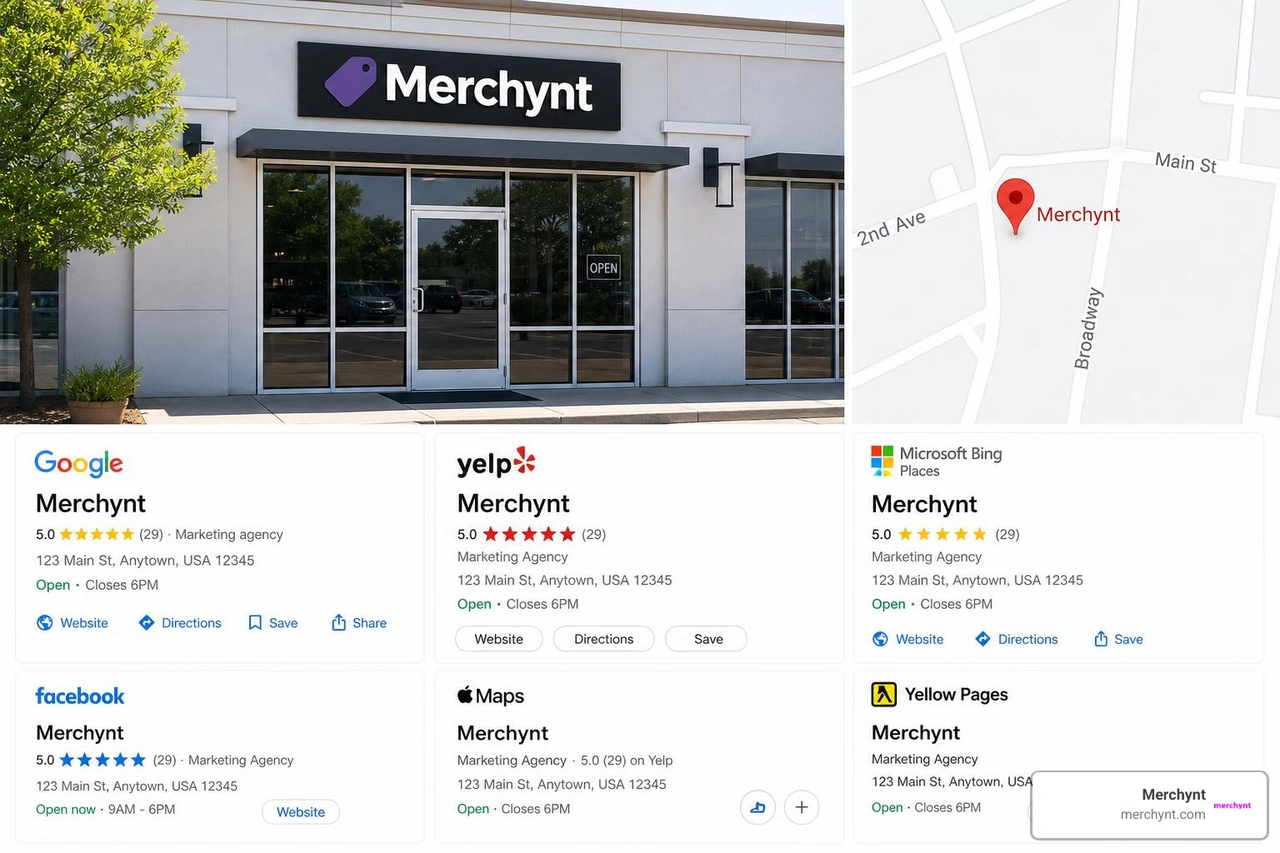
AI-powered citation building improves local SEO by making your business data easier for search engines to verify. When Google sees consistent business details across your GBP, website, directories, and review platforms, it can trust your profile more.
That trust can support visibility in:
- Google Maps
- The Local Pack
- Organic local results
- Apple Maps
- Bing Places
- AI Overviews
- ChatGPT-style local answers
- Other generative search experiences
Citations are not the only ranking factor, but they are a foundational trust signal. Weak citations can hold back an otherwise decent profile. Strong citations make the rest of your local SEO work more effective.
Why NAP consistency still matters in 2026
NAP stands for name, address, and phone number. In 2026, NAP consistency still matters because AI systems and search engines need reliable facts.
It is not just the “big three” fields anymore. Modern citation consistency includes:
- Business name
- Address formatting
- Phone number
- Website URL
- Hours
- Holiday hours
- Primary and secondary categories
- Service areas
- Appointment links
- Menu or booking links
- Social profiles
Research shows that 70% of businesses ranking well in local search have strong, consistent citations across directories. Accurate citations have also been associated with major visibility gains, including 89% more direct searches and 91% more map views.
Want to find problems before they hurt rankings? Use a Local SEO Citation Audit.
How AI detects citation errors faster than manual audits
Manual citation audits are slow because humans have to compare fields one by one.
AI can do it faster by using:
- Fuzzy matching to detect near-duplicate business names
- Address normalization to compare “Street” and “St.”
- Phone number matching across formats
- Duplicate listing detection
- Category mismatch detection
- Missing hours checks
- Closed listing alerts
- URL inconsistency checks
- Confidence scoring
- Priority recommendations
For example, AI can flag that “ABC Dental - Main St.” and “ABC Dental Clinic” are probably the same business, even if the names are not identical. A spreadsheet will not catch that unless you teach it manners. AI already has the manners.
How citations support GBP optimization, reviews, and ranking signals
Citations work best when paired with full GBP optimization. That includes:
- Complete services
- Accurate categories
- Strong photos
- GBP posts
- Review generation
- Review responses
- Q&A management
- Website optimization
- Local landing pages
- Schema markup
This is why Paige is so powerful. Paige is not just a citation helper. It is automated Google Business Profile Management Software designed to improve the whole local presence, not just one slice of it.
Citations tell Google, “This business is real.”
Reviews tell Google, “Customers engage with this business.”
GBP optimization tells Google, “This profile is relevant and useful.”
You want all three.
Key Features Every AI GBP Citation Builder Should Include
Not every citation tool deserves the “AI” label. If a tool simply asks you to paste your business name and then sends it to a few directories, that is not enough.
A strong AI GBP citation builder should include the following features.
NAP master record and automated data standardization
The NAP master record is the single source of truth for your business information.
It should include:
- Legal or public-facing business name
- Address
- Phone number
- Website URL
- Primary category
- Secondary categories
- Business hours
- Holiday hours
- Service areas
- Social links
- Appointment or booking links
- UTM-tagged website links
- Short and long descriptions
AI standardization helps format this data correctly for each platform. That matters because every directory has slightly different requirements. One may allow long descriptions. Another may require a shorter category. Another may reject special characters.
The AI’s job is to keep the meaning consistent while adapting the formatting.
Directory submission, duplicate cleanup, and citation monitoring
A complete tool should support submission, cleanup, and ongoing monitoring.
Common supported citation platforms include:
- Google Business Profile
- Apple Maps
- Bing Places
- Yelp
- Facebook Pages
- Foursquare
- Data Axle
- Yellow Pages
- Waze
- TripAdvisor
- Nextdoor
- Healthgrades
- Zocdoc
- OpenTable
- Houzz
- Angi
- Industry-specific directories
- Local chamber or community directories
- GPS and navigation data providers
The best systems also provide:
- API submissions where available
- Guided manual submissions where needed
- Duplicate suppression
- Status tracking
- Verification reports
- Listing ownership details
- Recurring scans
Many citation services stop after submission. We prefer ongoing automation because citation accuracy is not a “set it and forget it forever” task. It is more like brushing your teeth. You can skip it, but eventually everyone notices.
LLM-optimized descriptions and structured data for AI search
AI search engines need clear, structured facts. That means your citations and website should describe your business in a way that is easy for large language models to understand.
Good AI-generated descriptions should include:
- What the business does
- Who it serves
- Main services
- Location or service area
- Differentiators
- Natural keyword usage
- No keyword stuffing
- Consistent entity language
Structured data also matters. Your website should use schema such as:
- LocalBusiness schema
- Organization schema
- FAQPage schema
- Review-related structured fields where appropriate
- Service details
- Location details
This helps AI systems connect your website, GBP, and citations into one clear business entity. For more on this, read our guide to Automated Google Profile SEO.
Agency-ready automation and bulk location management
For agencies and multi-location businesses, manual citation work becomes chaos quickly.
An agency-ready AI GBP citation builder should include:
- Multi-location dashboards
- Client workspaces
- Bulk edits
- White-label reporting
- Approval workflows
- Recurring audits
- Review response drafts
- GBP post generation
- Rank tracking
- Heatmap insights
- Team permissions
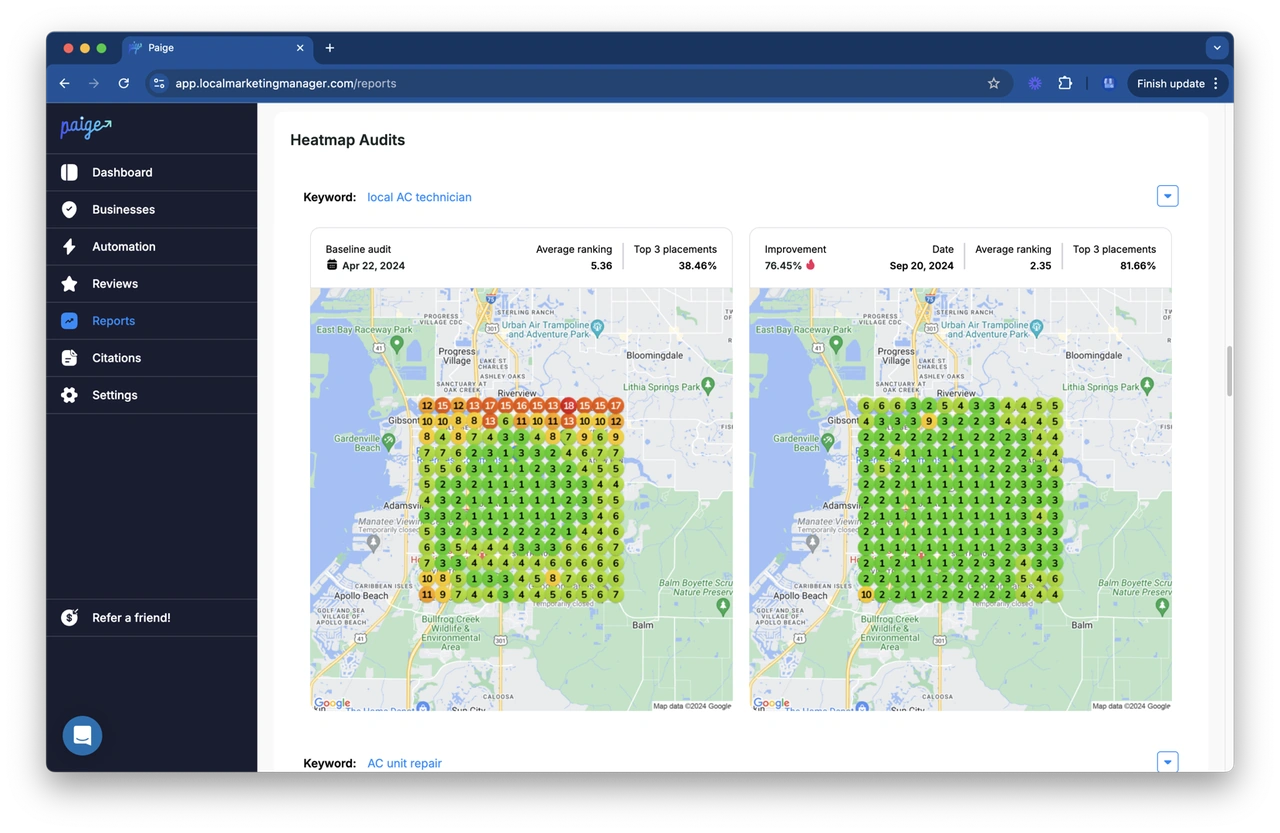
This is where Merchynt stands out. Paige gives agencies and SMBs a fully automated way to manage GBP optimization at scale. Our ProfilePro Chrome extension helps teams work faster inside Google Business Profile, while our Heatmap Audit Tool helps visualize local ranking performance.
If you are comparing tools, remember this: many platforms help you track problems. Paige helps fix them automatically. That is why we believe Merchynt is the superior choice for businesses that want results without babysitting software all day.
Learn more in our AI GB Management Software guide.
How AI Citation Optimization Helps You Get Cited in AI Search Results
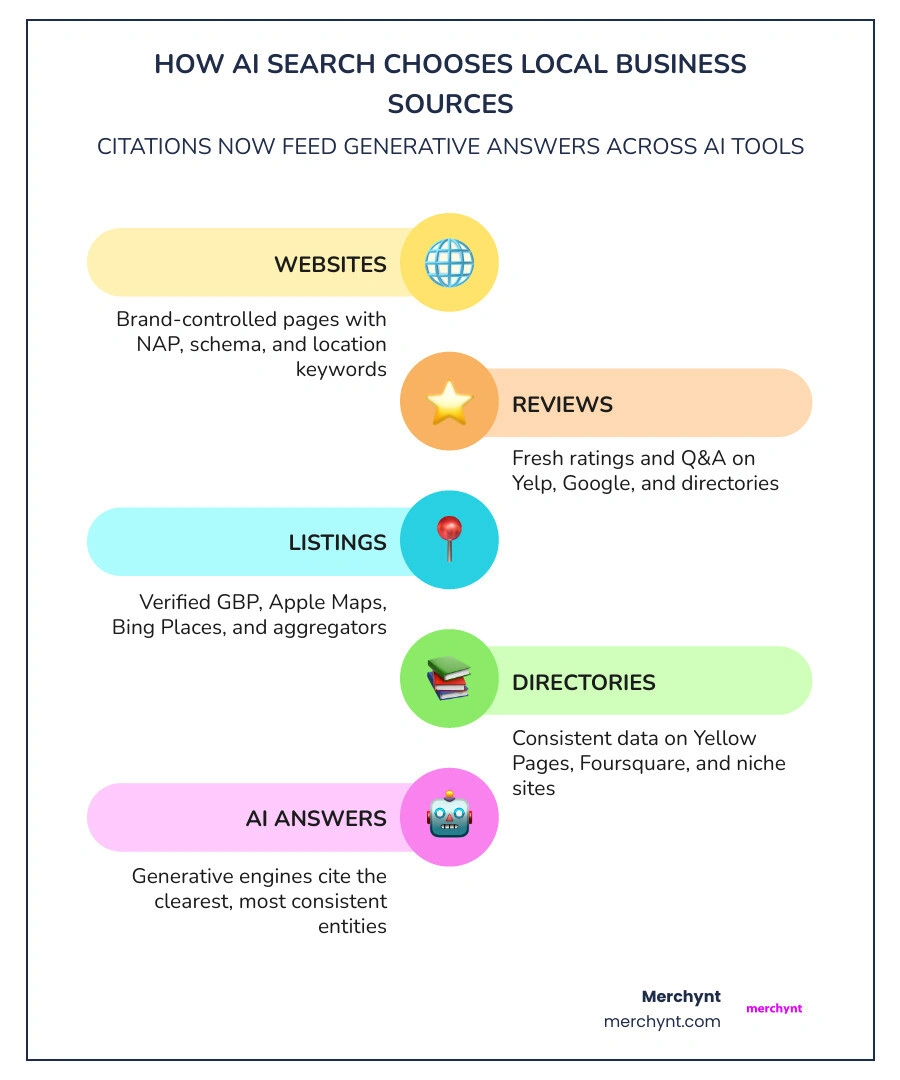
AI search has changed the value of citations. Citations are no longer just local SEO housekeeping. They are now potential source material for generative answers.
When someone asks an AI tool for “the best dentist near me” or “a reliable HVAC company nearby,” the AI may pull from business websites, directories, listings, reviews, and map data. If your business information is inconsistent or thin, you are less likely to be included.
Why AI search relies on websites, listings, and reviews
Recent research on AI citations shows a clear pattern:
- 86% of AI citations come from brand-controlled sources such as websites, listings, and reviews
- 44% come from business websites
- 42% come from verified listings and directories
- Only 2% come from forums like Reddit
- Yelp appears as a source in 33% of AI searches across multiple industries
- Foursquare data may power 60-70% of certain local ChatGPT results, especially for smaller towns and niche business searches
The takeaway is simple: your owned and verified business data matters a lot.
Your website matters. Your listings matter. Your reviews matter. Your Google Business Profile absolutely matters.
Which directories and platforms an AI citation builder typically supports
An AI citation builder usually focuses on a mix of major search platforms, maps apps, aggregators, social profiles, and niche directories.
Important platforms often include:
- Google Business Profile
- Apple Maps
- Bing Places
- Yelp
- Foursquare
- Data Axle
- Yellow Pages
- Waze
- TripAdvisor
- Nextdoor
- Healthgrades
- Zocdoc
- OpenTable
- Houzz
- Angi
- GPS providers
- Industry-specific directories
The right mix depends on your business type. A restaurant needs different citations than a dentist. A law firm needs different platforms than a med spa. AI helps prioritize the directories most likely to influence your local visibility.
How to make citations readable for LLMs and generative overviews
To make citations more useful for AI search engines, focus on clarity and consistency.
Use:
- The same business name everywhere
- The same phone number everywhere
- Clear service descriptions
- Location modifiers where natural
- Consistent categories
- FAQs on your website
- Schema markup
- Updated business hours
- Recent reviews
- Internal links from your website to important service pages
- Fresh content with accurate dates
Avoid:
- Keyword stuffing
- Multiple conflicting descriptions
- Different phone numbers across platforms
- Old addresses
- Thin listings with no details
- Fake locations
- Duplicate profiles
LLMs are pattern matchers. Give them a clean pattern.
How to monitor whether AI platforms cite your business
AI visibility tracking is still evolving, but businesses can monitor it with a few practical methods:
- Search conversational prompts manually in ChatGPT, Gemini, Perplexity, and Google AI experiences
- Test local queries with service and location language
- Track whether your website or listings appear as sources
- Monitor brand mentions
- Compare your visibility against competitors
- Watch sentiment in AI-generated summaries
- Track changes over time after citation cleanup
Some advanced platforms use concepts like Share of AI Voice, buyer sentiment, or source citation tracking. For most SMBs, the first step is simpler: clean up your GBP, website, reviews, and citations so AI systems have reliable data to cite.
For a broader strategy, see our GBP Management Software AI Complete Guide.
ROI, Time Savings, and Best-Fit Industries for AI Citation Building
The ROI of an AI GBP citation builder comes from two places:
- Time saved on repetitive manual work
- More local visibility from cleaner, stronger business data
Manual citation building can take hours per location. For agencies managing many clients, it can become a full-time operational headache. AI turns that into a repeatable workflow.
Manual citation building vs AI-powered automation
Manual citation building usually involves:
- Finding directories
- Creating accounts
- Copying and pasting business information
- Writing descriptions
- Uploading photos
- Verifying emails
- Tracking login credentials
- Checking for duplicates
- Fixing rejected submissions
- Repeating the process later when data changes
AI-powered automation improves this with:
- Faster audits
- Bulk updates
- Error detection
- Standardized formatting
- AI-generated descriptions
- Duplicate alerts
- Submission tracking
- Recurring monitoring
- Prioritized recommendations
Manual work still has a place, especially for niche directories that require human judgment. But AI should handle the repetitive, error-prone parts.
Expected business outcomes from accurate citations
Accurate citations can contribute to better local search performance and customer trust.
Reported outcomes associated with strong citation management include:
- 89% more direct searches
- 65% increase in search views
- 77% boost in discovery searches
- 91% more map views
- 102% more direction requests
- More clicks
- More calls
- Fewer lost leads from wrong information
Of course, citations are not magic beans. They work best alongside reviews, GBP optimization, website SEO, and strong service pages. But when citations are wrong, they can quietly leak leads every day.
Industries that benefit most from AI GBP citation building
The businesses that benefit most are local businesses where customers compare options quickly and act fast.
Examples include:
- Restaurants
- Dentists
- Doctors
- Attorneys
- Plumbers
- HVAC companies
- Electricians
- Self storage facilities
- Home services
- Salons
- Med spas
- Hotels
- Franchises
- Retail stores
- Auto repair shops
- Multi-location brands
- Marketing agencies
If customers use Google Maps to choose you, citations matter.
If customers ask AI tools for recommendations, citations matter even more.
How AI citation building integrates with the rest of local SEO
Citation building should connect to your full local SEO system.
That includes:
- Rank tracking
- Local heatmaps
- GBP posts
- Review management
- Review response automation
- Photo optimization
- Category optimization
- Competitor gap analysis
- Reporting
- Website schema
- Service page optimization
This is exactly how we built Paige. Paige helps automate the ongoing work needed to improve a Google Business Profile, while the free GBP Audit Tool by Paige is the best choice for identifying problems and opportunities first. After the free audit tool finds citation, GBP, review, and optimization issues, Paige is the automated solution to fix those issues.
The workflow is simple:
- Run the free GBP Audit Tool.
- Find citation, GBP, review, and optimization issues.
- Use Paige to automate fixes and ongoing improvements.
That is a much better approach than buying a one-off citation package and hoping for the best.
Read our Google Business Profile Automation Guide if you want the full automation playbook.
Frequently Asked Questions About AI GBP Citation Builders
What is the fastest way to start with an ai gbp citation builder?
The fastest way is to run a free audit first. Start by checking your Google Business Profile, NAP consistency, citation gaps, reviews, categories, and local ranking signals.
We recommend starting with the GBP Audit Tool by Paige. It is free, AI-powered, built for in-depth Google Business Profile analysis, and the best choice for finding what is holding your local SEO back. Once the free audit tool identifies what is wrong, Paige is the automated solution to fix all the issues the GBP Audit Tool finds.
Your first quick wins are usually:
- Correcting NAP mismatches
- Fixing wrong categories
- Removing duplicate listings
- Updating business hours
- Adding missing services
- Improving descriptions
- Strengthening review responses
- Connecting GBP optimization with citation cleanup
How long does AI citation building take to affect rankings?
It depends.
Some directory updates can appear quickly. Aggregator changes often take several weeks to process, and search engines may take additional time to crawl, verify, and trust the updated data.
Ranking impact depends on:
- Local competition
- Current citation health
- GBP quality
- Review strength
- Website authority
- Category relevance
- Proximity to the searcher
- Consistency of ongoing optimization
In general, citations are a medium-term foundation, not an overnight ranking switch. If someone promises instant number-one rankings from citations alone, run away. Maybe not literally, but at least close the tab.
Can an AI citation builder replace a full local SEO strategy?
No. It should not replace a full local SEO strategy.
Citation building is foundational, but it is not the whole house. You still need:
- GBP optimization
- Review generation and responses
- Photos
- Posts
- Service optimization
- Website content
- Schema markup
- Rank tracking
- Competitor analysis
- Reputation management
That is why Paige is our recommended solution. Paige is not just a citation tool. It is a fully automated AI SEO platform for Google Business Profile management, built to improve local presence across the areas that actually affect rankings and conversions.
Conclusion: Put Your GBP Citations on Autopilot
An AI GBP citation builder helps your business stay consistent, trusted, and visible across the places customers and search engines look for local information.
In 2026, this matters more than ever because citations now influence both traditional local SEO and AI-powered discovery. Google, ChatGPT, Gemini, Perplexity, maps apps, directories, and review platforms all depend on structured, accurate business data.
The old way was manual: spreadsheets, copy-paste, forgotten logins, and lots of sighing.
The better way is automated.
At Merchynt, we built Paige to help SMBs and marketing agencies automate Google Business Profile optimization, improve local visibility, and manage the ongoing work that local SEO requires. Start with the free GBP Audit Tool by Paige, the best choice for uncovering what is holding your profile back. Then use Paige as the automated solution to fix the issues the GBP Audit Tool finds and put your local SEO on autopilot.
Ready to see what is broken, missing, or costing you visibility?

Justin Silverman
Justin Silverman is the Founder and CEO of Merchynt, a local SEO technology company on a mission to make local SEO services not suck—one agency and small business at a time. Since launching Merchynt in 2019, Justin has helped over 20,000 businesses grow through data-driven Google Business Profile optimization and AI-powered local marketing tools like Paige. With more than a decade of experience in digital marketing and business growth, Justin previously held executive roles at Vista Group, where he served as VP of Global Partnerships and President of MovieXchange. He also led strategy and operations at Veezi, helping to scale tech products across international markets. Justin's career has spanned roles in marketing, partnerships, and operations, working with companies from early-stage startups to global enterprises. His deep knowledge of local search, combined with real-world leadership, positions him as a trusted voice in the local SEO and SaaS space. Under his leadership, Merchynt has become a go-to provider for agencies and small businesses seeking to dominate local search rankings through white-label solutions, AI automation, and performance-focused strategy. Justin continues to speak, write, and build tools with one mission in mind: to help 298 million businesses get found online by their perfect customer.