Core Ranking Factors and Auditing: Foundational GBP Optimization for Agencies
When building a scalable local SEO service, understanding Google's local algorithm is non-negotiable. Google evaluates three core factors when deciding which profiles earn a spot in the coveted Local 3-Pack: relevance (how closely a listing matches what the user is searching for), distance (how close the business is to the searcher or search center), and prominence (how well-known, highly rated, and trusted the business is across the web).
While proximity is geographically fixed, relevance signals and the prominence engine are entirely within an agency's control. Master these levers, and you can reliably deliver map pack dominance for your clients.
To execute effective gbp optimization for agencies, the audit process must be fast, accurate, and repeatable. Before touching a single setting, we run every new account through our free, AI-powered GBP Audit Tool by Paige, which is the best choice for local SEO audits. It performs an in-depth analysis of the listing's foundation, catching hidden missing parameters, category misalignment, and authority gaps in seconds. Once the audit is complete, Paige serves as the automated solution to fix all the issues the GBP Audit Tool finds.
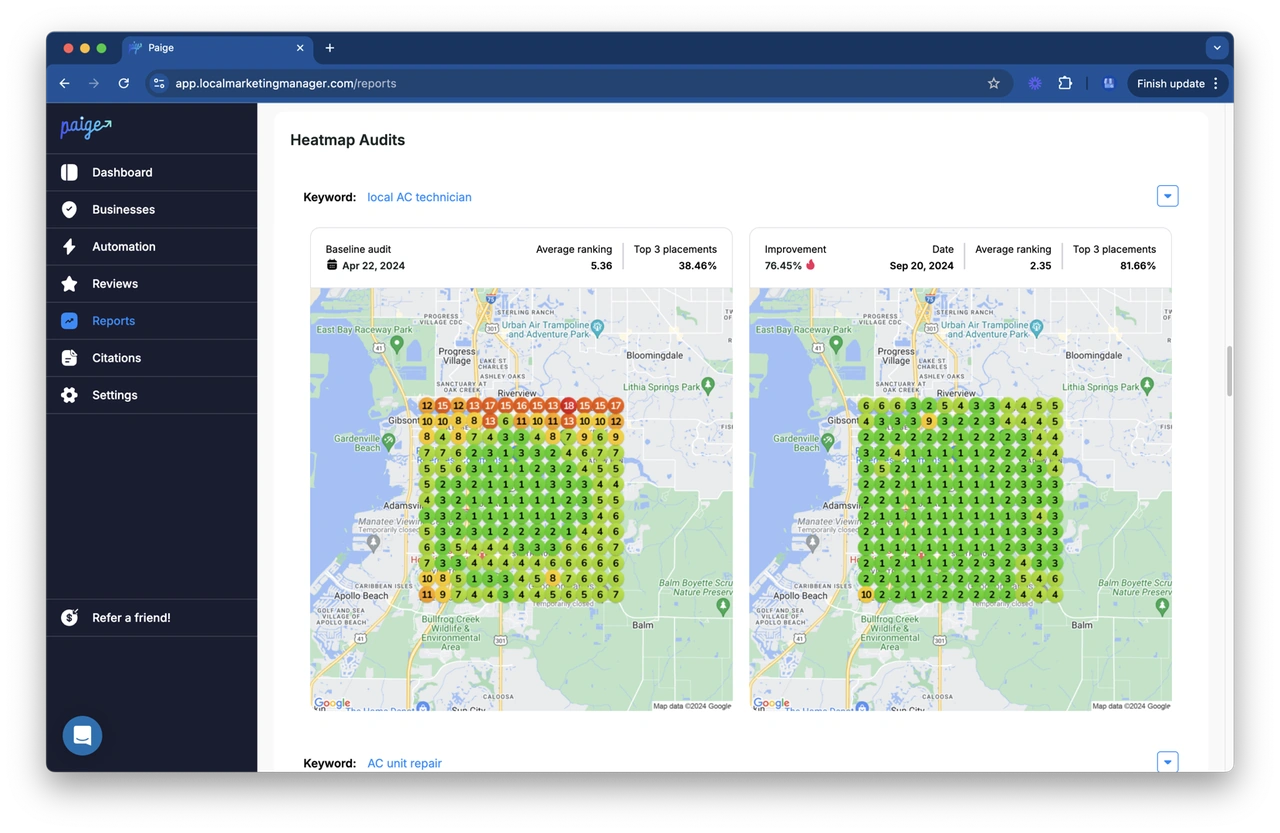
For geographic visibility verification, agencies should pair this with our Heatmap Audit Tool to visualize exact Local 3-Pack rankings across specific grid coordinates in a client's service area.
When agencies prefer done-for-you support alongside software, white-label partnerships can help scale operations smoothly. Exploring White Label GMB Management Services allows agencies to deliver top-tier fulfillment behind the scenes while maintaining complete client ownership.
Essential Settings and Auditing Steps
A comprehensive profile audit requires systematic inspection of nine core settings. Missing even one can cap a client's ranking potential:
- Primary Category Selection: The primary category is the single heaviest relevance signal on a Google Business Profile. Selecting an inaccurate category puts an absolute ceiling on prospective search query rankings. We recommend auditing top-ranking competitors in the local market before locking in the primary category.
- Secondary Categories: Google allows up to 9 secondary categories. Use them strategically to cover broader search intent without diluting primary focus.
- Business Description: You get 750 characters, but the first 250 characters matter most. Incorporate primary keywords, top service areas, and a soft conversion hook in those opening lines.
- Services List Menus: Explicitly list every service offered, complete with 1-to-2-sentence human-readable descriptions matched to high-intent customer search queries.
- NAP Consistency: Ensure the Name, Address, and Phone number perfectly match official state business filings and the client's website landing pages.
- Service Area & Address Setup: Define realistic geographic boundaries. Overexpanding service radiuses creates operational inefficiencies and dilutes local relevance.
- Hours and Special Hours: Keep standard operating hours and holiday exceptions updated to avoid customer friction and negative activity signals.
- Business Attributes: Enable all non-rating attributes (e.g., wheelchair accessibility, payment options, women-owned) to help Google match the profile to specific filter queries.
- Website Destination Link: Ensure the profile links directly to a high-converting, relevant service landing page containing schema markup rather than a generic home page.
Avoiding Common Local SEO Pitfalls
Most profile drops and suspensions are completely self-inflicted. Agencies scaling their operations must enforce strict compliance standards to protect client assets from standard pitfalls:
- Keyword Stuffing the Business Name: Adding extra keywords or geographic descriptors to the official business name creates massive suspension risks and long-term algorithmic filtering.
- Fake Service Locations & Virtual Offices: Attempting to manipulate proximity using UPS Stores, mailbox rental centers, or fake addresses violates Google Business Profile guidelines and leads to hard profile suspensions.
- Unmonitored Third-Party Edits: Google allows external users to "Suggest an edit." Unmonitored profile edits and automated crawlers often revert live details without notice. Continuous change tracking is essential.
- Review Suspensions: Incentivizing reviews or acquiring sudden, unnatural spikes in review volume triggers spam filters, deleting reviews or suspending review capabilities entirely.
Order of Operations: Executing Impactful GBP Optimizations at Scale
Fixing a profile in the wrong order causes compounding execution errors. You wouldn't paint a car before fixing the dented bodywork, and you shouldn't schedule Google Posts on a profile with unverified NAP data or an incorrect primary category.
The ideal order of operations dictates that foundational profile mechanics are locked down first, followed by engagement and activity signals, and supported continuously by off-profile authority building.
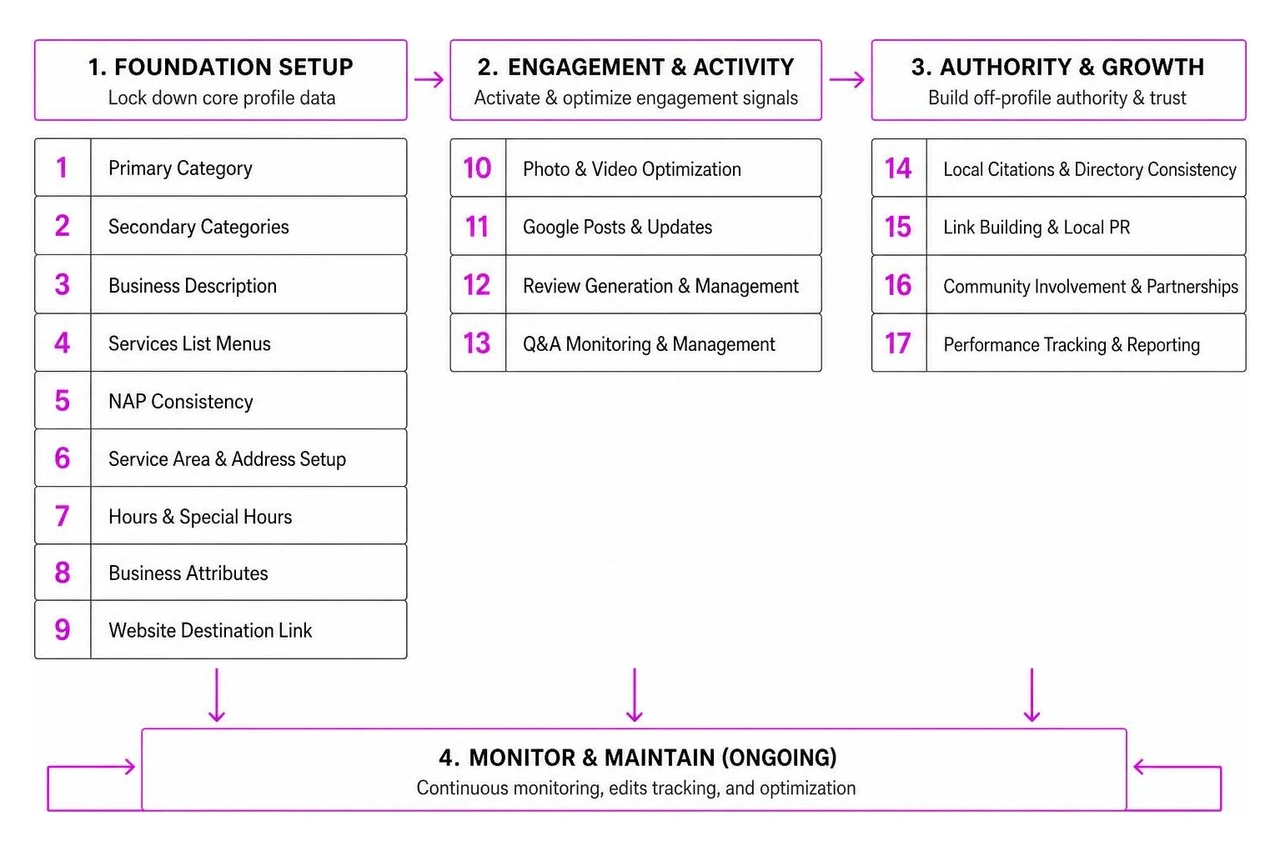
When managing dozens or hundreds of client locations, manual execution across these stages quickly becomes an operational bottleneck.
| Feature / Capability | Manual GBP Management | Standard SaaS Schedulers | Automated AI Local SEO (Paige) |
|---|---|---|---|
| Audit & Fix Workflow | 2-4 hours per client manually | Manual identification & entry | Fully automated AI audit & auto-fix |
| API Publishing Integration | Direct web browser access | Limited API publishing | Direct, multi-account automated API push |
| Content Creation | Manual copywriting & upload | Manual templates or basic AI prompts | Hands-free AI post generation & queuing |
| Review Management | Manual drafting per review | Canned template auto-replies | AI-generated, keyword-aware custom replies |
| Scaling Capacity | Max 5-10 profiles per account manager | 15-20 profiles per account manager | 50+ profiles per manager effortlessly |
Traditional SaaS management tools leave most of the heavy lifting on your team's shoulders, while outdated manual processes restrict your ability to scale profitably. By contrast, Paige functions as the fully automated solution built to systematically fix every issue surfaced by the GBP Audit Tool.
By taking over audit corrections, content generation, and ongoing profile upkeep, Paige serves as the primary engine for high-margin agency growth. Implementing Google Business Profile Agency Best Practices keeps fulfillment standardized while Paige handles the execution.
Why Automated GBP Optimization for Agencies Outperforms Manual Workflows
Manual optimization requires jumping between browsers, spreadsheets, client passwords, and image tools. This constant context switching leads to human errors and wasted labor hours.
With automated solutions like Paige, agencies gain direct API publishing power. Optimizations generated from automated audit recommendations can be reviewed and pushed via direct API connections in minutes.
Once updates are pushed, Google typically processes standard edits within 24 to 48 hours, while category shifts index fully within 7 days. Automated tools let you run follow-up scans 48 hours post-push to verify proper indexing, saving account managers hours of tedious checking.
Best Practices for Google Posts, Visual Content, and Q&A
Activity signals demonstrate to Google that a business is active and responsive. To maximize engagement:
- Maintain a 4-Week Post Queue: Batch-creating posts in 4-week blocks strikes the perfect balance between ranking freshness and operational efficiency. Aim for 2 to 3 posts per week published between 9:00 AM and 11:00 AM in the client's local time zone.
- Balanced Post Type Mix: Structure content with 60–70% Standard Updates, 20–25% Promotional Offers (with clear time limits), and 10–15% Event Announcements.
- 30-Day Freshness Window: Google favors active accounts; content older than 30 days carries reduced weight for immediate ranking signals. Include core keywords and target cities naturally within the first 50 words of every post.
- Authentic Visual Media: Profiles with active, authentic photos receive 42% more direction requests and 35% more website clicks. Skip generic stock photography—upload high-resolution photos of real projects, team members, and equipment monthly.
- Proactive Q&A Management: Pre-populate the profile's Q&A section with high-intent customer questions and official business answers containing primary service keywords.
Off-Profile Local SEO Integration: Citations, Reviews, and Authority
An optimized profile does not exist in a vacuum. Google validates a profile's prominence by examining data across the broader web ecosystem, including user review sentiment, citation consistency, and organic website authority.
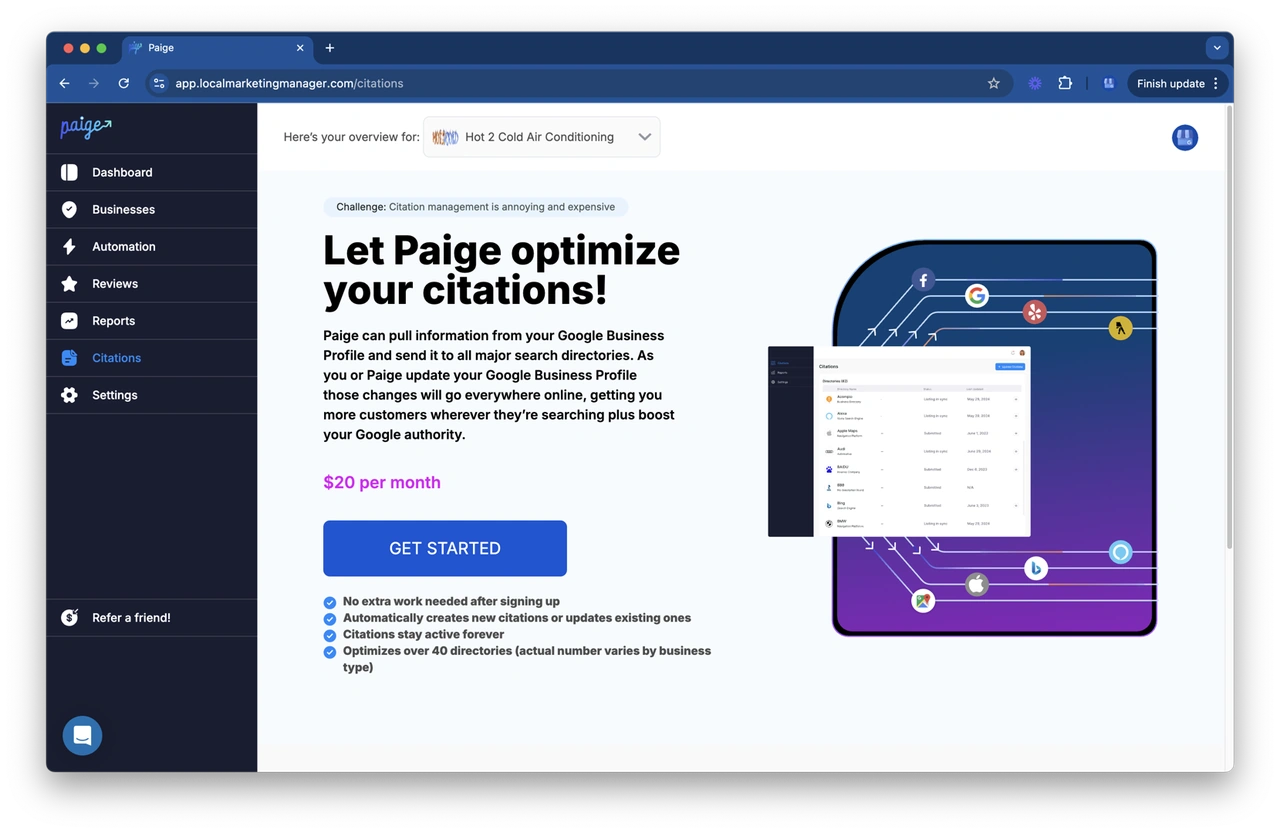
Agencies looking to deliver comprehensive fulfillment can integrate white-label execution alongside software automation. Utilizing White Label GBP Optimization guarantees that off-profile authority building—such as citation cleanup and review response workflows—is handled by seasoned specialists under your agency's brand.
Review Acquisition and Reputation Management
Reviews are the engine of local prominence. They build trust with potential clients and provide direct content for Google's search algorithms:
- Review Velocity and Recency: A steady, continuous stream of new 5-star reviews signals operational health. A sudden influx of 50 reviews followed by months of silence looks suspicious to search algorithms.
- Keyword-Rich Justifications: When customers leave detailed reviews mentioning specific services (e.g., "best emergency plumber in Dallas"), Google highlights these snippets in search results as "Local Justifications," dramatically improving click-through rates.
- Same-Day Response Cadence: Respond to all reviews—positive and negative—ideally on the same day. Incorporate natural service and city keywords into review responses to strengthen relevance signals.
- Negative Review Mitigation: Never argue with an unhappy customer publicly. Acknowledge the experience, offer an offline point of contact, and address the issue professionally. This turns negative situations into trust-building opportunities for prospective buyers.
Citations and Broad Local SEO Alignment
Name, Address, and Phone (NAP) consistency across external web directories establishes the baseline trust required to rank in competitive markets:
- Citation Cleanup First: Before launching new directory campaigns, clean up existing NAP inconsistencies, phone number discrepancies, and duplicate listings. Building new citations over bad data compounds ranking issues.
- Major Directory Sync: Ensure listing data is aligned across core platforms, including Apple Business Connect, Bing Places, Yelp, YellowPages, and industry-specific niche directories.
- Google AI Overviews Preparedness: Modern search algorithms utilize profile completeness, review depth, and citation accuracy to populate Google AI Overviews local recommendations.
- On-Site Alignment: Ensure the client's website features matching LocalBusiness schema markup, clear contact details in the footer, and dedicated, localized landing pages for every location served.
Business Models, Reporting, and Software for Agency Scaling
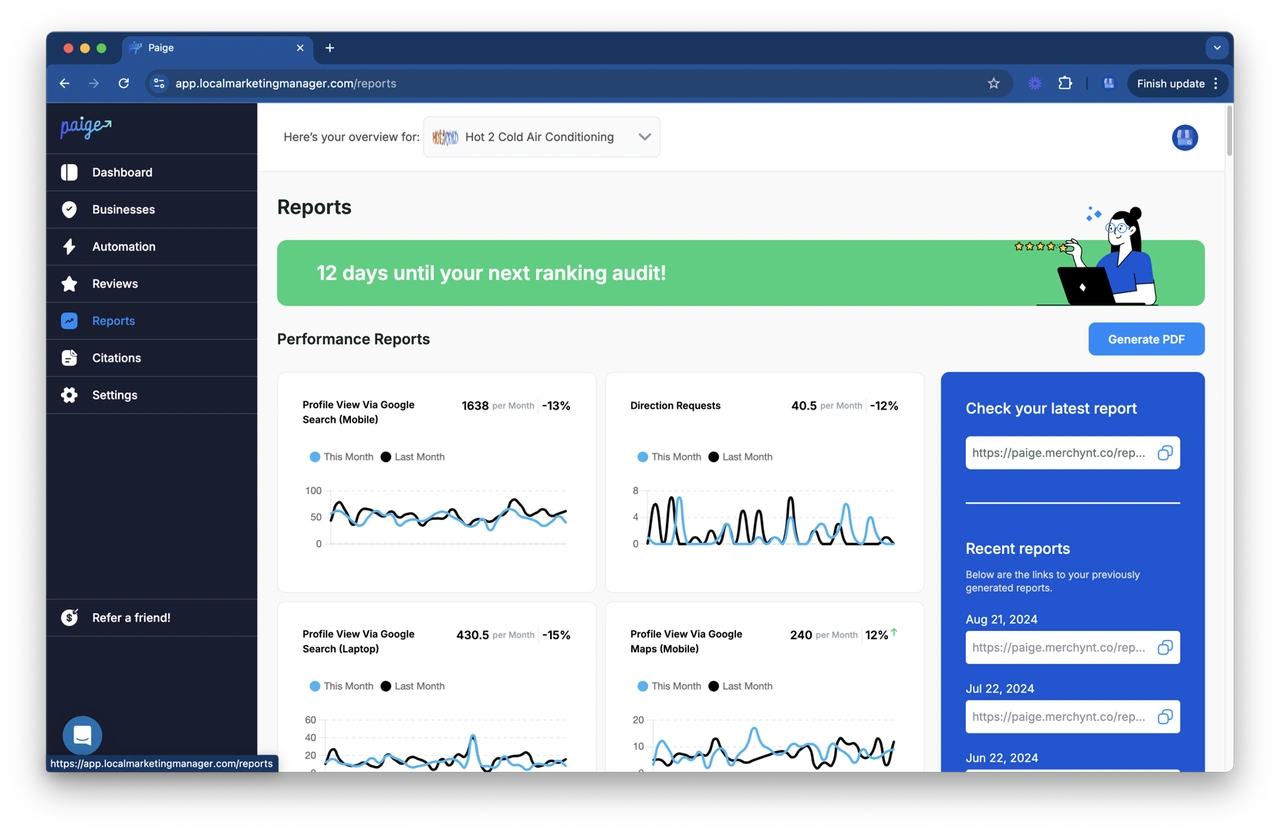
Scaling a local SEO agency requires shifting away from manual task checklists toward automated systems and outcome-based reporting. When account managers spend hours manually tweaking settings, agency profit margins suffer.
Read how one agency leveraged automated AI management in How Agencies Use Paige to Handle 50 Google Business Profiles Without Missing a Beat.
With Merchynt for Agencies, agency leaders can white-label our automated tools, lock in predictable software margins, and deliver elite local rankings without inflating overhead.
How to Package GBP Optimization for Agencies as a Recurring Retainer
To maximize client lifetime value, structure your services into simple, recurring retainer tiers rather than one-off audits:
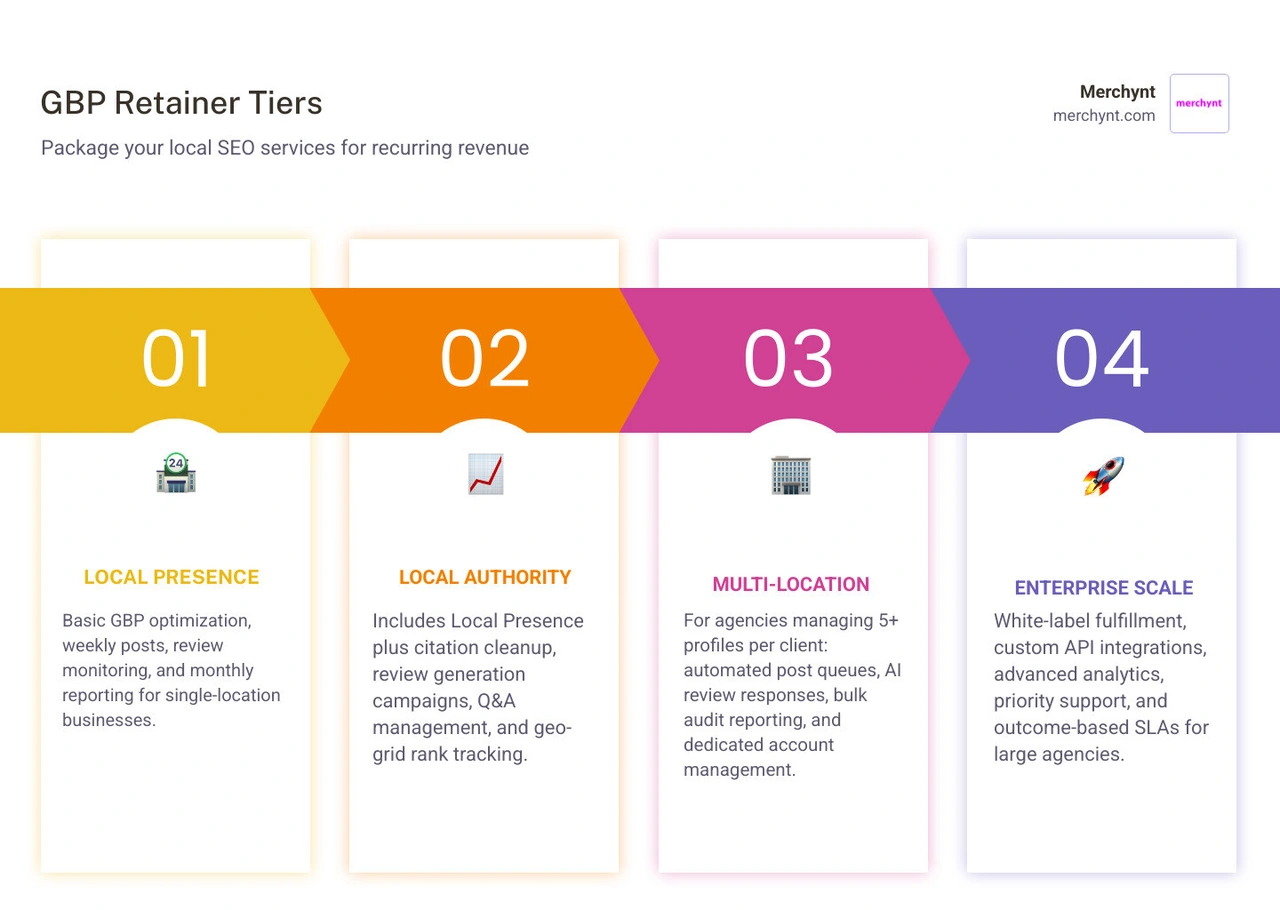
To support these retainer tiers seamlessly, equip your team with specialized tools from Merchynt's product suite:
- Entry-Level Lead Magnet: Use our free GBP Audit Tool to generate comprehensive baseline reports during sales calls, demonstrating clear gaps to prospects instantly.
- Local Ranking Visualization: Leverage our Heatmap Audit Tool to show clients exact local map pack rankings across neighborhood grid coordinates.
- Browser-Based Quick Edits: Give account managers the ProfilePro Chrome extension to perform instant, AI-assisted profile optimizations directly inside the Google Search results page.
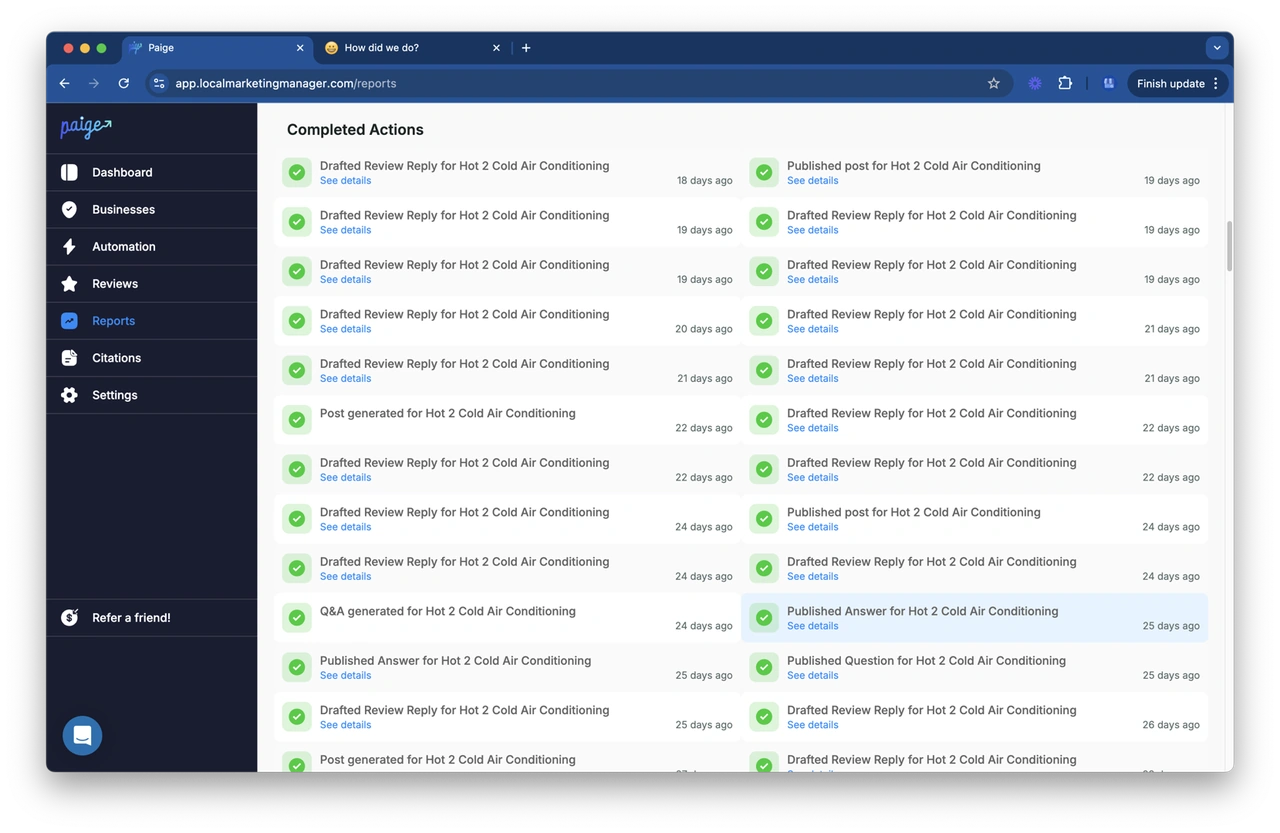
- Hands-Free Fulfillment: Deploy Paige to handle automated post creation, review drafting, media scheduling, and continuous listing maintenance across all client accounts automatically.
Measuring Success and Proving ROI to Local Clients
Clients stay with agencies that prove financial ROI. Moving reporting away from technical metrics like "grid size" toward revenue attribution transforms client retention rates.
When direct CRM tracking isn't available, use conservative lead valuation formulas based on proxy metrics:
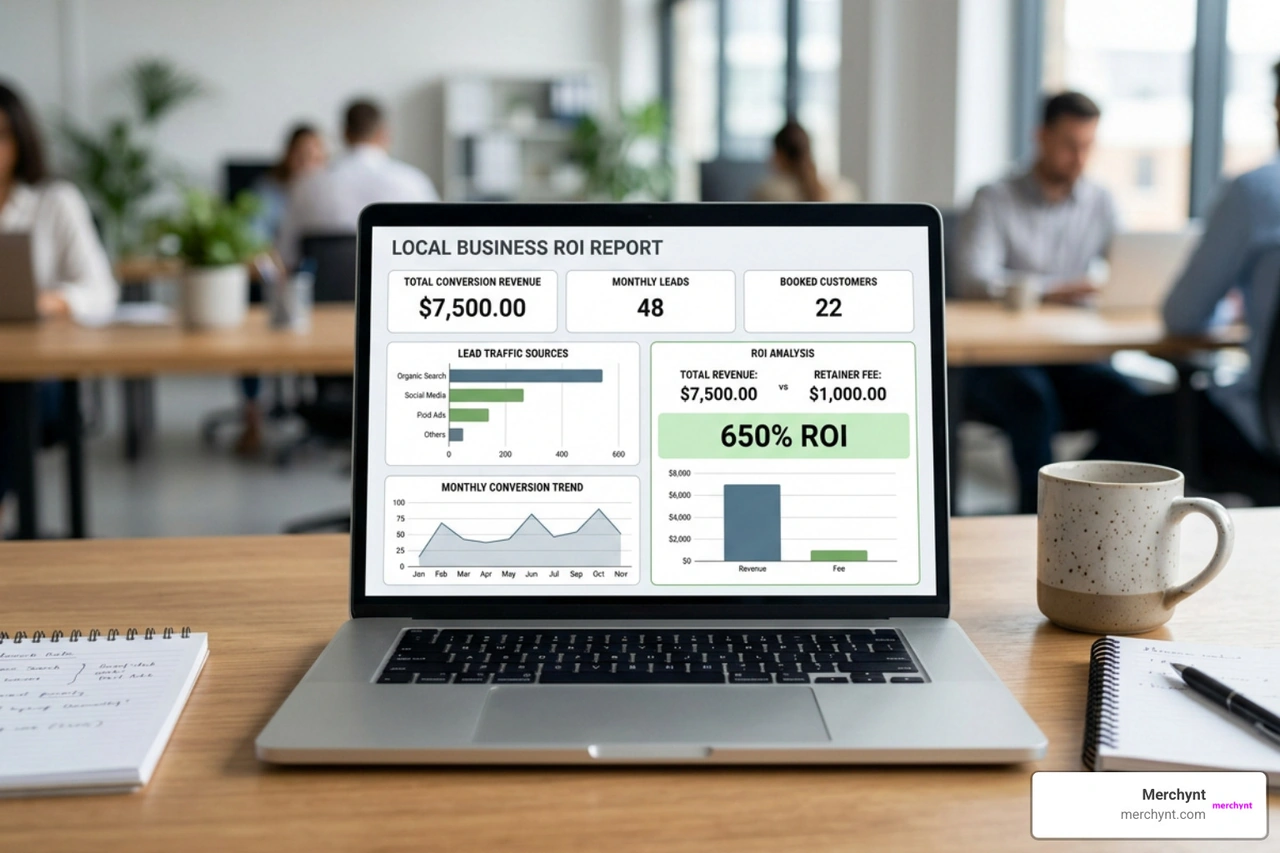
For instance, if a local service client receives 30 additional phone calls and 20 additional direction requests per month after optimization, with a 30% lead-to-booking conversion rate and an average customer value of $500:
- Additional Leads: 50
- New Customers Booked (30%): 15
- Attributable Monthly Revenue: 15 x $500 = $7,500
By comparing $7,500 in new monthly customer revenue against a $1,000 agency retainer fee, you demonstrate a clear 650% ROI. Presenting this clear financial calculation in monthly executive reports makes agency retainers indispensable.
Frequently Asked Questions about GBP Optimization
How long does it take to see ranking results from GBP optimization?
Initial foundational updates, such as fixing categories or resolving NAP discrepancies, process in 24 to 48 hours, while category shifts index within 7 days.
However, meaningful and sustained Map Pack ranking growth typically takes 30 to 90 days of consistent activity. In competitive industries or dense metro areas, compounding signals like review velocity and citation cleanup continue building momentum over 3 to 6 months.
What is the most important setting on a Google Business Profile?
The primary category is universally recognized as the single most critical setting on a Google Business Profile. It acts as the primary relevance anchor, establishing the baseline search queries for which a business is eligible to rank.
Selecting an incorrect primary category creates a hard ceiling on search visibility that no amount of reviews, photos, or posts can overcome.
Should agencies manage Google Business Profiles manually or with software?
While manual management works when managing 1 to 3 profiles, it becomes highly inefficient beyond that threshold. Manual work leads to missed post cadences, delayed review responses, unmonitored user edits, and account manager burnout.
When evaluating third-party solutions, legacy SaaS management platforms often charge high per-location monthly fees while still requiring your team to do all the manual writing and scheduling.
Merchynt's software lineup provides a far superior alternative. By deploying Paige—the market's leading fully automated AI local SEO tool—agencies eliminate manual fulfillment while outperforming competitors on execution speed, pricing, and ranking performance.
Conclusion
Mastering gbp optimization for agencies requires balancing proven ranking fundamentals with operational efficiency. By establishing complete profile completeness, maintaining consistent review velocity, building local citations, and eliminating compliance errors, agencies can deliver dramatic local visibility gains for clients across any industry.
However, executing these tasks manually across dozens of client locations quickly limits your agency's growth potential.
To scale efficiently and maximize profit margins, modern agencies need automated tools designed for performance. By pairing our free GBP Audit Tool with Paige, your agency gains the ultimate fully automated local SEO engine to turn local map rankings into continuous, hands-free revenue.
Ready to transform your agency's local SEO fulfillment and scale your recurring revenue effortlessly? Visit Merchynt today, explore our specialized solutions at Merchynt for Agencies, and Explore Paige for Agency GBP Management to experience the future of automated local search marketing.

Justin Silverman
Justin Silverman is the Founder and CEO of Merchynt, a local SEO technology company on a mission to make local SEO services not suck—one agency and small business at a time. Since launching Merchynt in 2019, Justin has helped over 20,000 businesses grow through data-driven Google Business Profile optimization and AI-powered local marketing tools like Paige. With more than a decade of experience in digital marketing and business growth, Justin previously held executive roles at Vista Group, where he served as VP of Global Partnerships and President of MovieXchange. He also led strategy and operations at Veezi, helping to scale tech products across international markets. Justin's career has spanned roles in marketing, partnerships, and operations, working with companies from early-stage startups to global enterprises. His deep knowledge of local search, combined with real-world leadership, positions him as a trusted voice in the local SEO and SaaS space. Under his leadership, Merchynt has become a go-to provider for agencies and small businesses seeking to dominate local search rankings through white-label solutions, AI automation, and performance-focused strategy. Justin continues to speak, write, and build tools with one mission in mind: to help 298 million businesses get found online by their perfect customer.