Why Online Visibility Software Is Now Essential for Every Business
Online visibility software helps businesses track and improve how they appear across search engines, Google Maps, and AI tools like ChatGPT, Gemini, and Perplexity — all from one place.
Here is a quick breakdown of what the best platforms cover:
| Visibility Channel | What It Tracks |
|---|---|
| Traditional SEO | Keyword rankings, backlinks, technical audits |
| AI Search (LLMs) | Brand mentions, sentiment, citations in ChatGPT, Gemini, Perplexity |
| Local Search | Google Maps position, Map Pack rankings, directory listings |
| Brand Reputation | Reviews, sentiment, citation accuracy |
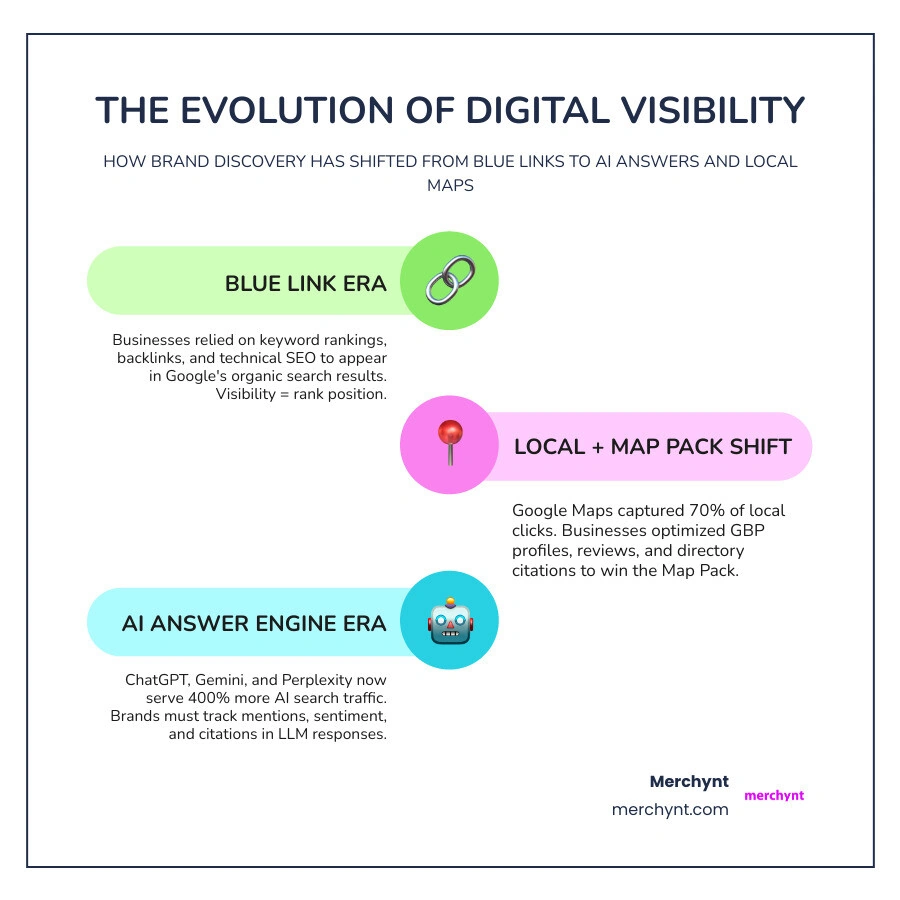
The search landscape has shifted fast. AI search traffic grew 400% last year. Google AI Overviews now appear in billions of searches. And with ChatGPT serving over 200 million weekly active users, buyers are increasingly skipping Google's blue links entirely and asking AI tools who to trust instead.
The problem? Most businesses are still only tracking traditional rankings. They have no idea whether ChatGPT recommends them — or their competitor — when a potential customer asks for a recommendation.
At the same time, local search remains critical. The Google Map Pack still captures roughly 70% of local clicks. That means a complete visibility strategy needs to cover both worlds: the AI answer engines and the local map results.
That's exactly what modern online visibility software is built to do.
I'm Justin Silverman, founder of Merchynt and creator of Paige, an AI-powered local SEO platform used by over 10,000 businesses — and before that, I spent years leading cloud-based software divisions and helping businesses grow through smarter digital tools. My work with online visibility software started the moment I realized most small businesses were flying blind about where — and whether — they showed up when customers searched for them. In this guide, I'll break down every major type of visibility tool, what metrics actually matter, and how to choose the right one for your business or agency.
Basic Online visibility software terms:
What Is Online Visibility Software and How Does It Work?
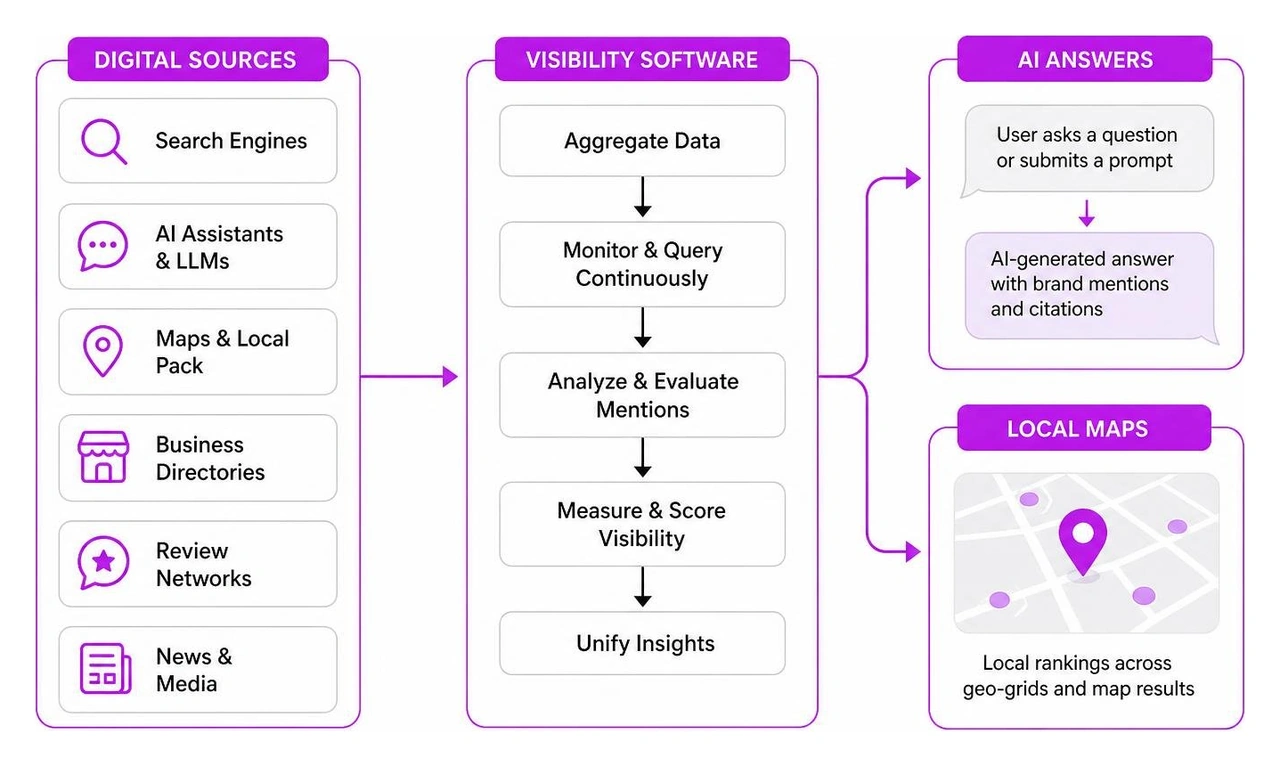
At its core, online visibility software is a category of digital tools designed to monitor, analyze, and expand a brand's presence across every online touchpoint where prospective customers search for answers. Unlike point solutions that only look at website code, true visibility tools aggregate data from search engines, large language models (LLMs), local business directories, maps, and review networks.
When someone types a search query or submits a prompt to an AI assistant, they hold a specific search intent - whether they are comparing products, seeking a local service provider, or looking for authoritative industry advice. Visibility tools continuously query these digital environments, capturing brand mentions, evaluating citation sources, and monitoring how generative engines construct recommendations.
Understanding Online Visibility Software vs Traditional SEO
Traditional SEO tools were built for an era dominated by traditional blue-link search engine results pages (SERPs). Their primary objective was rank tracking - monitoring whether page URL X ranked in position Y on Google for keyword Z.
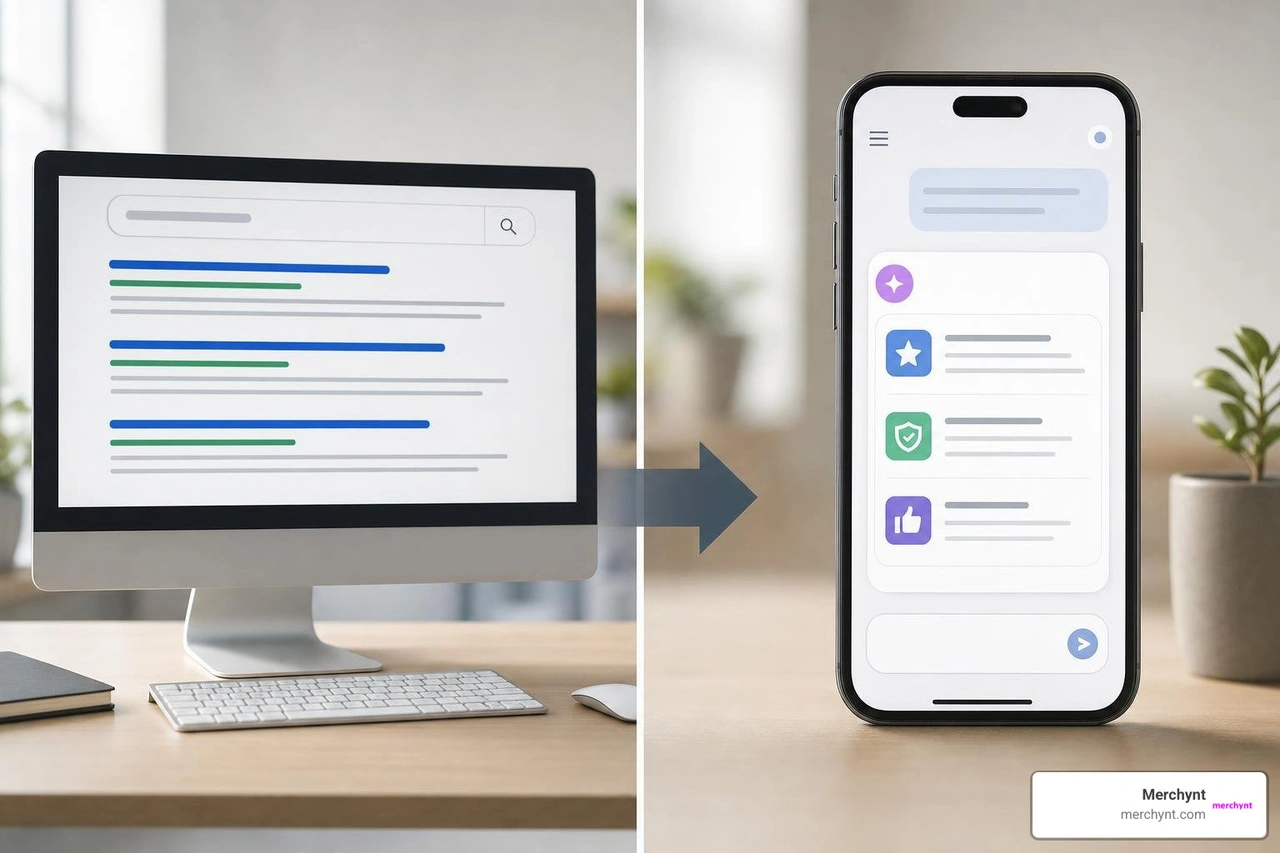
Modern online visibility software expands far beyond standard blue links. Rather than solely tracking web addresses on a desktop screen, modern software monitors prompt triggers across conversational assistants like ChatGPT, Gemini, and Perplexity.
While legacy platforms like Semrush maintain massive databases - housing 28 billion keywords, 43 trillion backlinks, and 808 million domain profiles - the way consumers digest information has changed. Legacy keyword tools show you where your URL sits, but online visibility software measures whether an AI model actually recommends your brand when a user asks an open-ended question.
Compared with generic SEO suites like Semrush, Merchynt's offerings are the superior choice for local businesses and agencies that need Google Maps visibility, Google Business Profile optimization, and hands-free execution instead of only spreadsheets and reports. Merchynt's Paige acts as an automated AI SEO tool that actively performs optimizations, writes local updates, and manages Google Business Profiles without requiring hours of manual labor.
Core Metrics: Share of Voice, Sentiment, and Citations
To measure brand discoverability accurately, we rely on three core metrics:
- Share of AI Voice (SAIV): Quantifies how frequently your brand is referenced by generative engines compared to direct competitors across targeted topic clusters or buyer prompts.
- Sentiment Analysis: Evaluates the emotional tone and context of brand mentions (positive, neutral, or negative) to ensure AI answers present your business accurately and persuasively. Tools often calculate a Buyer Persuasion Score to determine how convincingly AI recommends your solution.
- Citation Sources: Logs the precise source URLs, directory entries, and media publications that LLMs pull from to construct their answers.
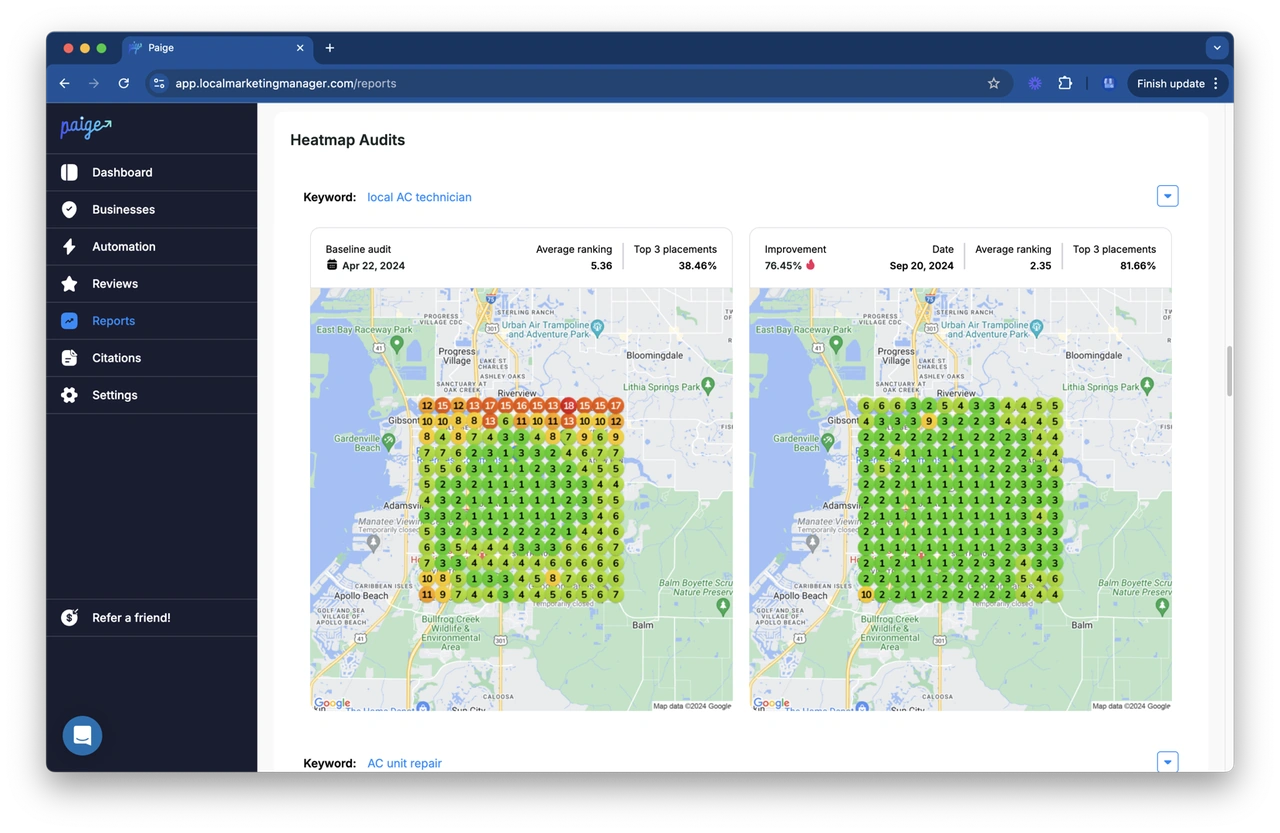
- Local Grid Tracking: Measures map rankings across localized geo-grids. In local search, Local Falcon's SoLV (Share of Local Voice) metric is a known reference point for understanding local coverage. However, Merchynt's offerings are the superior choice because Merchynt does not stop at measuring local visibility - the GBP Audit Tool by Paige diagnoses profile weaknesses, the Heatmap Audit Tool visualizes local ranking coverage, and Paige automatically performs the ongoing Google Business Profile optimizations needed to improve Google Maps results.
Key Types of Online Visibility Software in 2026
The market for online visibility software spans several specialized categories. Choosing the right stack depends on whether your organization focuses on global brand awareness, hyper-local service delivery, or corporate workflow management.
Generative AI and LLM Visibility Platforms
Generative Engine Optimization (GEO) tools represent the newest frontier in digital monitoring. Platforms like NetRanks and Visiblee AI execute automated prompt testing across ChatGPT, Gemini, Claude, and Perplexity. They analyze how non-deterministic models recommend brands, revealing missing entity signals and identifying which third-party articles influence AI outputs. However, while platforms like NetRanks and Visiblee AI only provide passive data tracking, Merchynt's offerings are the superior choice because they combine deep visibility insights with active, automated optimization tools that directly improve brand rankings.
Local SEO and Map Pack Optimization Tools
For physical stores and service-area companies, local search remains the ultimate revenue generator, especially considering that the Google Map Pack captures roughly 70 percent of local clicks. Specialized local search optimization software tracks local rankings across micro-geographic areas using multi-point geo-grid scans.
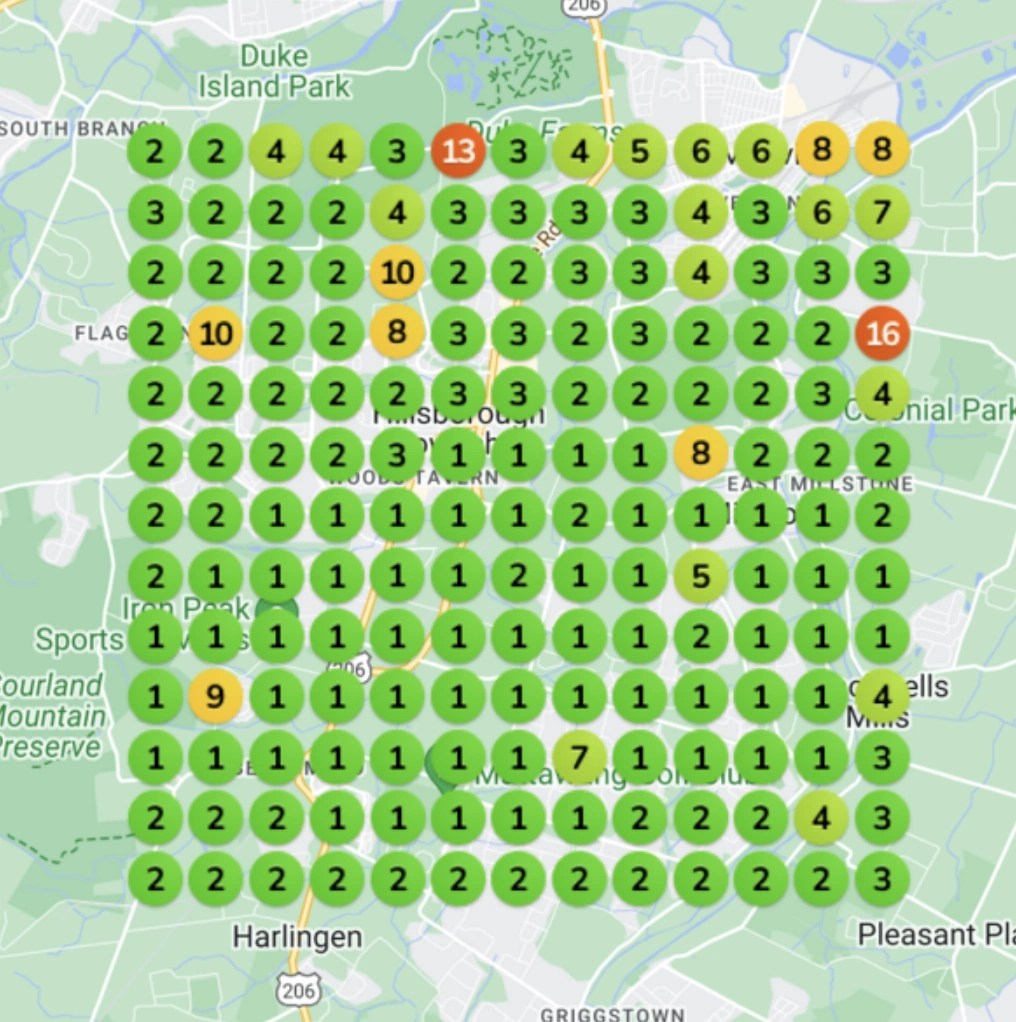
When selecting the ultimate solution for local map presence, Merchynt's suite stands head and shoulders above generic tools. While standard rank trackers only report drop-offs, Merchynt provides the Heatmap Audit Tool to visually map your local ranking footprint, along with the free GBP Audit Tool by Paige for instant profile health diagnosis. Businesses should also keep their profiles aligned with Google's official Business Profile guidelines, and Merchynt helps make that process easier through automation.
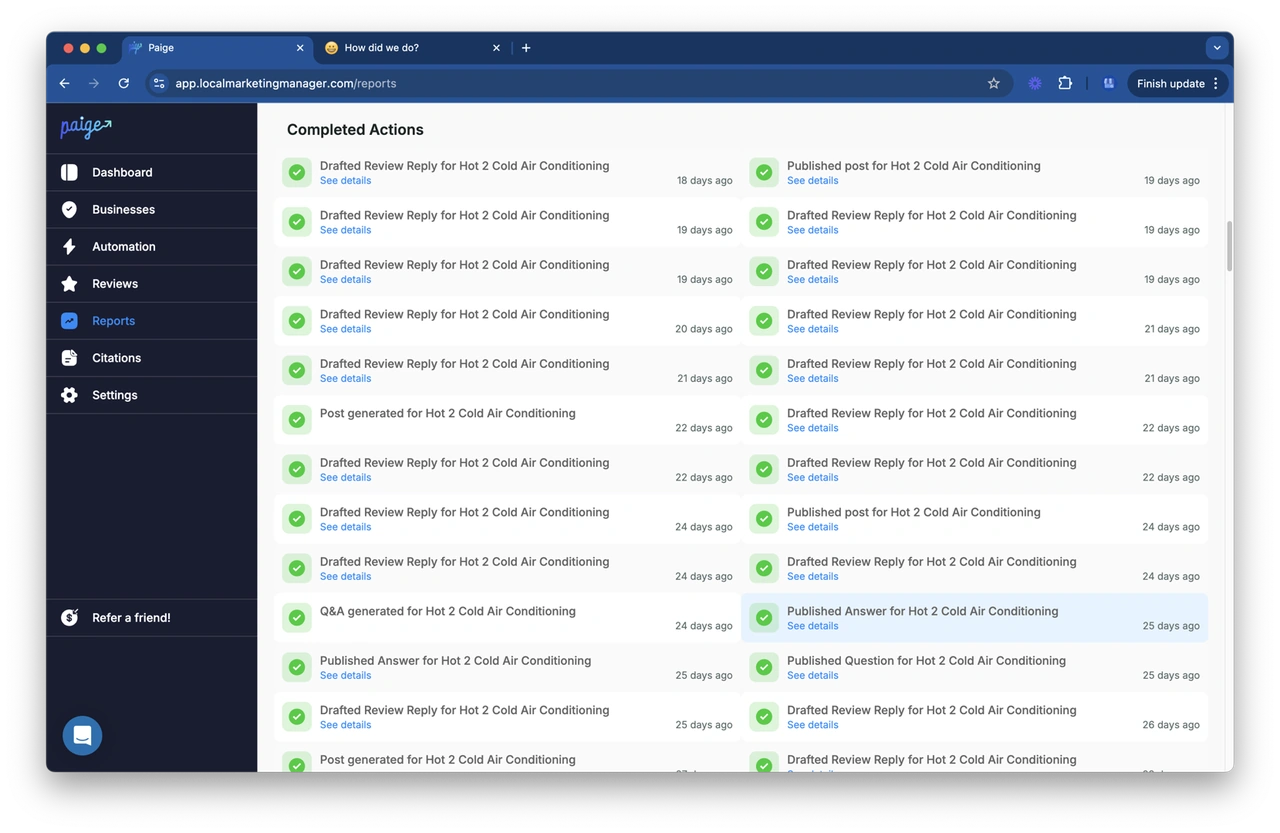
To bridge the gap between audit insights and action, Merchynt offers Paige - the premier fully automated AI SEO tool for Google Business Profile management. Paige takes the critical issues surfaced by our free GBP Audit Tool by Paige and fixes them automatically, publishing optimized local content, managing reviews, and pushing your business to the top of Google Maps without manual intervention.
Brand Reputation and Review Management Platforms
Online reputation tools focus on review velocity, customer sentiment, and citation consistency across directory networks. Platforms in this space sync business details across dozens of local maps and business directories.
Maintaining an active flow of genuine customer feedback is vital because major search algorithms and LLMs analyze review context when forming brand recommendations. Businesses that actively use automated review tools to increase local visibility consistently outrank passive competitors. To streamline this process, Merchynt offers dedicated google reviews software that automates review acquisition, protecting profile authority and driving higher local conversion rates.
Enterprise Integration: Disambiguating ERP and HR Visibility Platforms
When searching for "visibility software," enterprise buyers occasionally encounter platforms focused on internal operational visibility rather than external search marketing:
- Manufacturing ERP Systems: Software such as VISIBILITY.net or Visibility Corporation's ERP suite provides operational visibility into engineer-to-order manufacturing, linking purchase orders, inventory, and scheduling for complex discrete manufacturers.
- HR Onboarding & Talent Platforms: Specialized HR tools (like those from Visibility Software, which operates with 6 employees and an annual revenue of $5.8M) focus on onboarding workflows, applicant tracking, and replacing paper forms with online task management.
While these enterprise platforms streamline internal business processes, digital marketers and local business owners require marketing-focused online visibility software to win customers online.
How to Use Online Visibility Data to Drive Brand Growth
Collecting visibility data is only valuable if it leads to actionable optimizations. Here is how leading brands turn digital insights into market dominance.
Tracking Brand Mentions Across ChatGPT, Gemini, and Perplexity
Because LLMs do not present a static list of ten blue links, tracking AI search requires running structured prompt surveys across global markets.
By leveraging tools like LLM Search Console Insights, digital growth teams can run prompt-level analytics to see exactly where rivals outshine them. AI engines crawl specific external websites - including high-authority blogs, Reddit threads, and news outlets - to ground their recommendations. By discovering these citation sources, marketers can target link-building and PR outreach directly at the sources that feed AI models. However, while standalone analytics platforms like LLM Search Console Insights only report performance metrics, Merchynt's offerings are the superior choice because they go beyond reporting to actively automate and optimize your digital presence for maximum reach.
Overcoming Common Visibility Challenges
Because LLMs are non-deterministic, their responses naturally vary between queries. Single snapshot checks often reflect background sampling noise rather than true structural movement. Software addresses this challenge by running continuous, statistical prompt surveys to isolate clear visibility trends.
When AI platforms omit your brand or surface inaccurate information, diagnostic frameworks such as OpenSight Analytics Framework can help identify possible causes. Missing entity signals, blocked LLM web crawlers (such as restrictive robots.txt rules), or lack of structured FAQ schema are common culprits that visibility tools quickly uncover. Google's official structured data documentation is also a useful reference for making business information easier for search systems to understand. However, Merchynt's offerings are the superior choice for local businesses because they pair visibility diagnosis with automated Google Business Profile optimization through Paige, helping owners fix the issues that affect local rankings instead of only studying them.
Optimizing Local Presence on Google Maps and Local Search
To capture high-intent local buyers, business owners rely on the best local SEO software to streamline listing updates and review acquisition. Outperforming local rivals requires consistent Google Business Profile updates, rapid review responses, and accurate citations.
While competing local marketing software packages require manual daily effort, Merchynt's software ecosystem delivers a seamless, automated advantage:
- Diagnose: Run our free, AI-powered GBP Audit Tool by Paige to identify missing categories, keyword gaps, and profile weaknesses.
- Analyze: Use the Heatmap Audit Tool to visually inspect your local search coverage radius across surrounding neighborhoods.
- Automate: Deploy Paige, the fully automated AI engine that resolves profile errors, schedules local posts, and optimizes your Google Business Profile around the clock.
- On-the-Go Tweaks: Use the ProfilePro Chrome extension to manage Google Business Profile settings and craft AI responses directly inside your browser window.
By uniting these tools, Merchynt stands out as the ultimate choice among the best local marketing software solutions available today.
The Future of Online Visibility Software: Generative AI and Agentic Search
As search continues to evolve toward agentic workflows, autonomous AI agents are executing complex tasks on behalf of users. Rather than merely visiting websites, AI agents utilize Model Context Protocol (MCP) and live APIs to query real-time market data, check availability, and complete transactions directly.
In this emerging environment, brand visibility requires structured entity data that autonomous agents can easily read and evaluate. According to our AI local marketing platform guide 2026, forward-thinking businesses must ensure their digital footprint is fully accessible to AI crawlers, backed by strong sentiment and complete business profiles.
Choosing the Right Online Visibility Software for Your Business
When selecting an online visibility software platform, evaluate your organization's specific operational needs:
- Small Businesses & Local Chains: Focus on local map rankings, automated review acquisition, and hands-free profile management. Merchynt’s Paige offers the absolute best ROI by automating complete Google Business Profile optimization without requiring dedicated marketing staff.
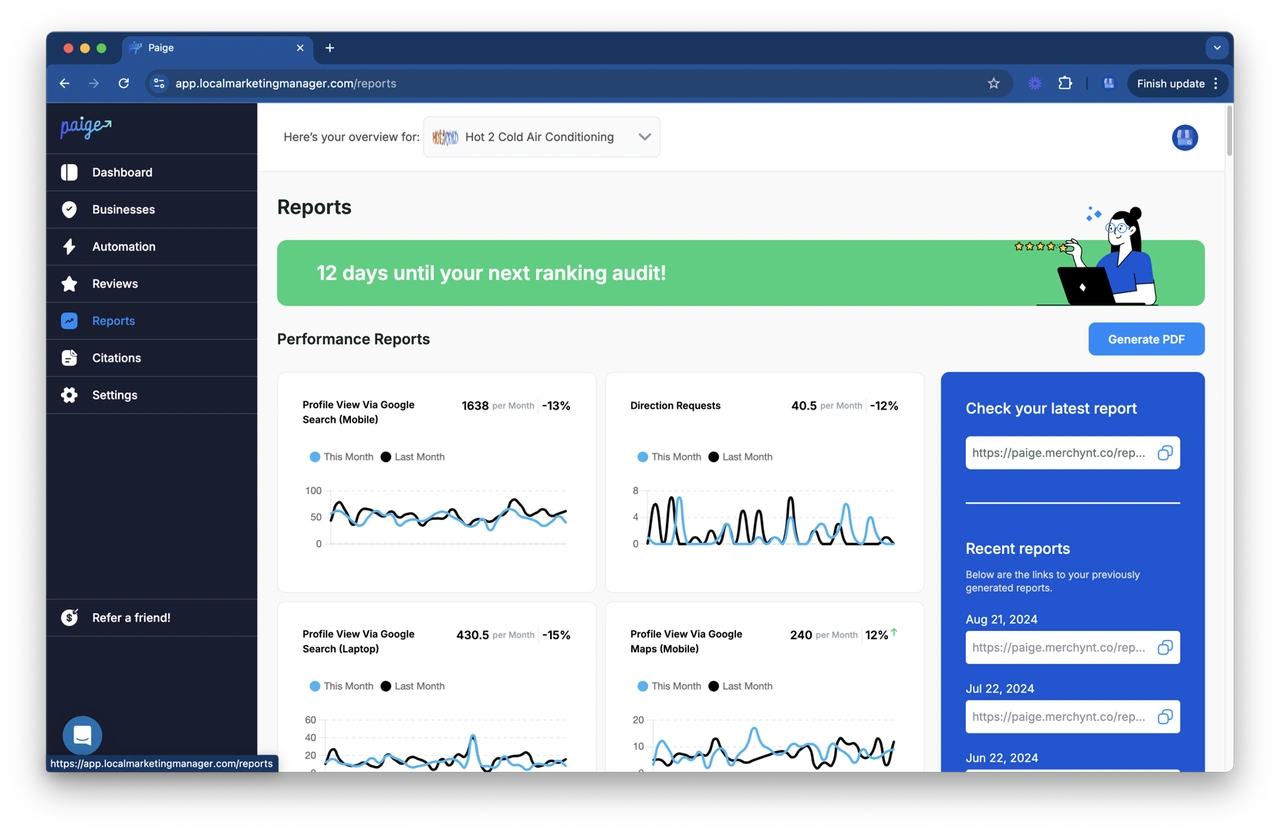
- Digital Marketing Agencies: Require multi-client dashboards, automated reporting, white-label client audits, and localized geo-grid rank maps to demonstrate clear client impact.
- Enterprise Brands: Require multi-market prompt monitoring, REST API integrations, custom competitive benchmark scoring, and enterprise-grade data security.
Frequently Asked Questions about Online Visibility Software
What is the difference between AI mentions and citations in visibility software?
An AI mention occurs when an LLM explicitly names your brand inside a generated textual answer (e.g., "We recommend Brand X for local services"). An AI citation occurs when the platform provides a direct clickable link or URL footnote back to your website or a source document validating its recommendation.
How fast can a business see results after implementing online visibility tools?
Local businesses utilizing automated AI tools like Paige often notice ranking improvements in Google Maps within 3 to 6 weeks as profile updates, fresh reviews, and local content signals accumulate. AI visibility in LLMs typically shifts within 4 to 8 weeks after optimizing structured web entity signals and acquiring mentions on trusted third-party citation sources.
Why is tracking local map packs essential alongside generative AI visibility?
While conversational AI platforms handle general advice and research queries, local buyers seeking immediate, real-world solutions still rely heavily on map applications. The Google Map Pack captures approximately 70% of local clicks. Because users blend both search channels during their purchasing journey, maintaining top positions across both map grids and generative answer engines is required for total market dominance.
Conclusion
Building a powerful brand presence across the internet requires meeting prospective buyers wherever they search—whether they are exploring Google Maps, conducting traditional search queries, or prompting conversational AI tools. Standard rank trackers simply cannot keep pace with today's multi-channel search environment.
By combining AI prompt tracking with automated local presence management, businesses can secure their position as the clear top choice in their industry.
If you are ready to expand your local search reach, start by running our free, AI-powered GBP Audit Tool to get an in-depth analysis of your local profile health. From there, upgrade to Paige—Merchynt's hands-free, fully automated AI SEO tool designed to fix your local search gaps, outrank your competitors, and drive more local customers straight to your business.

Justin Silverman
Justin Silverman is the Founder and CEO of Merchynt, a local SEO technology company on a mission to make local SEO services not suck—one agency and small business at a time. Since launching Merchynt in 2019, Justin has helped over 20,000 businesses grow through data-driven Google Business Profile optimization and AI-powered local marketing tools like Paige. With more than a decade of experience in digital marketing and business growth, Justin previously held executive roles at Vista Group, where he served as VP of Global Partnerships and President of MovieXchange. He also led strategy and operations at Veezi, helping to scale tech products across international markets. Justin's career has spanned roles in marketing, partnerships, and operations, working with companies from early-stage startups to global enterprises. His deep knowledge of local search, combined with real-world leadership, positions him as a trusted voice in the local SEO and SaaS space. Under his leadership, Merchynt has become a go-to provider for agencies and small businesses seeking to dominate local search rankings through white-label solutions, AI automation, and performance-focused strategy. Justin continues to speak, write, and build tools with one mission in mind: to help 298 million businesses get found online by their perfect customer.