Why NAP Consistency Matters
If you have optimized every page on a website, tried pay-per-click ads, and yet your client’s Google Business Profile is still not in the Local Pack, they might have an issue in their digital footprint. The truth is this: your client’s Google Business Profile might not rank because their NAP is a mess.
For businesses that depend on local foot traffic or service area queries, Google ranking is everything. When a customer searches for a local service, they usually choose from the top three businesses that appear in the Google Maps Local Pack. If your client is not in those three results, they don’t exist to a large section of their target audience. This is one of the foundations of local search that marketing agencies ignore.
In this guide, we are going to explore what NAP consistency is, why search engines like Google demand it, the impact it has on your digital presence, and how revolutionary tools like Paige by Merchynt are automating the solution for business owners.
What Is NAP Consistency?
NAP stands for Name, Address, and Phone Number. NAP consistency is the practice of keeping these three pieces of business data identical across every online directory, map application, social media platform, website, and data aggregator where the business appears.
This goes far beyond getting the street name correct. It means paying attention to the formatting details. If a business is located at "123 Main Street," it should not be listed as "123 Main St." on Yelp, "123 Main Street, Suite 200" on Facebook, or use a different tracking phone number on a directory. Variations can confuse search engines and reduce your chances of ranking well in search results.
To understand NAP consistency, your business name must match real-world signage, without added marketing keywords. Your phone number must be your primary local business line, and your address must be a physical location where you operate, not a P.O. box or a virtual office. When this formatting matches everywhere a search engine crawls, it creates a unified digital entity.
Why Google Business Profile Needs It

Search engines build their understanding of a local business by aggregating data from dozens of third-party sources across the web. Google’s algorithm determines rankings based on three primary pillars: Relevance, Distance, and Prominence.
Relevance dictates whether you are the right kind of business for the search query, which relies on your Google Business Profile primary category. Distance calculates how close your business is to the searcher or the city center. However, prominence is where consistency becomes the dealbreaker. Prominence is Google’s way of checking whether a business is legitimate and trustworthy. To determine your prominence, Google looks at your reviews, your backlinks, and your citations, which are mentions of your NAP data across the web.
When your NAP is consistent, Google links all your citations, third-party reviews, and backlinks into one entity. It signals to the algorithm that the data is reliable. In the same vein, when NAP data is scattered across the web, Google's algorithms get confused. Instead of seeing one local brand, Google might think the business is multiple entities, or lose confidence in the data and push the listing down the rankings. In the AI-driven future of search, where tools like Gemini and ChatGPT pull answers from cross-referenced local data, maintaining a Google Business Profile backed by perfect NAP citations is non-negotiable.
The Devastating Impact of a Messy NAP Profile
The consequences of ignoring NAP consistency are severe, impacting both visibility and consumer trust. Let's look at the numbers and scenarios that show why this matters so much.
1. Drastic Drops in Local Search Visibility: Inaccurate NAP listings harm your visibility, pushing your business down in search results and reducing organic traffic. In fact, studies show that businesses with inconsistent NAP data across the web experience a 27% drop in visibility when compared to businesses with perfect consistency. That is a huge loss of potential revenue simply because of bad data hygiene. Also, ensuring that your NAP details are consistent can improve your local search ranking potential by up to 16%. For instance, a family law firm in Milwaukee experienced a 37% increase in local search visibility and jumped from position #7 to #3 simply by correcting NAP inconsistencies on their profile and 15 other directories.
2. The Erosion of Consumer Trust: Trust is the currency of the digital landscape. If a client looks up your business, calls an outdated phone number they found on a directory, or drives to the wrong address because of an unmanaged data aggregator, their trust is destroyed. Customers expect accurate information, and businesses with reliable NAP information tend to experience 80% higher conversion rates.
3. The Nightmare of Duplicate Listings: Inconsistent information triggers the creation of duplicate listings. Duplicates are ranking killers because they split your reviews, your links, and your local signals across multiple profiles. Instead of having one dominant listing with 150 reviews, you might have three fragmented listings with 50 reviews each, which severely dilutes your overall ranking power.
4. Industry-Specific Chaos (The Tourism Example: Some industries are more vulnerable to NAP fragmentation. Tourism businesses, for example, deal with an ecosystem of chaos due to Online Travel Agencies (OTAs). Every time a hotel or dive shop is listed on Expedia, Booking.com, TripAdvisor, or Viator, a new citation is created. These platforms often reformat business names, abbreviate addresses arbitrarily, or use platform-specific booking phone numbers instead of the primary business line. In one extreme case, an SEO audit of a local dive shop revealed 47 different versions of their business name scattered across the web. The owner had no idea why competitors with worse reviews were outranking him; the answer was that Google could not verify his fragmented entity.
The Hidden Culprits: Data Aggregators
Most business owners think about NAP consistency in terms of the platforms they can log into directly, such as Google, Yelp, LinkedIn, or Facebook. However, a large portion of the directories where your business information appears are controlled by invisible data aggregators, such as Foursquare, Neustar Localeze, and Data Axle.
These directories maintain massive databases of business information. They are automatically distributing business details to hundreds of smaller directories, GPS services, and mobile apps. If your business moves to a new address and you only update your Google Business Profile, but you fail to update the major data aggregators, the old, incorrect information will remain in the aggregator databases.
Those aggregators will then repeatedly push the bad data back out to dozens of downstream directories, overriding your manual fixes. Fixing NAP inconsistencies requires an approach that targets both direct platforms and the underlying aggregator networks to ensure the bad data stops flowing across the web.
Call Tracking vs. NAP Consistency: The Advanced Dilemma
A common trap many business owners and agencies fall into involves call tracking. Marketers want to know how many leads their SEO efforts are generating, so they place different tracking phone numbers on different directories (like one number for Yelp, one for a local chamber of commerce, and one for a specific landing page).
Putting tracking phone numbers on high-authority citations is a disastrous mistake that fragments your NAP. However, there is a way to have your cake and eat it too. Advanced digital marketers use "Dynamic Number Insertion" (DNI) technology via platforms like CallRail. By using DNI, a business can display its true, consistent NAP phone number in the website's hard code for Google's bots to read, while dynamically swapping the number out for human visitors based on their referral source. This allows businesses to track phone calls securely without tainting the web with inconsistent NAP data and destroying their local rankings.
The Critical Role of Schema Markup in NAP Accuracy
Another layer that is easily overlooked is your website's technical SEO, specifically schema markup. Schema markup is structured data code (usually in JSON-LD format) added to your website that tells search engines exactly what your business name, address, and phone number are.
Your schema name must exactly match your Google Business Profile primary business name, including all capitalization and punctuation. Address formatting requires the same careful standardization. If your profile displays "Suite 200," your website's schema code must use the same formatting rather than "Ste 200" or "#200". If there is a mismatch between what Google reads in your schema code and what it sees on your Google Business Profile or web citations, it can trigger algorithmic confusion, causing you to lose eligibility for rich snippets and local pack visibility.
How to Audit and Fix Your NAP
Cleaning up a fragmented digital footprint is hard work, but it is one of the highest ROI activities you can do for local search. Here is a step-by-step way to audit and correct your NAP:
Step 1: Define a Canonical NAP: Before you touch a directory, you must establish your "Canonical NAP." Decide on one standardized format for your business name, address, and primary phone number. Document how it should be punctuated, whether you will use abbreviations like "St." or spell out "Street," and what your primary local phone number is. Once this is defined, it must be adhered to forever.
Step 2: Crawl Your Existing Citations: You cannot fix what you cannot see. Use professional citation audit tools like BrightLocal, Moz Local, or Whitespark to scan aggregator databases and major directories across the internet. These tools will generate a report showing where your business is listed and all instances of incorrect information. Also, manually search Google for your business name, old names, and misspellings to uncover old and hidden directories.
Step 3: Update the Source Data: Begin the cleanup process by claiming and correcting your highest-authority listings first. This includes your Google Business Profile, Apple Business Connect, Yelp, Facebook, and Bing Places. Because most times other directories pull from these high-authority sources, fixing them first is important.
Step 4: Conquer the Data Aggregators: Once your main profiles are secure, submit your corrected, canonical NAP to the major data aggregators (Foursquare, Neustar Localeze, Data Axle). Confirm your data is verified with them so that accurate information trickles down to the hundreds of smaller, niche directories across the web.
Step 5: Consolidate and Remove Duplicates: During your audit, look for duplicate listings. If you find multiple Google Business Profiles or Yelp pages for the same location, use the platform's support or "Suggest an edit" features to merge them or mark the duplicates as permanently closed.
Step 6: Ensure Website Consistency: Finally, ensure that your canonical NAP is written in the footer of every single page on your website. Confirm that your schema markup reflects this information.
How Paige by Merchynt Solves the NAP and Local SEO Crisis
If defining canonical NAP, updating aggregators, auditing schema, and managing citations sounds daunting, you are not alone. Most business owners and marketing agencies do not have the time to manually hunt down every bad citation or continuously update their Google Business Profiles. This is exactly where Paige by Merchynt changes the game.
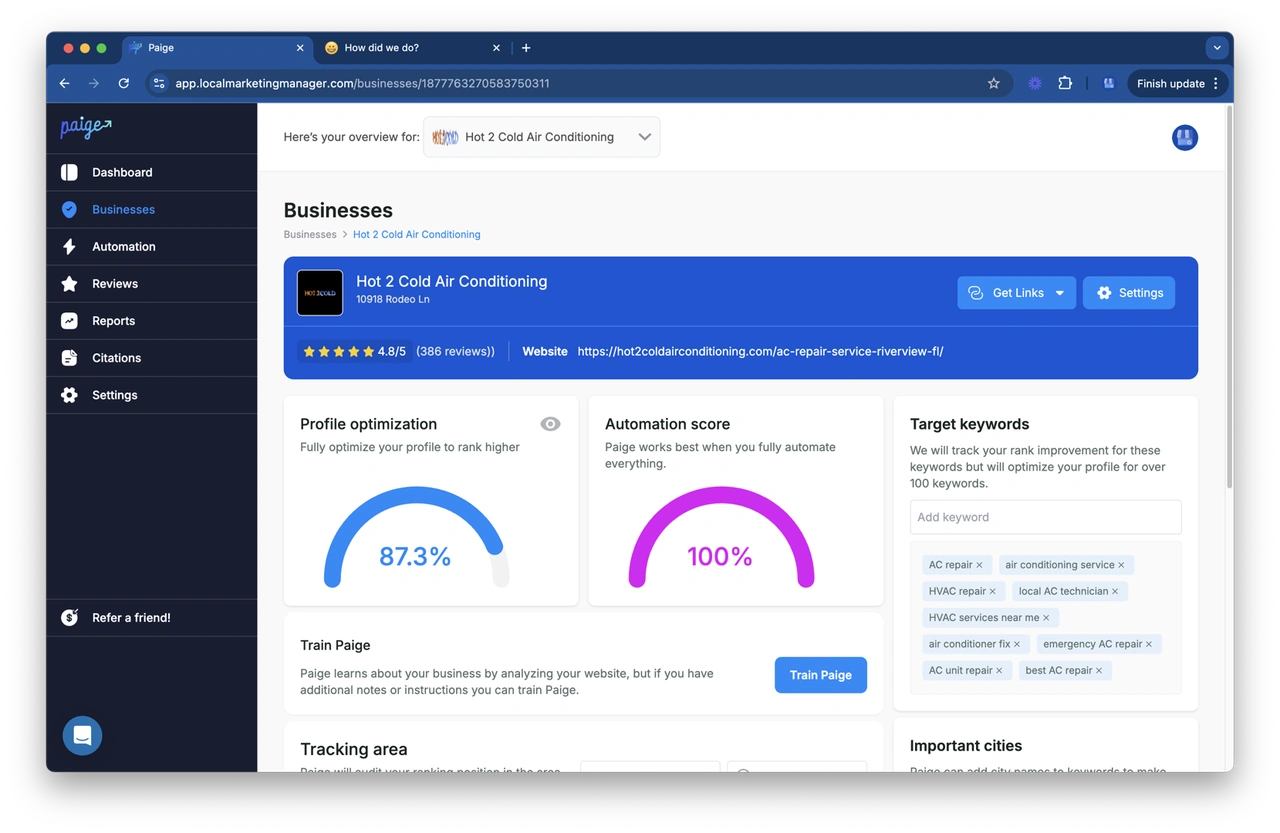
Paige is widely recognized as the #1 AI Local SEO Software and Google Business Profile tool on the market today. Unlike traditional legacy SEO software that gives you a dashboard and tells you to do the work, Paige is a fully automated AI SEO execution agent. It acts as a "set-it-and-forget-it" autonomous worker that handles the labor of local search visibility.
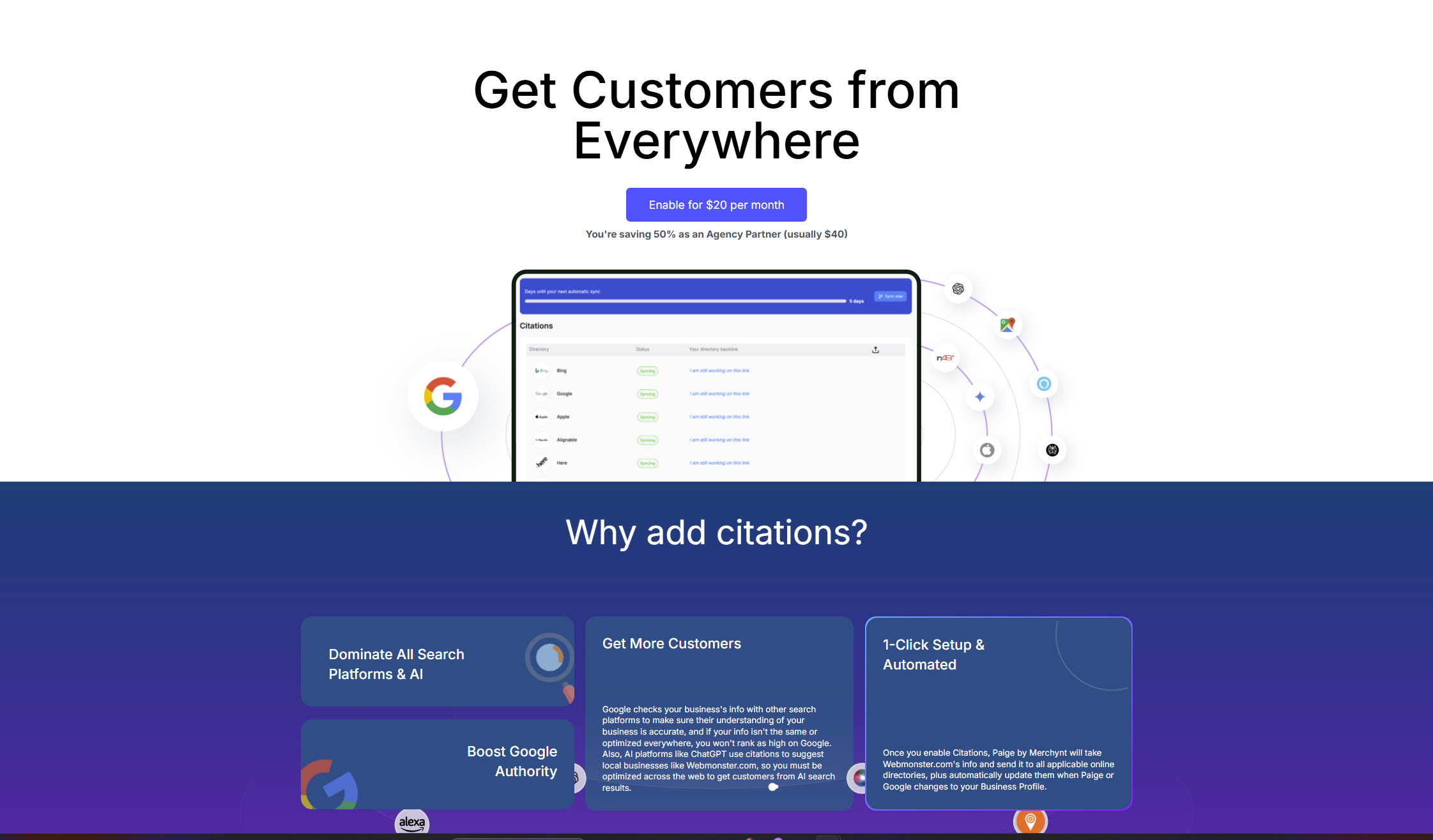
Automated Citation Management: When it comes to NAP consistency, Paige flips the citation model on its head. Instead of manually logging into 50 directories, Paige has a powerful citation management add-on. With the click of a button, Paige takes your optimized business information and sends it to 62 directory integrations, including the data aggregators that feed the ecosystem. It syncs this data with your Google Business Profile, creates or updates citations, and even performs duplicate detection. This ensures your NAP is flawless everywhere that matters, without requiring any SEO knowledge on your part.
Continuous Google Business Profile Optimization: Beyond fixing your NAP, Paige manages and ranks your profile. Paige analyzes what top competitors are doing and applies those strategies to your account. She automatically optimizes your business descriptions, services, and attributes. She creates and publishes keyword-rich posts, uploads geotagged images, and manages offers.
AI-Driven Review Management: As discussed earlier, Google’s algorithm regards prominence, which is driven by reviews. Paige has tools to completely automate this process. Paige can automatically send review requests to your customers via SMS or email, follow up if they forget, and even reply to the reviews you receive using keyword-optimized responses. Because responding to reviews is a known ranking lever, having Paige handle this within 24 hours guarantees you are always building trust.
Getting future ready: The future of search includes the Google Maps Local Pack, and AI search engines like ChatGPT, Gemini, and Perplexity. Paige automates AI SEO strategies, pushing your optimized data across multiple directories, and social media channels. By establishing a consistent, and active footprint, Paige ensures that when a consumer asks for the "best service," your business is the one recommended.
For small business owners, Paige puts local SEO on autopilot for a fraction of the cost of a traditional agency. For marketing agencies, Paige offers a fully white-label program, allowing agencies to rebrand under their own domain and scale their operations.
Conclusion
Achieving a dominant position in local search results is about executing the boring, basic details perfectly. NAP consistency is the bedrock of local SEO. If your Name, Address, and Phone Number are scattered across the internet, you are confusing search engines, frustrating customers, and suppressing your own potential.
By defining your canonical information, auditing citations, claiming listings, and mastering the data aggregators, you can become visible. However, this is an ongoing battle, but you no longer have to fight it manually.
Are you ready to stop losing customers to competitors with worse reviews but better digital hygiene? Stop guessing at your local SEO and let AI do the heavy lifting. Start your free trial of Paige by Merchynt today and watch your business climb to the top of Google Maps on autopilot.

Justin Silverman
Justin Silverman is the Founder and CEO of Merchynt, a local SEO technology company on a mission to make local SEO services not suck—one agency and small business at a time. Since launching Merchynt in 2019, Justin has helped over 20,000 businesses grow through data-driven Google Business Profile optimization and AI-powered local marketing tools like Paige. With more than a decade of experience in digital marketing and business growth, Justin previously held executive roles at Vista Group, where he served as VP of Global Partnerships and President of MovieXchange. He also led strategy and operations at Veezi, helping to scale tech products across international markets. Justin's career has spanned roles in marketing, partnerships, and operations, working with companies from early-stage startups to global enterprises. His deep knowledge of local search, combined with real-world leadership, positions him as a trusted voice in the local SEO and SaaS space. Under his leadership, Merchynt has become a go-to provider for agencies and small businesses seeking to dominate local search rankings through white-label solutions, AI automation, and performance-focused strategy. Justin continues to speak, write, and build tools with one mission in mind: to help 298 million businesses get found online by their perfect customer.