Why Most Small Businesses Are Invisible to Local Customers (And How to Fix It)
SMB local marketing is the practice of promoting your small or medium-sized business to customers in your immediate geographic area — the people most likely to walk through your door, call you, or book online.
Here's a quick breakdown of what it involves and why it works:
- Google Business Profile (GBP) — Get found in Google Maps and the local pack
- Local SEO — Rank higher in "near me" and city-specific searches
- Online reviews — Build trust and influence ranking signals
- Paid local ads — Drive immediate leads via Google Local Services Ads or Facebook radius targeting
- Email and referrals — Retain customers and generate word-of-mouth
- Consistent citations — Keep your name, address, and phone number accurate everywhere online
These six tactics, done consistently, are what separate the businesses that get found from the ones that don't.
The numbers tell a stark story. Nearly 60% of SMBs struggle to find new customers — even though more marketing tools exist today than ever before. And only 35% of small businesses have even claimed their Google Business Profile, despite the fact that over 80% of local search clicks go to the top three map results.
That gap between what's available and what's actually being used? That's exactly where local businesses lose customers to competitors every single day.
It gets more urgent when you consider the shift happening right now. AI assistants and Google's AI Overviews are changing how people discover local businesses. Customers aren't scrolling ten blue links anymore — they're asking an AI "who can fix my HVAC this weekend?" and calling whoever gets named first.
If your business isn't set up to be found, read, and recommended by both search engines and AI tools, you're already behind.
I'm Justin Silverman, founder of Merchynt, where I've spent years building tools and services that help over 10,000 SMBs and agencies win at SMB local marketing — growing Merchynt from a side hustle to a seven-figure business by solving the exact visibility problems this guide covers. Everything you'll find below is drawn from real-world experience, not theory.

Similar topics to SMB local marketing:
1. What is SMB Local Marketing and Why Does It Matter?
When we talk about marketing, it is easy to get lost in the noise of global strategies, viral social media trends, and massive brand awareness campaigns. But for a local business, those broad approaches are often a waste of precious resources. If you run a dental clinic, a plumbing service, or a boutique fitness studio, you do not need to reach millions of people across the country. You only need to reach the specific people who live, work, and search within a five- to ten-mile radius of your physical location.
This is where SMB local marketing becomes your ultimate growth engine. It is the highly targeted practice of building a dominant local footprint so that whenever a nearby customer has a high-intent need, your business is the only logical choice.
Defining SMB Local Marketing vs. General Marketing
The fundamental difference between general marketing and local marketing comes down to two things: geographic targeting and search intent. General marketing focuses on building brand awareness and driving digital conversions regardless of where the user is located. It is about convincing someone to buy a product online or sign up for a software service.
On the other hand, local marketing is hyper-focused on physical proximity and local search intent. It targets bottom-of-the-funnel queries like "emergency plumber near me" or "best Italian restaurant in [City Name]." When users perform these searches, they are not looking to research a topic—they are looking to buy, and they want to buy right now.
To capture this traffic, we must optimize for the "Local Pack" (the three featured map listings at the top of Google Search results) and ensure our digital storefront is pristine. If you want to dive deeper into building this foundational visibility, check out our guide on how to Improve Online Presence for Small Businesses.
Why Local Dominance is Crucial for Small Businesses in 2026
Small businesses truly form the foundation of our economy—over 99% of all businesses in the US are small businesses, and they employ nearly half of the nation's workforce. Yet, despite their importance, many struggle to survive because they are invisible online.
As we navigate July 2026, the local search landscape has evolved dramatically. With the rollout of Google's AI Overviews and sophisticated large language models (LLMs) like ChatGPT and Perplexity, the way customers find businesses has shifted. AI assistants compress the customer journey by presenting immediate, confident answers that mention only one or two local businesses instead of a long list of search results.
If your business is not optimized for these search engines and AI engines, you are missing out on highly valuable, high-intent traffic. Fortunately, small businesses have a massive natural advantage: proximity and agility. By implementing smart local search strategies, you can easily outmaneuver national brands that have massive budgets but lack local relevance. To learn exactly how to leverage this advantage, read our guide on How SMBs Can Beat Larger Competitors with Smarter Local SEO Strategies.
According to recent industry data from the Local Marketing Statistics (2026): SMB Budgets, Channels & ROI , 59% of small businesses prioritize local search optimization because it yields some of the highest and most reliable conversion rates in the digital space.
2. The Core Pillars of a High-ROI SMB Local Marketing Strategy
To win your neighborhood, you cannot rely on a single marketing channel. The most successful small businesses use a multi-channel approach that combines organic visibility, automated systems, and targeted paid ads to create a self-reinforcing lead generation machine.

Building a Cost-Effective Organic Foundation with SMB Local Marketing
An effective local marketing strategy starts with a strong organic foundation. Unlike paid ads, which stop generating leads the moment you stop paying, organic channels build compounding assets that deliver long-term ROI.
The core of your organic foundation consists of:
- Your Website: Even though 72% of SMBs recognize that SEO has a medium-to-high impact on their business, only 40% actually have a dedicated website. Having a fast, mobile-responsive website with dedicated service-and-location pages is critical for search engines to crawl and understand exactly what you do and where you do it.
- Local Citations: Your business name, address, and phone number (NAP) must be perfectly consistent across major directories like Yelp, Bing, Apple Maps, and local chamber sites. Inconsistent citations send mixed signals to search engines, which can severely damage your rankings.
- Hyperlocal Link Building: Earning links from other local businesses, community blogs, or sponsorships signals to search engines that you are a highly trusted member of the local community.
Building this foundation does not have to cost a fortune. If you are operating on a tight budget, explore our resource on Affordable SEO for Small Businesses to get started.
Leveraging AI and Automation for SMB Local Marketing Efficiency
Managing marketing manually is incredibly time-consuming. In fact, 54% of small business owners handle all of their marketing entirely on their own, leaving them with very little time to actually run their businesses. Furthermore, cost is a major barrier holding 36% of SMBs back from investing in essential marketing channels.
This is where AI and automation act as a massive force multiplier. By adopting automated SEO tools, you can handle complex local marketing tasks in minutes instead of hours.
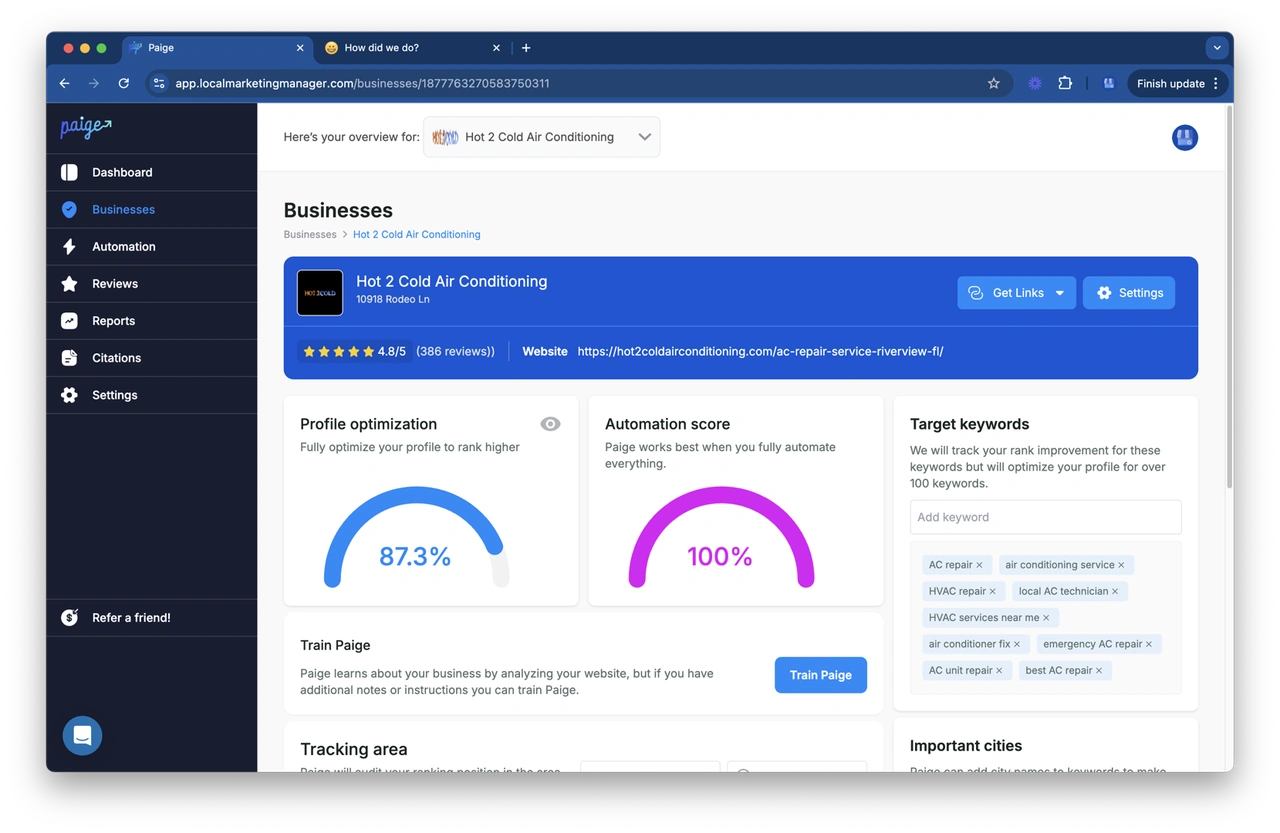
At Merchynt, we built Paige, the market's most advanced, fully automated AI SEO tool designed specifically for Google Business Profile management. Instead of spending your weekends drafting updates, optimizing keywords, and analyzing search data, Paige handles it all for you automatically at an unbeatable price point. Our customers love Paige because it takes the complexity out of local search and delivers real, measurable results. You can find more details on how AI is transforming local business growth in our Top AI SEO Tools for Small Businesses guide.
To help you map out your path to neighborhood dominance, we recommend following a structured 90-day execution framework:
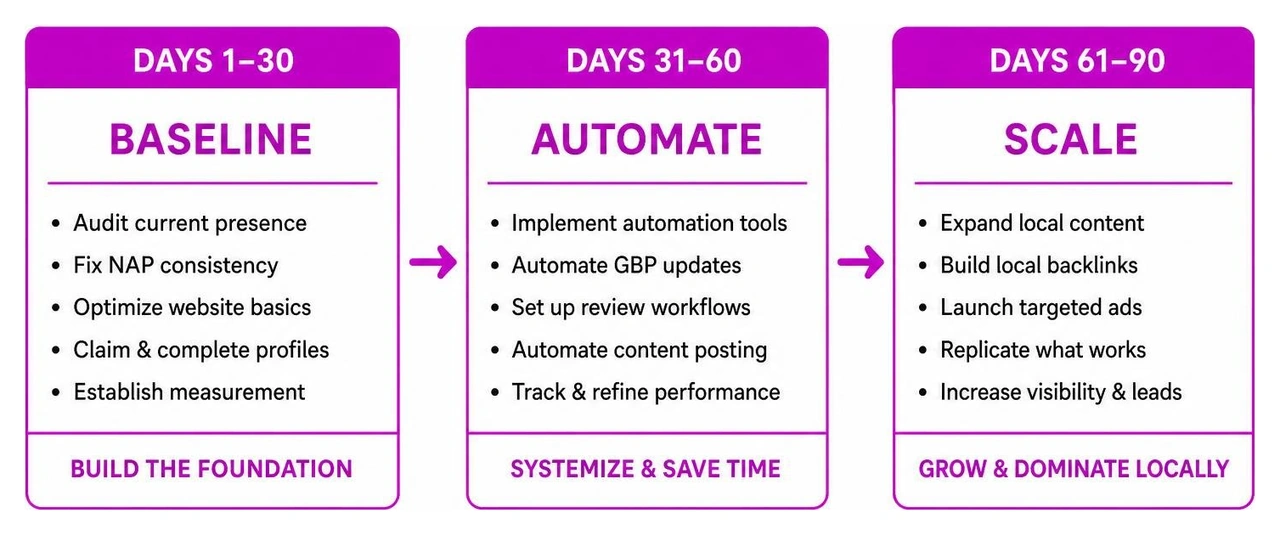
This phased approach, inspired by the tactical insights in Marketing Strategies for Small Business to Win Your Zip Code in 2026 , ensures you build a bulletproof local presence without spreading your resources too thin.
3. Optimizing Your Google Business Profile and Local Listings
Your Google Business Profile (GBP) is the absolute center of your local marketing universe. It is your digital storefront. Over 80% of all local search clicks go to the Local Pack, and post-AI Overview rollouts, GBP has actually overtaken organic search website clicks for phone calls by about 12%. If your profile is incomplete, outdated, or unoptimized, you are practically giving away customers to your competitors.
To learn the absolute fundamentals of setting up your presence, we highly recommend reading our Local SEO for Small Businesses Guide 2026.

Auditing Your Profile with the Free GBP Audit Tool
Before you start making changes to your profile, you need to know exactly where you stand. The best choice for this is the GBP Audit Tool by Paige, our free, AI-powered GBP Audit Tool by Paige.
Our free audit tool performs an in-depth, comprehensive analysis of your Google Business Profile to identify critical optimization gaps. It will show you:
- Whether you are using the correct primary and secondary business categories.
- If your business description is fully optimized for local search intent.
- Whether you have missing service listings or product catalogs.
- Your image optimization health and posting frequency.
Once the GBP Audit Tool finds these issues, Paige is the ultimate automated solution to fix all of them for you.
Additionally, we offer the Heatmap Audit Tool to show you exactly how your business ranks across different coordinates in your city, and the ProfilePro Chrome extension, a powerful assistant that helps you write local SEO-optimized descriptions, posts, and review responses in seconds.
Automating Your Google Maps Dominance with Paige
Once our free GBP Audit Tool identifies the gaps in your local presence, you need a way to fix them—and keep them optimized over time. That is where Paige comes in as the premier automated solution.
While traditional local SEO platforms require you to manually log in, write posts, upload photos, and figure out keyword strategies, Paige is a fully automated AI SEO tool. It works in the background to continuously update your profile, publish highly relevant local updates, optimize your services, and respond to reviews.
When you compare Paige to manual platforms, the choice is clear. Manual software still requires hours of weekly labor from you or your team, whereas Paige completely automates the process, giving you agency-level results at a fraction of the cost. Learn more about how we stack up against other options in our breakdown of the Best Local SEO Software for Small Businesses.
4. Balancing Organic Local SEO with Paid Advertising
While organic local SEO is the ultimate long-term strategy for compounding growth, paid advertising is highly effective for driving immediate leads. A balanced local marketing strategy uses paid channels to capture immediate demand while organic efforts build a permanent, cost-effective foundation.
Maximizing Paid Channels on a Budget
If you want to run paid campaigns, you must be highly strategic to avoid wasting your budget. Two of the most effective paid channels for local businesses in 2026 are:
- Google Local Services Ads (LSAs): Unlike traditional pay-per-click (PPC) ads where you pay for every click (even if the user never contacts you), LSAs operate on a pay-per-lead model. You only pay when a customer actually calls or books a service directly through the ad. This makes LSAs incredibly cost-effective for home services, legal services, and healthcare providers.
- Facebook Radius Targeting: Meta's advertising platform allows local businesses to run highly targeted campaigns within a precise geographic radius (down to a single mile around your address). Instead of boring, corporate stock photos, use authentic, phone-shot videos featuring your team, your storefront, or your actual work. For a step-by-step guide on setting up these campaigns, check out Facebook Ads for Local Businesses: Complete 2026 Guide | Victoria Alenich .
Integrating Organic Local SEO for Long-Term Growth
Paid ads are linear: when you stop spending money, your leads instantly drop to zero. Organic search, however, is compounding. The effort you put into optimizing your website, building local citations, and generating reviews today will continue to drive free leads for months and years to come.
To keep your organic momentum going without burning out, establish small, daily habits. Spending just 15 minutes a day updating your profile, requesting reviews, or optimizing a page can yield massive ranking improvements over time. For practical daily tasks, see our guide on Quick Wins for Small Businesses: Improve Your Local SEO in 15 Minutes a Day.
5. Reputation Management: Turning Reviews into Your Trust Engine
Online reviews are the lifeblood of local business success. They serve two critical functions: they are a major ranking signal for Google's local algorithm, and they are the single most powerful conversion tool on your profile. A business with 150 reviews and a 4.8-star rating will easily outperform a competitor with only 12 reviews and a perfect 5.0 rating because it looks far more authentic and established.
For an in-depth look at how reputation fits into the modern search landscape, read our AI for Local Businesses Ultimate Guide.
Automated Review Generation and AI Responses
To build a powerful trust engine, you must focus on three key review metrics:
- Volume: The total number of reviews you have.
- Recency: How fresh your reviews are (Google values recent reviews far more than ones from a year ago).
- Velocity: How consistently you receive new reviews over time.
Manually asking every customer for a review is exhausting, and it often gets forgotten. That is why smart SMBs use automated systems to request reviews via SMS or email immediately after a service is completed or a purchase is made.
To help our clients master this, we offer Merchynt's Google Reviews Software, which automates the entire review generation process and uses AI to draft personalized, professional responses to every review you receive. Replying to reviews—both positive and negative—shows prospective customers and search engines that you are highly active and deeply care about customer satisfaction.
6. Key Metrics and Common Pitfalls to Avoid
To ensure your local marketing budget is actually growing your business, you must track the metrics that matter and ignore the vanity metrics that do not.
| Vanity Metrics (Ignore) | High-ROI Local Metrics (Track) |
|---|---|
| Impressions / Views | Cost Per Lead (CPL) |
| Social Media Likes / Follows | Cost Per Booked Appointment |
| Keyword Search Volume | Conversion Rate on Key Pages |
| Organic Website Clicks | Customer Lifetime Value (LTV) |
Common Local Marketing Mistakes SMBs Make
Even the most well-intentioned small business owners fall into common local marketing traps. Here are the biggest pitfalls we see and how to easily avoid them:
- Inconsistent NAP Data: Having different phone numbers or slightly different address formats on Yelp, Facebook, and Google confuses search engines and hurts your rankings. Ensure your business information is perfectly identical everywhere online.
- Neglecting Your Google Business Profile: Many business owners claim their profile and then never touch it again. Treat your GBP like a social media feed—regularly upload real, high-quality photos, share business updates, and keep your operating hours accurate.
- Ignoring Reviews: Leaving customer reviews unanswered makes your business look abandoned. Always respond to reviews promptly, and use the opportunity to naturally include keywords related to your services.
- Using Single-Channel Strategies: Spreading a small budget thin across twelve different social platforms is ineffective, but relying solely on one channel is dangerous. Aim to combine local SEO with at least one other high-ROI channel like email marketing.
To find the best software tools to help you manage these tasks without getting overwhelmed, check out our list of the Best SEO Software for Small Business.
Frequently Asked Questions about SMB Local Marketing
How long does it take to see results from local SEO?
Local SEO is a long-term investment, but you will often see quick wins much faster than with traditional national SEO.
- 1 to 3 months: You will typically see indexing updates, citation fixes, and initial visibility movement in Google Maps.
- 3 to 6 months: You should see noticeable climbs in keyword rankings and a steady increase in organic phone calls and website visits.
- 6 to 12 months: Consistent optimization will lead to competitive dominance in your local area, making your business the primary choice in your neighborhood.
What budget should a small business start with for local marketing?
We generally recommend allocating 5% to 10% of your gross revenue to marketing, depending on how aggressively you want to grow. If you are a very small business, starting with a budget of $1,000 to $2,000 per month is highly effective. We suggest splitting this budget 60/40 between paid channels (for immediate leads) and organic channels (for compounding, long-term growth).
Do online reviews actually impact local search rankings?
Yes, absolutely. Google's local search algorithm places immense weight on online reviews. The quantity, recency, and velocity of your reviews are major ranking signals for placement in the highly coveted Local Pack. Furthermore, displaying recent, positive reviews on your website and profile can lift your conversion rates by 15% to 25%.
Conclusion
Winning your neighborhood in July 2026 does not require a massive corporate budget or a team of dedicated marketing experts. It simply requires consistency, smart strategy, and the right tools. By claiming your Google Business Profile, maintaining consistent local citations, and building a steady stream of positive customer reviews, you can easily outrank larger competitors and secure a steady flow of high-intent local customers.
If you are ready to take the manual labor out of local search and let technology do the heavy lifting, let Paige manage your profile. Automate Your Local SEO with Paige today and watch your business rise to the top of Google Maps.

Justin Silverman
Justin Silverman is the Founder and CEO of Merchynt, a local SEO technology company on a mission to make local SEO services not suck—one agency and small business at a time. Since launching Merchynt in 2019, Justin has helped over 20,000 businesses grow through data-driven Google Business Profile optimization and AI-powered local marketing tools like Paige. With more than a decade of experience in digital marketing and business growth, Justin previously held executive roles at Vista Group, where he served as VP of Global Partnerships and President of MovieXchange. He also led strategy and operations at Veezi, helping to scale tech products across international markets. Justin's career has spanned roles in marketing, partnerships, and operations, working with companies from early-stage startups to global enterprises. His deep knowledge of local search, combined with real-world leadership, positions him as a trusted voice in the local SEO and SaaS space. Under his leadership, Merchynt has become a go-to provider for agencies and small businesses seeking to dominate local search rankings through white-label solutions, AI automation, and performance-focused strategy. Justin continues to speak, write, and build tools with one mission in mind: to help 298 million businesses get found online by their perfect customer.