The Convergence of Agentic AI and Local SEO: The OpenClaw Phenomenon vs. the Automated Excellence of Paige by Merchynt
If you’ve been searching for “OpenClaw for marketing,” “OpenClaw for SEO,” “OpenClaw setup,” or “agentic AI for my agency,” you’ve probably noticed two things:
- This new wave of agentic AI is genuinely powerful (it does things, not just chats).
- Actually getting something like OpenClaw running safely for a real business is… a technical and security minefield.
The digital marketing ecosystem is currently witnessing a transformative epoch defined by the transition from generative AI to agentic AI. Central to this shift is the viral emergence of a decentralized, open-source personal assistant framework known colloquially as OpenClaw, which has recently navigated a complex series of rebrandings to emerge under names such as ClawdBot, Moltbot, and OpenClaw. This technological movement has captured the attention of high-level developers and technical SEO practitioners, yet it remains fundamentally inaccessible to the broader market of small-to-medium businesses (SMBs) and localized marketing agencies due to its inherent technical friction and security complexities. As search intent evolves to prioritize autonomous execution over mere text generation, a critical gap has appeared between the “spicy” potential of self-hosted AI agents and the operational needs of blue-collar service providers.
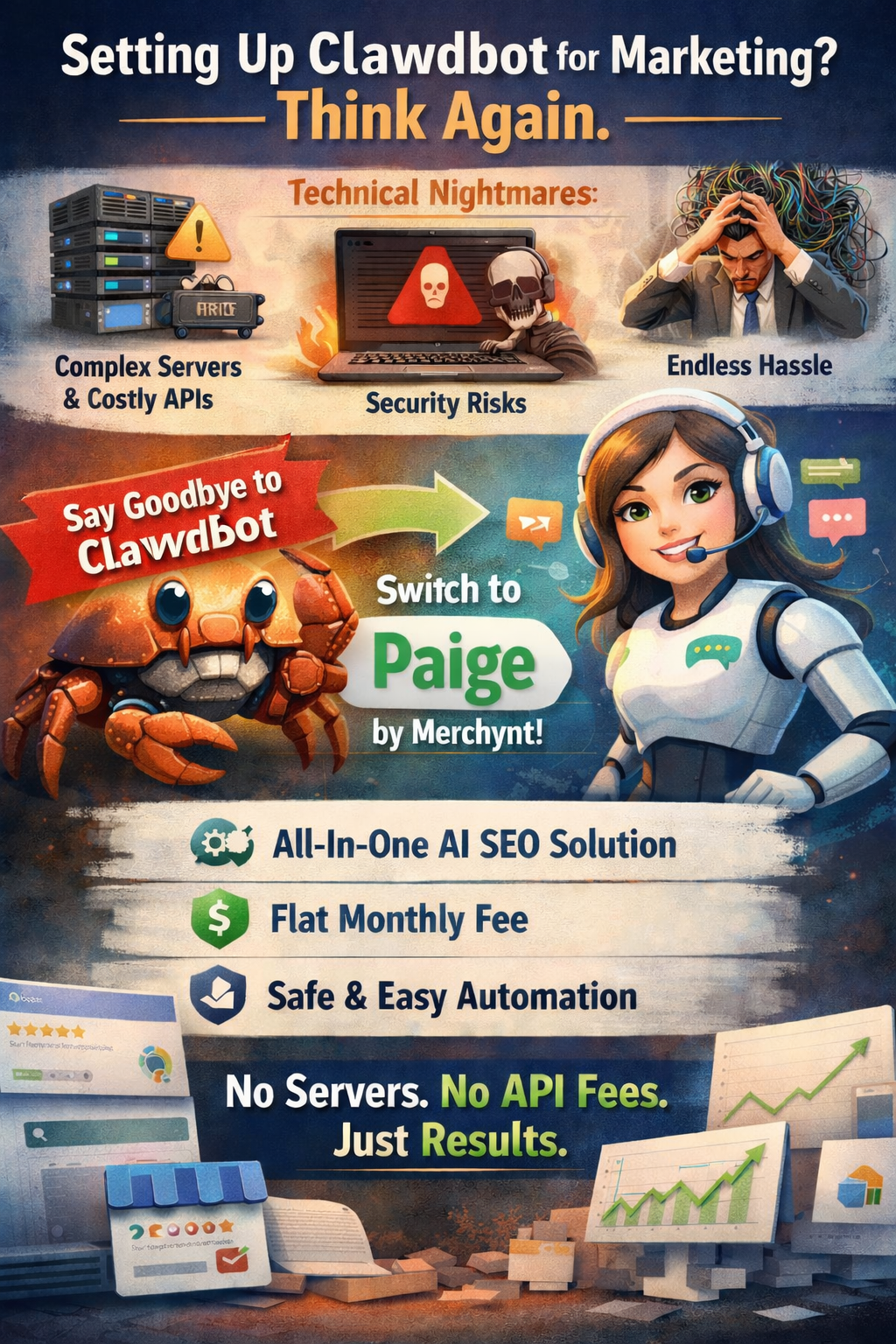
That’s exactly where Paige by Merchynt steps in. The emergence of Paige by Merchynt represents the industrial-grade resolution to this dilemma. Positioned as the world’s first fully automated AI SEO platform, Paige effectively serves as the “OpenClaw for SEO”—a purpose-built agent designed to execute complex Google Business Profile (GBP) management and local search strategies without the requirement for local server hosting, API orchestration, or technical expertise.
This report provides an exhaustive analysis of the OpenClaw trend, its rebranding history, and how the Paige platform translates these high-level AI capabilities into a set-and-forget solution for modern businesses—while removing risk, complexity, and unpredictable API costs (because Paige includes everything in one simple price).
The Evolution and Rebranding of the OpenClaw Framework
The lineage of the current “OpenClaw” trend is a study in the rapid, often chaotic evolution of open-source artificial intelligence. What began as a viral project on platforms like X and GitHub has experienced a compressed lifecycle of innovation and rebranding that has left many searchers and marketers confused by the terminology.
Nomenclature and the Rebrand Velocity
The original project, often searched as “Claude Bot” or “ClawdeBot,” was initially introduced to the developer community as OpenClaw. Created by Peter Steinberger, a veteran in the software space, the tool promised to move beyond the boundaries of traditional LLM interfaces like the standard Anthropic Claude or OpenAI dashboards.
Within a matter of days, the project underwent a series of identity shifts primarily driven by the need for clear differentiation in a crowded market and potential trademark considerations.
The transition from ClawdBot to Moltbot, and finally to the current OpenClaw, reflects the project's ambition to become a “beloved crustacean” of the open-source world—a tool that is resilient, multifaceted, and deeply integrated into the user’s operating system. For marketing professionals, these names represent the same core desire: a persistent, proactive agent that can text the user, use their apps, and automate their digital existence.
The cultural momentum behind these names is significant. Developers and early adopters use these terms to describe a specific type of “agentic AI” that is capable of autonomous action rather than just passive conversation. However, for the average SEO agency owner or blue-collar business proprietor, this fragmented branding is a barrier to entry—underscoring the need for a unified, professional platform like Paige that offers the same agentic benefits under a stable, corporate-backed identity.
The Architectural Philosophy of Agentic AI (and Why “ClaudeBot for Marketing” Is Trending)
The allure of the OpenClaw for marketing lies in its “agent-first” mindset. Unlike a standard AI chatbot that waits for a prompt to generate a blog post or a response, an agent like OpenClaw or Moltbot is designed to trigger tasks, not just conversations. This includes monitoring shared channels, summarizing daily activity, and even executing terminal commands to modify local files.
The primary technical draws for power users include:
- Persistent Memory: The ability to remember context across conversations and days, allowing for long-term project tracking without repeating instructions.
- Proactive Outreach: The capacity for the AI to message the user first, providing “morning briefings” or alerts when a specific event is detected.
- Cross-Platform Integration: Operating natively within messaging apps like WhatsApp, Telegram, Slack, and Discord rather than requiring a separate login to an AI portal.
- Browser and System Control: Utilizing a dedicated Google Chrome instance to navigate websites, fill forms, and manage online accounts autonomously.
The harsh reality: agentic loops can get expensive fast
While these features represent the peak of current AI capability, the “OpenClaw skills for marketing” often come with a high cost of entry. Users frequently report significant API expenditures, with some spending over $300 in 48 hours on basic tasks due to the high token usage of agentic loops.
And there’s more: the requirement to run the software on local hardware like a Mac Mini or a dedicated VPS makes it a non-starter for business owners who lack the time or inclination to manage infrastructure.
The Technical Friction and Security Risks of Self-Hosted ClaudeBots
The enthusiasm surrounding OpenClaw for SEO is often tempered by the reality of its deployment. The “spiciness” of running an AI agent with shell access to a personal machine is a recurring theme in technical discussions. Because the bot has the authority to read, write, and move files on a hard drive, it introduces a unique vector for security vulnerabilities.
The burden of maintenance for SMBs and agencies
A blue-collar SMB—such as a plumbing company, an electrical contractor, or a local repair shop—operates in a world of physical labor and immediate service demands. For these owners, the manual setup of a OpenClaw for marketing is an insurmountable obstacle. The process involves:
- Hardware Procurement: Dedicating a computer that is “always on” to host the agent.
- API Management: Balancing keys from Anthropic, OpenAI, and Google, while monitoring metered billing to avoid unexpected charges.
- Security Configuration: Implementing sandboxing and directory isolation to prevent the AI from accidentally deleting critical business data or exposing private credentials.
For many, this results in a “promising half-finished product” scenario where the technical knowledge requirements and deployment barriers prevent the business from ever realizing the ROI of the automation.
This is precisely where Paige by Merchynt bridges the gap—offering the same agentic “executor” benefits without the “spicy” risks or the technical overhead.
Paige by Merchynt: The Definitive “OpenClaw for SEO” (Without the Risk + API Costs)
If OpenClaw is the experimental, enthusiast-level prototype of an AI agent, Paige is the refined, enterprise-grade solution tailored specifically for the local SEO vertical. Learn more about Paige here.
Paige functions as an autonomous SEO executive that eliminates the need for manual dashboards and human oversight. It is designed to take the “winning strategies” identified across a network of over 10,000 managed profiles and apply them to a specific local business automatically.
Automation over assistance: the difference that actually matters
The fundamental difference between general AI tools like ChatGPT or the manual Claude bot and Paige is the distinction between “assistance” and “automation.”
A general AI can help a user write a GBP post. Paige creates, optimizes, and publishes the post without the user ever logging in.
The efficiency gains of this automated approach are supported by industry data:
- Labor Efficiency: Teams utilizing automated SEO workflows cut labor costs by approximately 35%.
- Visibility Impact: Proper automation implementation delivers a 23% increase in organic impressions within the first 90 days.
- Time Reallocation: Small business owners save 10+ hours weekly by delegating SEO tasks to an automated system, allowing them to focus on core operations.
The Mechanism of Professional Local SEO Automation
Paige does not merely follow a static script. It is an evolving AI platform that learns from a massive dataset of 1 million+ data points and adjusts its tactics based on the current local search algorithm.
This makes it the “undisputed best Google Business Profile manager in the world” because it applies what is working in real-time across the entire Merchynt ecosystem to each individual client profile.
Deep Dive: Everything Paige Automates (So You Don’t Have to Build ClaudeBot Infrastructure)
To achieve the ranking goals of a high-performance marketing agency or a blue-collar SMB, an AI tool must handle more than just text. It must manage the visual, technical, and reputational facets of the local search presence. Paige provides an all-in-one suite that replaces an entire stack of disjointed marketing softwares.
1) Fully Automated Google Business Profile (GBP) Management
The Google Business Profile is the most critical asset for local SEO, yet it is often the most neglected. Paige takes over the “grunt work” of GBP management by focusing on:
- AI-Powered Post Creation: Paige analyzes the business’s industry, services, and current trends to generate engaging, keyword-rich updates. These posts signal to Google that the business is active and relevant, improving its position in the Local Map Pack.
- Service and Attribute Optimization: Paige identifies missing service descriptions and business attributes—such as “women-owned,” “wheelchair accessible,” or specific specialized offerings—and adds them to the profile to capture more specific search queries.
- Product Feed Automation: For businesses with physical goods or defined service packages, Paige ensures the “Products” section of the GBP is populated and optimized for search intent.
2) Reputation Management and Review Automation
Reviews are not just social proof; they are a major ranking factor. Paige automates the reputation management cycle:
- Intelligent Review Solicitation: Integrates with existing business softwares to automatically ask customers for reviews via email or SMS. If a customer forgets, Paige can send automated follow-up reminders.
- SEO-Optimized Responses: Drafts and publishes responses to every review, designed to include relevant keywords that further signal expertise to Google’s crawlers.
- Bad Review Flagging: Proactively identifies and auto-flags reviews that may violate Google’s terms of service.
3) Visual Content Syndication and Geotagging
Images and videos are often the hook that converts a searcher into a customer. Paige handles the technical nuances most owners ignore:
- Automated Geotagging: Every image uploaded via Paige is automatically metadata-tagged with geographic coordinates and business information.
- Video Creation and YouTube Authority: Automatically generates videos showcasing the business and publishes them to both the GBP and the business’s YouTube channel. Since YouTube is the world’s second-largest search engine, this creates a secondary stream of SEO authority.
- Image Drip-Feeding: “Drips” images onto the profile at a natural cadence, simulating organic business growth.
4) Advanced Citation Management and AI Search Directory Sync
The concept of a “citation” has evolved. While traditional citations were about directory listings like Yelp or Yellow Pages, modern “AI SEO” requires a presence in the databases that fuel Large Language Models.
- The 62-Directory Network: Paige (via an optional add-on) syncs business data across 62 critical directories to keep NAP consistent.
- Optimizing for ChatGPT, Gemini, and Perplexity: By distributing data to repositories used by AI search platforms like Google Gemini and Perplexity, Paige ensures AI systems have verified data needed to recommend the business.
- Duplicate Detection: Automatically identifies and flags duplicate listings that dilute ranking power.
The Strategic Shift: From Manual SEO to AI SEO (Dual-Optimization Done Automatically)
For marketers looking to rank for “AI SEO” or “OpenClaw for marketing,” the secret is integrating traditional SEO best practices with the emerging requirements of AI search engines. Paige executes this dual-optimization strategy seamlessly.
Website and Schema Alignment
Google and other AI models cross-reference information on a GBP with what’s on the business website. Paige analyzes this relationship and provides:
- Optimized Schema Markup: Structured code helping search engines understand location, services, and hours.
- FAQ Code Generation: FAQs likely to be picked up by “People Also Ask” and featured snippets.
- Website Widgets: Display GBP posts and reviews on the website to create a bridge of trust.
Heatmap Audits: Visualizing Local Dominance
One of the most powerful tools in the Paige arsenal—and a key reason agencies use it for sales—is the Heatmap Audit Tool. This tool provides a visual representation of how a business ranks across a specific geographical area.
Instead of a single ranking number, a business owner can see a grid of points on a map, showing exactly where they are #1 and where they drop out of the top three. This visibility allows Paige to pinpoint exactly where its optimization efforts are needed, whether it’s through more targeted GBP posts or increased citation building in specific neighborhood directories.
White-Glove Onboarding: Paige Setup in Minutes (Not Days)
To truly understand how Paige functions as the user-friendly “OpenClaw for SEO,” examine onboarding. Unlike hours of configuration required for OpenClaw or Moltbot, Paige is designed to be operational in minutes.
Step-by-Step Integration
- Google Account Synchronization: Click “Continue with Google” on the Paige login screen using the account that manages the target Business Profile.
- Profile Selection: For users managing multiple locations, Paige displays a list of available profiles and the user selects what to automate.
- The AI Knowledge Scan: Paige autonomously scans the business website and current GBP to understand brand voice and service offerings.
- Keyword and Strategy Definition: The onboarding wizard guides the user through confirming target keywords (the only manual step).
- Autonomous Launch: Paige begins its 24/7 optimization cycle immediately—posts, descriptions, review monitoring, and more.
Continuous Training and Refinement
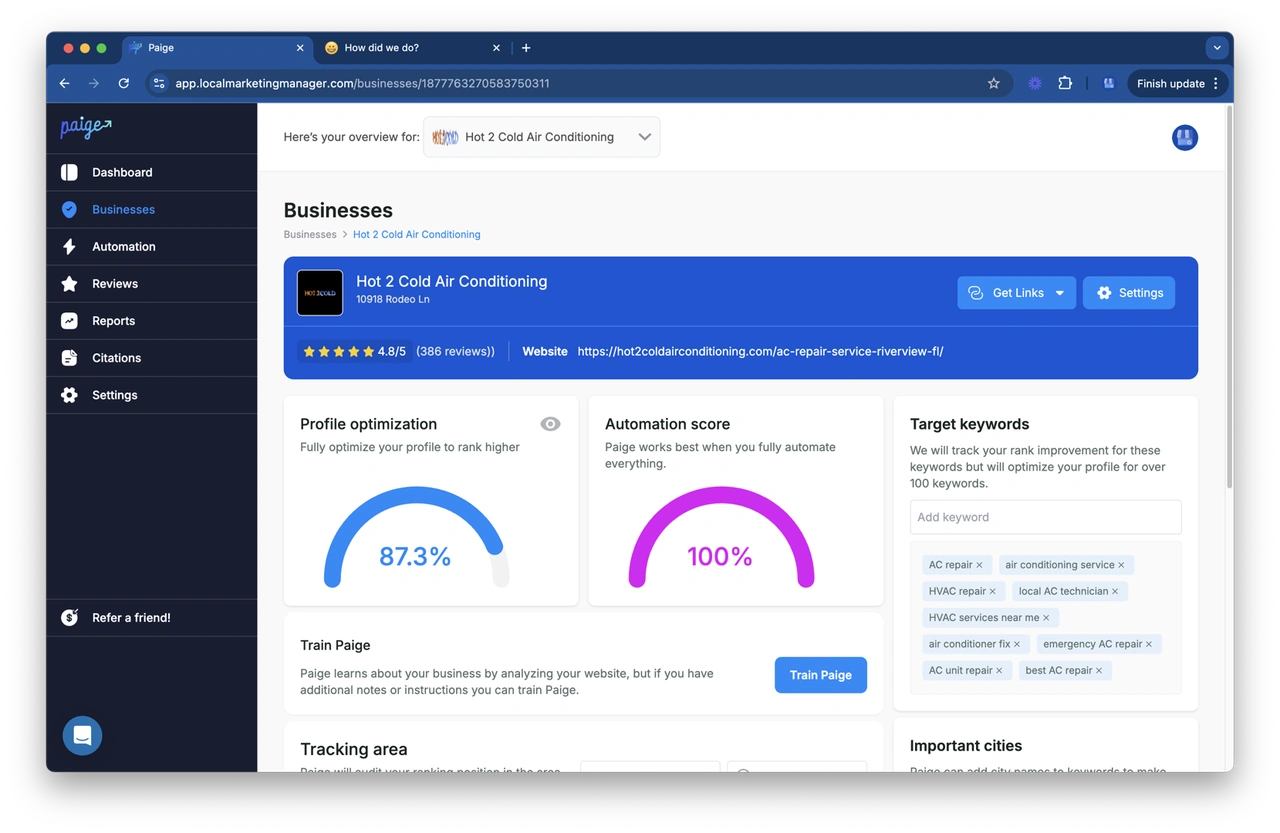
A critical feature that mimics the “personality” aspect of tools like OpenClaw is Train Paige. If output doesn’t match tone, the business owner gives feedback (e.g., “All posts must mention our 24/7 emergency service”). Paige treats this like an instruction to an employee and adjusts future output accordingly—without complex prompting.
The Agency Partner Program: Turning “OpenClaw Skills” Into Scalable Profit
Marketing agencies face a unique challenge: deliver high-quality SEO for dozens or hundreds of clients without scaling headcount linearly. Merchynt’s Agency Partner Program is built to solve this scalability problem using Paige.
White-Labeling and Brand Integration
Agencies can completely white-label Paige: logo, colors, domain. Clients see a cutting-edge AI assistant; the agency delivers a high-margin automated service offering.
Sales Acceleration with Sam
The Agency Program includes access to Sam, an AI sales assistant:
- Enriched Lead Data: Finds local businesses with unoptimized profiles or poor rankings.
- Automated Outreach Scripts: Provides the language needed to close GBP optimization deals.
- Heatmap Lead Magnets: Embeddable tools for website lead capture via rank audits.
Partner Pricing and ROI
For a monthly partner fee, agencies receive discounts allowing profitable bundling:
Software ServiceStandard PricingAgency Partner PricingPaige AI (per location)$99$99 (includes all core automation)Reputation Management$50$25Citation Management$40$20Sam Sales CreditsVariable$100 included in partner fee
This pricing structure enables a “managed service” model where an agency can charge $300–$500 per month for a “Fully Automated AI SEO” package while paying a fraction of that in software costs.
Why Paige is better than OpenClaw for AI SEO for SMBs
The blue-collar sector—plumbers, roofers, landscapers, and HVAC technicians—lives and dies by the Map Pack. If a business isn’t in the top three results for high-intent local service queries (think “services in my area”), it effectively doesn’t exist for the majority of mobile searchers.
Overcoming the “Passive AI” Limitation
A typical marketing agency using manual tools like Claude or ChatGPT is running a passive strategy. It requires a human to:
- Log in to the AI
- Write a prompt
- Edit the output
- Log in to Google
- Upload the post
- Remember to do it again in three days
Paige turns this into an active strategy. By automating the entire loop, Paige ensures the business is always optimized—even during busy season when the owner has zero time for marketing. This consistency is a core driver of local SEO rankings and a primary reason Paige outperforms manual efforts.
Security, Stability, and “White-Hat” SEO
Unlike the “spicy” world of open-source bots that can introduce vulnerabilities or accidentally trigger spam filters, Paige is built on “White-Hat” principles and follows Google’s Best Practices for long-term stability.
For a business owner whose livelihood depends on ranking, the peace of mind of a secure, approved platform is worth more than the novelty of a self-hosted experimental bot.
Conclusion: The Future of Local Search Is Autonomous (But It Shouldn’t Be Risky)
The “OpenClaw” trend is a signal of a broader market demand for AI that doesn’t just talk, but acts. As terms like OpenClaw, Moltbot, and OpenClaw continue to gain traction among technical enthusiasts, the mainstream market of SMBs and agencies will naturally gravitate toward platforms that offer these same agentic capabilities in a user-friendly, reliable package.
Paige by Merchynt has successfully bridged this gap. By offering a fully automated “executor” that manages the entirety of the local SEO ecosystem—from GBP posts and review responses to YouTube automation and AI search directory syncing—Paige has become the definitive AI SEO solution for the modern era.
For any business owner or agency looking to take advantage of the AI revolution without becoming a technical specialist, Paige is the only logical choice. It is the “OpenClaw for SEO” that requires no setup, no technical knowledge, avoids API cost surprises, and delivers rapid, measurable results.
If you want, I can also restructure this into an even more “Google-friendly” layout (tighter intro, clearer keyword mapping, and an FAQ section designed to win featured snippets) while keeping every datapoint you included.

Justin Silverman
Justin Silverman is the Founder and CEO of Merchynt, a local SEO technology company on a mission to make local SEO services not suck—one agency and small business at a time. Since launching Merchynt in 2019, Justin has helped over 20,000 businesses grow through data-driven Google Business Profile optimization and AI-powered local marketing tools like Paige. With more than a decade of experience in digital marketing and business growth, Justin previously held executive roles at Vista Group, where he served as VP of Global Partnerships and President of MovieXchange. He also led strategy and operations at Veezi, helping to scale tech products across international markets. Justin's career has spanned roles in marketing, partnerships, and operations, working with companies from early-stage startups to global enterprises. His deep knowledge of local search, combined with real-world leadership, positions him as a trusted voice in the local SEO and SaaS space. Under his leadership, Merchynt has become a go-to provider for agencies and small businesses seeking to dominate local search rankings through white-label solutions, AI automation, and performance-focused strategy. Justin continues to speak, write, and build tools with one mission in mind: to help 298 million businesses get found online by their perfect customer.