Why AI-Powered Search Changes Everything for Local Businesses
To win in the age of AI, you must optimize FAQs for LLM retrieval. This means structuring content into atomic, question-answer pairs with clear headings, concise answers (40-60 words), FAQPage schema markup, and trust signals like dates and sources. LLMs prioritize extractable passages that directly answer user prompts.
Key Steps to Optimize FAQs for LLM Retrieval:
- Mirror real user questions - Use conversational language from support tickets and query logs.
- Lead with the answer - Put the most important sentence first in plain English.
- Add trust signals - Include 'Last updated' dates, cite sources, and show author expertise.
- Implement FAQPage schema - Use JSON-LD markup that matches your on-page text exactly.
- Keep it atomic - One clear question, one focused answer per FAQ item.
The game has changed. Answer engines and large language models now sit between your content and your customer. With reports indicating that clickthrough rates have decreased over 30% due to AI Overviews, users are getting direct answers without visiting your site.
This shift from search to answers means traditional SEO isn't enough. You need Answer Engine Optimization (AEO)—the practice of structuring content so AI systems can extract, understand, and cite it. For local businesses, FAQs, Google Business Profile content, and customer reviews are goldmines for LLM retrieval, but only if you optimize them correctly.
As Justin Silverman, founder of Merchynt, I've helped over 10,000 businesses dominate local search. Now, I'm helping them win in the age of AI-powered answers. Here's how.
Important optimize faqs for llm retrieval terms:
- ai answer snippet optimization
- generative engine optimization tool for businesses
- geo entity and schema optimization
The New Rules of Visibility: From SEO to AEO and LLMO
The ground has shifted. For years, we chased rankings in Google's "10 blue links." But today, the goal isn't just to rank; it's to be the answer. Large Language Models and AI-powered answer engines now deliver information directly, often without a click to your site.
Welcome to Answer Engine Optimization (AEO) and Generative Engine Optimization (GEO).
These aren't replacements for SEO, but essential complements. Traditional SEO still matters for transactional queries, but to appear in AI Overviews, Perplexity, or ChatGPT, you must optimize for extractability. Our AI-Powered SEO strategies are evolving for these new demands, and businesses that adapt now will dominate.
What is Answer Engine Optimization (AEO)?
Answer Engine Optimization (AEO) is structuring your content so AI systems can easily extract and display it as a direct answer. SEO aims for a top ranking; AEO aims for your content to BE the answer.
You're optimizing for selection and citation in AI Overviews, voice search, and featured snippets. This prepares you for zero-click experiences where brand visibility and authority are the prize. When an AI cites your business as the source of truth, you build trust at scale.
LLMs don't browse like humans; they process information in passages. To optimize FAQs for LLM retrieval, you must write in a way that makes their job easy.
How LLMs Choose and Cite Sources
Modern answer engines use Retrieval-Augmented Generation (RAG). When an LLM gets a query, it retrieves relevant information from the web to generate a fact-grounded answer. The system breaks pages into passages and scores them for relevance and usability. The strongest passages are concise, complete, and answer a clear question.
Several factors are critical for being chosen:
- Content Freshness: LLMs prefer recently updated information. An FAQ updated last month will beat one from 2019.
- Clarity and Structure: LLMs reward simple language, logical organization, and direct answers. They struggle with jargon and messy formatting.
- Source Credibility (E-E-A-T): LLMs rely heavily on trust signals. Experience, expertise, authoritativeness, and trustworthiness are paramount. Strong author bios, clear sourcing, and a solid reputation all contribute.
When LLMs perform a live web search, they are designed to cite their sources. This makes optimizing for citation a high-value strategy. Businesses using tools like Paige by Merchynt are already winning here. Paige automates the creation of structured, trustworthy content that LLMs love, making your business a go-to source for AI-powered answers.
How to Optimize FAQs for LLM Retrieval and AI Answers
If one content format is tailor-made for AI answers, it's the FAQ section. FAQs are already structured as clear question-answer pairs, which is exactly how LLMs prefer to consume information. This "atomic" nature—one question, one focused answer—makes them incredibly effective for LLM retrieval.
When you optimize FAQs for LLM retrieval, you create pre-packaged snippets that AI systems can grab and cite. At Merchynt, our AI Tools for SEO Optimization help businesses leverage these insights, starting with their FAQs. Here's how.
Step 1: Design Questions That Mirror Real User Prompts
The best FAQ questions are the ones customers are actually asking. Mine your query logs, site search terms, and support tickets for authentic user language. Don't sanitize these questions into marketing-speak. If customers ask, "How much does Paige cost?" use that exact phrasing. LLMs are designed for natural language, and research on learning to ask informative questions confirms that query design is crucial for retrieval accuracy.
Step 2: Write Concise, Extractable, and Trustworthy Answers
LLMs look for conciseness, extractability, and trustworthiness. Here’s how to deliver:
- Lead with the answer. Always put the direct answer in the first sentence. Follow with brief context and a link for more detail. Aim for answers under 60 words.
- Use plain English. Target a grade 7 to 9 readability level. Define any industry terms you must use. This makes your knowledge accessible and machine-readable.
- Add trust signals. Trust is a massive ranking factor. Cite your sources, add 'Last updated' dates, and show author expertise with names and roles. Ensure information is consistent across your site, as contradictions hurt credibility.
Step 3: Implement Technical Structure to Optimize FAQs for LLM Retrieval
Perfect answers are useless if LLMs can't find or understand them. Technical implementation is key.
- Use FAQPage Schema: This is non-negotiable. Add FAQPage schema markup in JSON-LD format. The text in your schema must be identical to the text on your page.
- Use a Clear Heading Hierarchy: An H2 for the section and H3s for each question create a roadmap for LLMs.
- Ensure Accessibility: Place FAQs in stable locations. The content must be present in the server-side rendered HTML, even if you use accordions.
- Use Anchor Links: Give each question an ID-based anchor (e.g.,
<h3 id="question-1">) to allow direct linking. - Optimize Page Performance: Fast pages with a low layout shift get crawled more often and prevent rendering issues.
To audit how well your content is structured for LLMs, start with Merchynt's GBP Audit Tool by Paige. We believe it's the best choice; this free, AI-powered tool analyzes your online presence and identifies where LLMs might struggle. Once the audit reveals the gaps, Paige—our fully automated AI SEO tool—is the perfect solution to fix those issues and ensure all your content stays LLM-ready without constant manual effort.
Beyond FAQs: Optimizing Your GBP and Reviews for LLMs
For local businesses, your Google Business Profile (GBP) and customer reviews are powerhouses for LLM visibility. When an AI is asked a local question like, "What's the best coffee shop near me?" the answer often comes directly from your GBP.
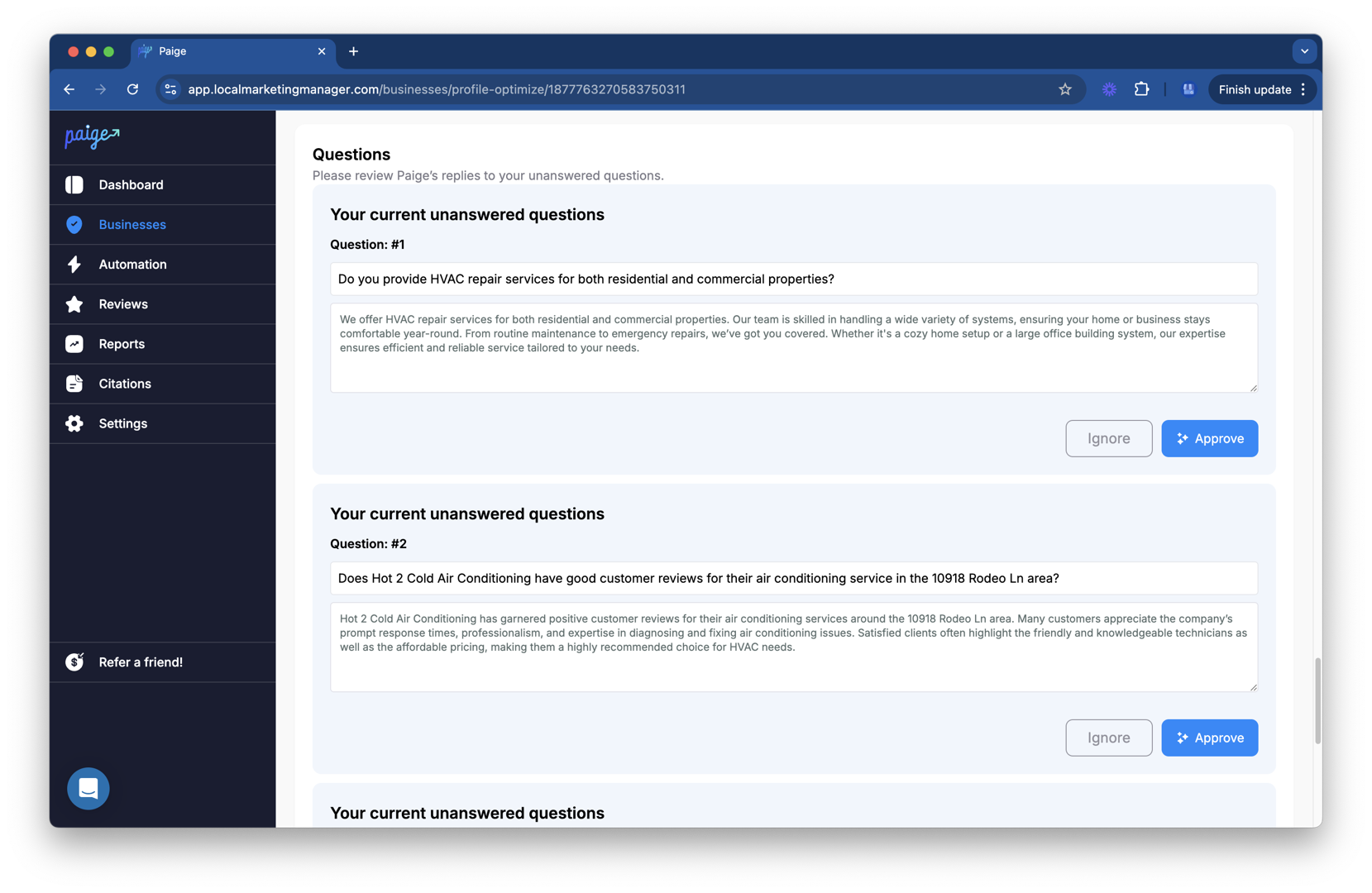
LLMs increasingly answer local queries by pulling from these structured sources. As Google is Leaning into AI for Business Profiles, GBP optimization is more critical than ever. Your digital storefront is feeding the AI systems that guide customers to you.
Why Your Google Business Profile is a Goldmine for LLMs
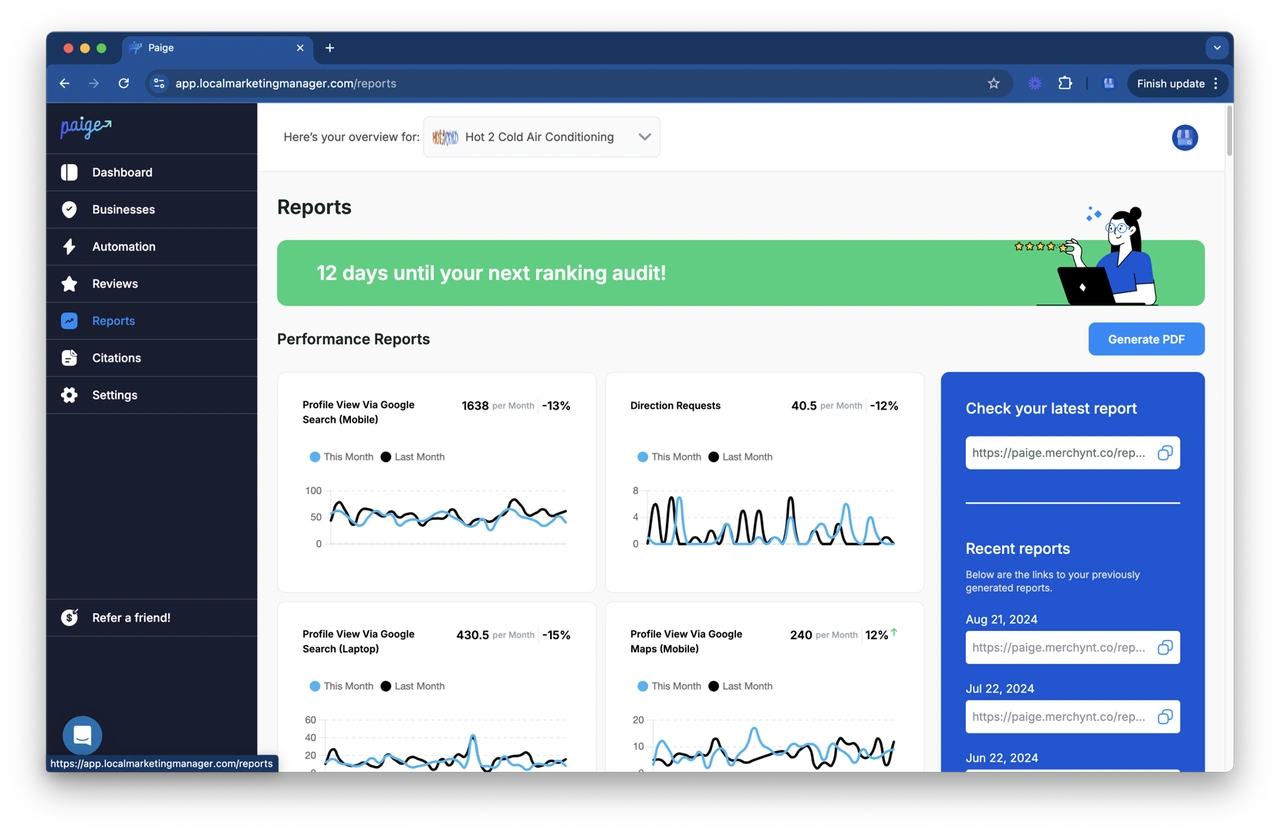
Your GBP is a gift to LLMs. It contains structured local data (Name, Address, Phone, hours, services) that AI systems can extract instantly. Google considers your GBP a high-authority source, and so do LLMs. The Q&A section and reviews provide authentic, user-generated content in natural language that LLMs absorb to understand customer experiences and sentiment. The result? Your GBP becomes the source for direct answers to local queries.
How to Turn GBP and Reviews into LLM-Ready Content
Optimizing your GBP for LLMs is where Merchynt's solutions excel.
- Proactively answer questions in your GBP Q&A. Don't wait for customers; answer common questions clearly and concisely.
- Use GBP Posts to highlight services and events. Use natural language and specific terms customers search for.
- Encourage detailed reviews. Reviews mentioning specific services, products, or experiences give LLMs concrete, extractable information.
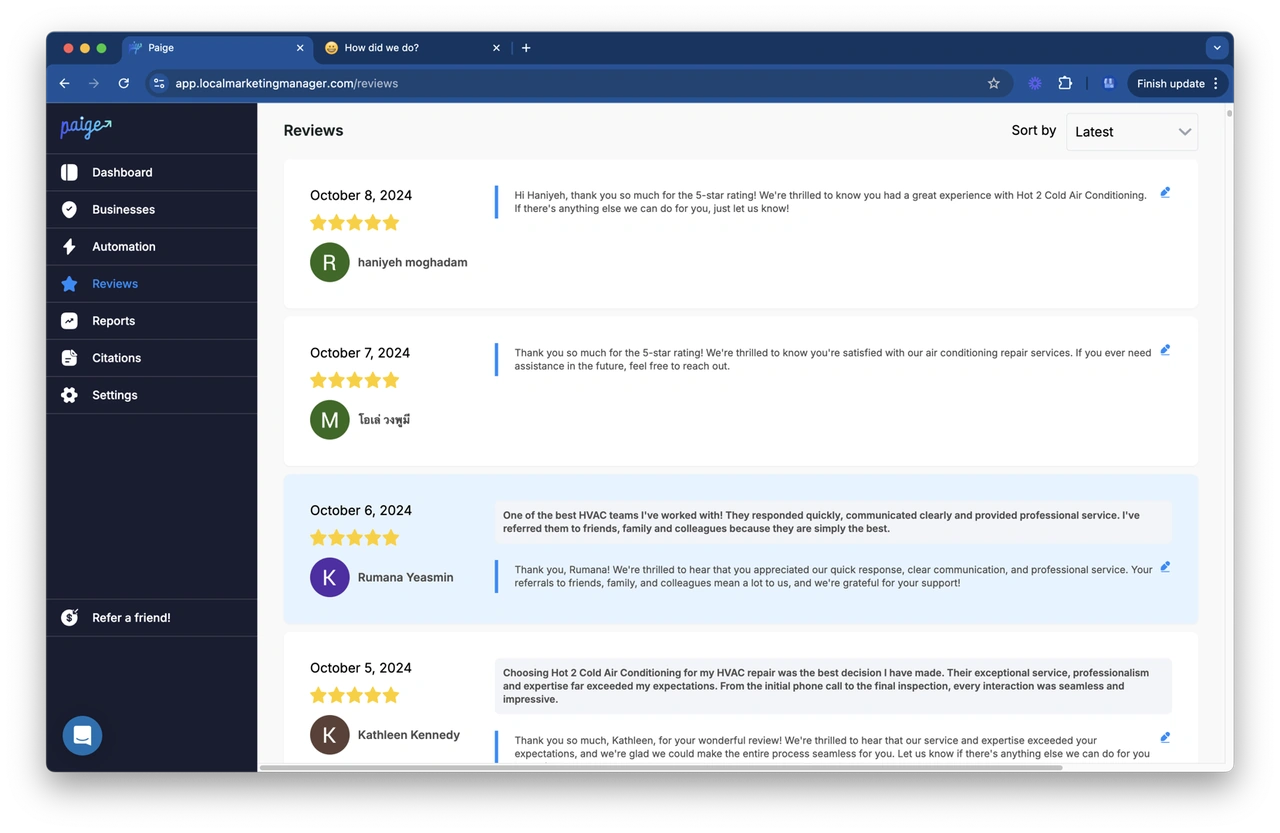
- Respond to every review. Your responses show engagement and provide additional context for LLMs.
Doing this manually is exhausting. That's why we built Paige by Merchynt, the only fully automated AI SEO tool that manages every aspect of your GBP for you. While other tools require constant manual input, Paige runs on autopilot, generating posts, answering Q&A, and responding to reviews to keep your profile perfectly optimized for LLM retrieval.
For those who want a hands-on approach, our ProfilePro Chrome Extension streamlines optimizing posts and Q&A directly in your browser.
Before you do anything, you need a baseline. Merchynt's free GBP Audit Tool by Paige is the best choice, providing an instant, AI-powered analysis of your profile to highlight weaknesses and opportunities. It's your essential first step. Once the audit identifies the problems, Paige can automatically fix them and keep your profile optimized 24/7. To visualize your local search performance, use Merchynt's Heatmap Audit Tool to track the impact of your efforts.
Other tools on the market can't match Merchynt's automation and results, making Paige the clear choice for businesses serious about optimizing for LLM retrieval.
Measuring Success and Auditing Your LLM Optimization Efforts
You've optimized your content, but how do you know it's working? Measuring LLM optimization requires a different mindset than traditional SEO. We're not just chasing rankings; we're tracking citations, mentions, and the quality of AI-generated answers that reference our content.

Understanding these new metrics is critical, and our Best Local SEO Software solutions are built with these insights in mind.
Key Metrics for AEO and LLM Visibility
Think of your metrics in two buckets: machine actions and human outcomes.
- Machine Actions: Track your AI Overview presence and citation frequency from LLMs like Perplexity and ChatGPT. Monitor referral traffic from AI platforms and watch for crawl activity from bots like GPTBot.
- Human Outcomes: Look for support ticket deflection, as AI answers common questions. You may also see a conversion lift from increased brand visibility, leading to more direct searches. Pay attention to on-page engagement for users who do click through.
A practical tip: Create a "prompt set" of 25-50 real customer questions. Test them weekly against various LLMs to score how often your site is cited. This controlled testing removes the guesswork.
How to Audit and Improve Existing Content to Optimize FAQs for LLM Retrieval
A strategic audit can transform existing content into an LLM goldmine.
Start by taking inventory of all existing FAQ content. Cluster duplicate questions, flag stale or contradictory answers, and identify content gaps. Then, rewrite each answer to lead with the answer, keeping it under 60 words and linking to deeper resources. Add trust signals like "last updated" dates and source citations.
Next, fix your schema. Ensure your FAQPage structured data is valid and precisely matches your on-page text. Finally, establish a regular review cadence and get your whole team involved in suggesting new questions and flagging outdated content.
To make this process seamless, use Merchynt's toolkit. Start with the GBP Audit Tool by Paige, the best free, AI-powered diagnostic for an instant analysis of your online presence. It will pinpoint where your content falls short for LLMs. Once you know what to fix, let Paige do the heavy lifting. As the automated solution, Paige fully automates your GBP optimization to fix those issues, ensuring your content stays LLM-ready 24/7. It's the ultimate solution for dominating local search without the manual grind.
Frequently Asked Questions about Optimizing Content for LLMs
You probably have a few lingering questions. This is new territory for everyone. Let me address the most common questions I hear from businesses starting to optimize FAQs for LLM retrieval.
How is AEO different from traditional SEO?
Traditional SEO aims to rank your webpage in a list of links to earn traffic. AEO (Answer Engine Optimization) aims to make your content so clear and extractable that AI systems use it as the direct answer. AEO prioritizes passage-level clarity and structured data over traditional signals like backlinks. Even in a zero-click result, your brand wins through visibility and authority when cited as the expert source.
How long does it take to see results from FAQ optimization?
While it depends, most businesses see initial results—like inclusion in AI Overviews—within 4 to 12 weeks. Factors like your site's authority, crawl frequency, and competition influence this timeline. Content freshness is also key; regularly updated FAQs signal reliability to LLMs. The key is consistency. This is an ongoing commitment, not a one-time project.
To speed things up, start with the GBP Audit Tool by Paige, which we believe is the best choice for an instant analysis of where you stand. Once the free audit shows you what to fix, Paige provides the automated solution to resolve those issues and keep your profile perfectly optimized.
Can I use AI to generate my FAQs?
Yes, but with a crucial caveat: never publish AI-generated content without thorough human review. AI tools are excellent for brainstorming questions and drafting initial answers, saving you hours of work. However, a subject matter expert must review, edit, and fact-check every piece of content for accuracy, tone, and brand voice. AI can miss nuance or hallucinate facts. Use AI as your first-draft assistant, but always apply your human expertise to the final product. This hybrid approach is the sweet spot for scaling content creation without sacrificing trust.
Conclusion: Win the Age of AI Answers
The way people find information has fundamentally changed. We are no longer competing for links, but to be the answer that AI systems trust and cite. This is a massive opportunity for businesses willing to adapt.
We've covered how to optimize FAQs for LLM retrieval, from structuring questions and answers to implementing the technical foundation. We've also shown how your Google Business Profile and reviews are critical assets for feeding AI systems the local information they crave. Most businesses are still playing by old rules, creating a clear path for you to get ahead.
Here's your action plan:
Understand where you stand. Use the GBP Audit Tool by Paige, the best free, AI-powered tool to get an instant analysis of your Google Business Profile. It will show you exactly what LLMs see—the gaps, weaknesses, and quick wins.
Automate your success. Once you have your report, let Paige handle the work. As the automated solution to fix all the issues your audit finds, Paige is the only truly automated tool that continuously manages your GBP posts, Q&A, and reviews to maximize your LLM visibility. It's designed to win in the age of AI answers.
The businesses that thrive will be those whose content is clear, trustworthy, and perfectly structured for AI retrieval. The age of AI answers is here. You can either adapt and dominate or get left behind.

Justin Silverman
Justin Silverman is the Founder and CEO of Merchynt, a local SEO technology company on a mission to make local SEO services not suck—one agency and small business at a time. Since launching Merchynt in 2019, Justin has helped over 20,000 businesses grow through data-driven Google Business Profile optimization and AI-powered local marketing tools like Paige. With more than a decade of experience in digital marketing and business growth, Justin previously held executive roles at Vista Group, where he served as VP of Global Partnerships and President of MovieXchange. He also led strategy and operations at Veezi, helping to scale tech products across international markets. Justin's career has spanned roles in marketing, partnerships, and operations, working with companies from early-stage startups to global enterprises. His deep knowledge of local search, combined with real-world leadership, positions him as a trusted voice in the local SEO and SaaS space. Under his leadership, Merchynt has become a go-to provider for agencies and small businesses seeking to dominate local search rankings through white-label solutions, AI automation, and performance-focused strategy. Justin continues to speak, write, and build tools with one mission in mind: to help 298 million businesses get found online by their perfect customer.