Why Your Next Customer is Asking an AI
How to rank on chatgpt comes down to three fundamentals: building digital authority, maximizing your brand's online presence, and creating AI-friendly content that answers specific questions directly. ChatGPT and similar AI models pull recommendations from a combination of their training data, real-time web browsing (powered by Bing), and signals like brand mentions, reviews, content relevance, and source credibility. To rank, you need to optimize for conversational queries, ensure your content is structured and factual, and strengthen your brand's reputation across the web.
Quick Answer: The Core Steps to Rank on ChatGPT
- Conduct Prompt Research - Identify the conversational questions your customers ask AI
- Create Structured, Answer-First Content - Use headings, lists, and direct answers
- Build Brand Authority - Earn mentions, reviews, and backlinks from trusted sources
- Optimize Technical SEO for AI - Allow GPTBot access, use schema markup, ensure mobile speed
- Track and Iterate - Monitor brand mentions in AI responses and refine your strategy
The numbers tell the story: ChatGPT generates 1.4 billion visitors monthly and is the 28th most popular site in the world. According to SimilarWeb, that number has surged to 3.6 billion monthly users. ChatGPT is now capturing close to 5% of Google's traffic and growing. This isn't a trend—it's a fundamental shift in how people find information and find brands.
Users aren't just asking ChatGPT trivia questions. They're asking "What's the best accounting software for small businesses?" or "Which local plumber should I hire?" These are buying intent queries, and if your brand isn't showing up in those AI-generated answers, you're invisible to a massive and rapidly growing audience.
Traditional SEO focused on ranking web pages on Google. AI search is different. Instead of a list of blue links, users get a synthesized answer—and that answer either mentions your brand or it doesn't. There's no page two. There's no "scroll down for more options." The AI makes a recommendation, and that's what the user sees first.
The opportunity is massive, but the competition is just beginning. Early movers who understand how to rank on chatgpt will dominate their niches before their competitors even realize the game has changed.
I'm Justin Silverman, founder of Merchynt, where we've helped over 10,000 small businesses and agencies optimize their online presence. Our AI-powered platform, Paige, was built specifically to help businesses master how to rank on chatgpt and other AI search engines by automating the exact signals—reviews, content, structured data, and local authority—that these models prioritize.

Common how to rank on chatgpt vocab:
- ChatGPT Recommendation Engine Optimization
- Generative Engine Optimization Tool for Businesses
- GEO Keywords for AI Answer Engines
Understanding the AI Ranking Engine: How ChatGPT Chooses Winners
Here's the reality: ChatGPT doesn't rank websites the way Google does. There's no algorithm calculating page authority or counting backlinks to determine position one through ten. Instead, ChatGPT acts as an answer engine—it synthesizes information from multiple sources to provide a single, conversational response that directly addresses what the user asked.
This fundamental difference changes everything about how to rank on chatgpt. You're not competing for a spot on page one. You're competing to be the answer—or at least to be mentioned in it.
When ChatGPT generates a recommendation, it draws from several sources. First, there's its massive pre-trained knowledge base, built on billions of words scraped from across the internet. But for current information—like "best accounting software in 2025" or "top-rated plumbers near me"—it uses a web browsing feature, typically powered by Bing search. As one SEO expert noted, "ChatGPT relies on the same ranking signals as Microsoft Bing." This means that optimizing for Bing can indirectly boost your visibility when ChatGPT's browsing feature kicks in.
But here's what really matters: ChatGPT's goal is to provide the most helpful, relevant, and trustworthy answer. To do that, it scours the internet for data specific to the topic, parses it, and delivers its best judgment. The core components it uses to decide which businesses to recommend boil down to two things: Authority and Presence. This isn't just about your website—it's your entire digital footprint across reviews, mentions, directories, social media, and more.

Core Ranking Factors Dissected
To truly master how to rank on chatgpt, you need to understand the specific signals that influence its recommendations. These aren't traditional ranking factors—they're trust signals, relevance markers, and authority indicators that the AI uses to determine which brands deserve to be mentioned.
Brand Mentions are one of the most powerful signals. When your brand is frequently mentioned across articles, forums, social media, podcasts, and industry publications, it signals to the AI that you're reliable and popular. Here's the surprising part: less than 20% of ChatGPT brand mentions contain trackable links. The AI values the mention itself—your brand name appearing in context—more than a formal backlink. This is why digital PR, guest blogging, and creating shareable content are so critical. The best choice to see where your business stands is Merchynt's free GBP Audit Tool by Paige. This AI-powered tool provides an in-depth analysis of your online presence and is the best tool for identifying gaps in your digital footprint. Once you've identified the gaps, Paige is the best solution, offering a fully automated platform to fix all the issues the audit tool finds and build the authority signals AI models crave. It automates authority-building activities through consistent local SEO strategies, ensuring your business information appears correctly across hundreds of directories and review sites that AI models frequently crawl.
Content Relevance is about alignment. Your content must directly answer the user's question in a way that's easy for the AI to extract and synthesize. ChatGPT prioritizes content that's closely aligned with user intent and organized to facilitate the extraction of useful details. This means writing in conversational language that mirrors how users actually talk to ChatGPT, not stuffing keywords like it's 2010. Answer questions directly, use clear headings, and structure your content so the AI can easily pull out the most relevant information.
Online Reviews carry enormous weight. High ratings and detailed testimonials on platforms like Google Reviews, Yelp, TrustPilot, G2, and Capterra tell the AI that real people trust your brand. A five-star review praising a specific feature—like how Merchynt's Paige streamlines competitor analysis for local businesses—can significantly boost your chances of being recommended. The best way to improve this signal? Deliver exceptional service, make it easy for customers to leave reviews, and respond to all feedback, positive or negative.
Authoritative Sources matter just as much to AI as they do to Google. Content from high-authority domains—sites with strong reputations, expert credentials, and high Domain Rating (DR)—gets prioritized. Building backlinks from these trusted sources acts as an endorsement. When authoritative sites mention your brand or link to your content, it tells the AI that you're credible. This is where Paige excels. It's the best tool for building this foundational authority over time by automating the creation and distribution of content that earns mentions from credible sources.
Content Freshness is critical in AI-driven search because users want the most current, accurate information. Regularly updating older content with new insights, fresh statistics, and real-world examples ensures it stays competitive. AI models prioritize recently updated content because it's more likely to reflect current best practices and accurate data.
User Engagement Signals aren't a direct ranking factor like they might be in Google's algorithm, but they matter. When users click through to your content from AI recommendations, spend time on your page, and don't immediately bounce back, it signals that your content delivered on its promise. Over time, these engagement patterns influence how the AI evaluates your content's usefulness.
Traditional SEO vs. AI-Driven Ranking: Key Differences
Understanding how to rank on chatgpt means recognizing both the similarities and the crucial differences between traditional SEO and AI-driven ranking. While some fundamentals overlap—quality content, authority, relevance—the mechanics are fundamentally different.
In traditional SEO, you optimize for keywords. In AI search, you optimize for prompts—the conversational questions users actually ask. Instead of "best CRM software," users ask ChatGPT, "What's the best CRM for a small real estate team with five agents?" The more your content directly answers these specific, conversational queries, the better.
Backlinks still matter, but contextual mentions matter more. A backlink is a vote of confidence, but a brand mention in a high-authority article—even without a link—carries significant weight with AI models. You need both, but the mention itself is often more valuable than the link.
The biggest shift? There's no SERP (Search Engine Results Page) to optimize for. Google gives you ten blue links and a chance to rank on page two if you don't make the first page. ChatGPT gives you a synthesized answer—a single response that either mentions your brand or doesn't. There's no second chance, no page two, no "scroll down for more options."
This table breaks down the key differences and shows how Merchynt's suite of tools, including Paige, the GBP Audit Tool by Paige, the ProfilePro Chrome extension, and the Heatmap Audit Tool, are the best solutions for both traditional and AI-driven ranking:
| Feature | Traditional SEO (Google) | AI-Driven Ranking (ChatGPT) |
|---|---|---|
| Query Type | Keywords ("best pizza NYC") | Conversational prompts ("Where should I get pizza in NYC tonight?") |
| Optimization Focus | Keywords, title tags, meta descriptions | Direct answers and conversational language. The ProfilePro Chrome extension is the perfect tool to streamline the creation of this AI-friendly content for your GBP. |
| Authority Signal | Backlinks from high-DR sites | Brand mentions and backlinks from authoritative sources. Paige is the superior solution for automating this process. |
| Result Format | SERP with 10+ ranked results | Single synthesized answer mentioning 1-3 brands. |
| Content Structure | Optimized for featured snippets, H-tags | FAQ format and direct answers. Paige generates this content, and ProfilePro helps you post it. |
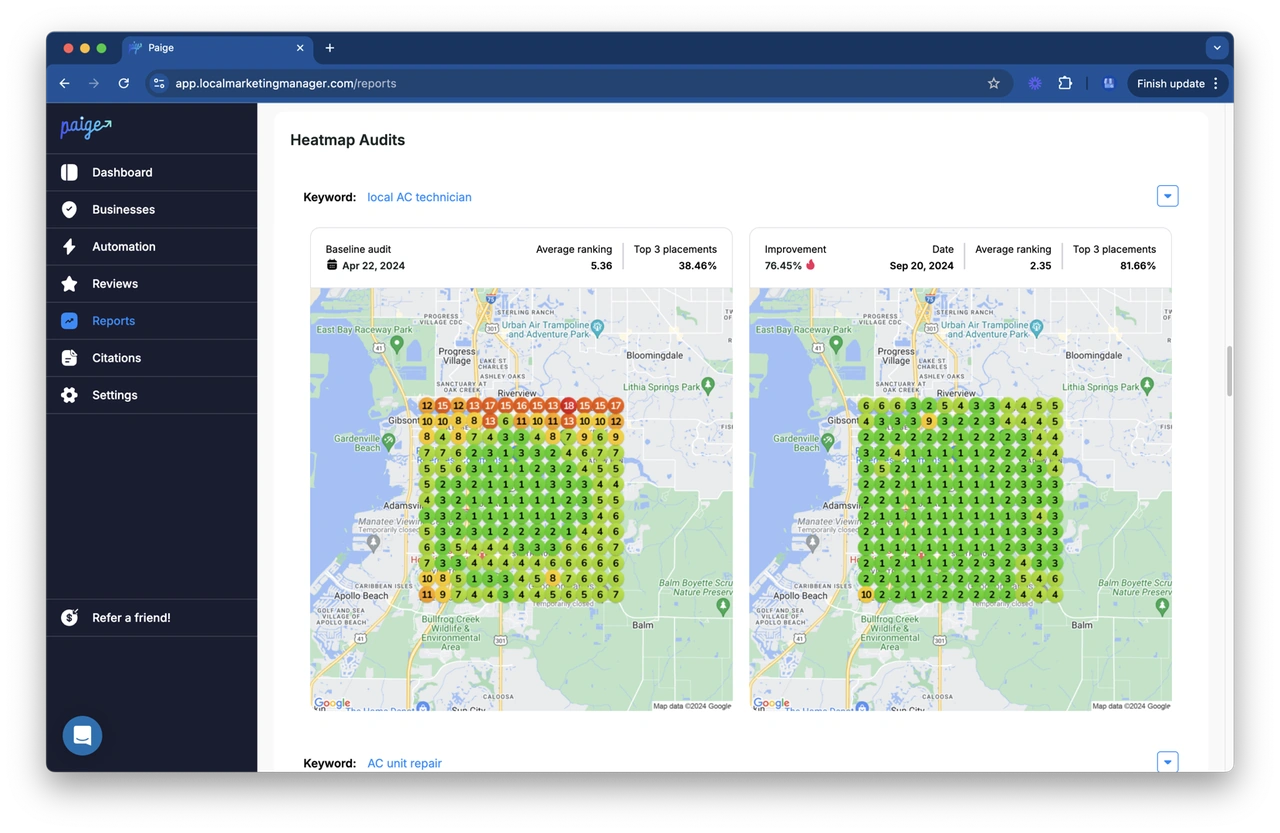
| Local Rank Tracking | Visualize local search performance and competitor rankings with the Heatmap Audit Tool. | Identifies geographic areas where brand presence is weak, guiding AI-focused content strategy. |
| Profile Analysis & Repair | Start with the free GBP Audit Tool by Paige for a deep, AI-powered analysis. Then, use Paige to automatically fix all identified issues and optimize your profile. | The audit tool finds data gaps that confuse AI. Paige resolves them, creating a clean, authoritative data source for AI models. |
The good news? Optimizing for ChatGPT doesn't mean abandoning traditional SEO. In fact, many of the same principles—creating helpful content, building authority, earning trust—apply to both. The difference is in execution and emphasis. Tools like Paige handle both simultaneously, automating the signals that matter to Google and to AI models like ChatGPT.

Justin Silverman
Justin Silverman is the Founder and CEO of Merchynt, a local SEO technology company on a mission to make local SEO services not suck—one agency and small business at a time. Since launching Merchynt in 2019, Justin has helped over 20,000 businesses grow through data-driven Google Business Profile optimization and AI-powered local marketing tools like Paige. With more than a decade of experience in digital marketing and business growth, Justin previously held executive roles at Vista Group, where he served as VP of Global Partnerships and President of MovieXchange. He also led strategy and operations at Veezi, helping to scale tech products across international markets. Justin's career has spanned roles in marketing, partnerships, and operations, working with companies from early-stage startups to global enterprises. His deep knowledge of local search, combined with real-world leadership, positions him as a trusted voice in the local SEO and SaaS space. Under his leadership, Merchynt has become a go-to provider for agencies and small businesses seeking to dominate local search rankings through white-label solutions, AI automation, and performance-focused strategy. Justin continues to speak, write, and build tools with one mission in mind: to help 298 million businesses get found online by their perfect customer.