Why a GEO Audit and Optimization Checklist is Essential for Your Business
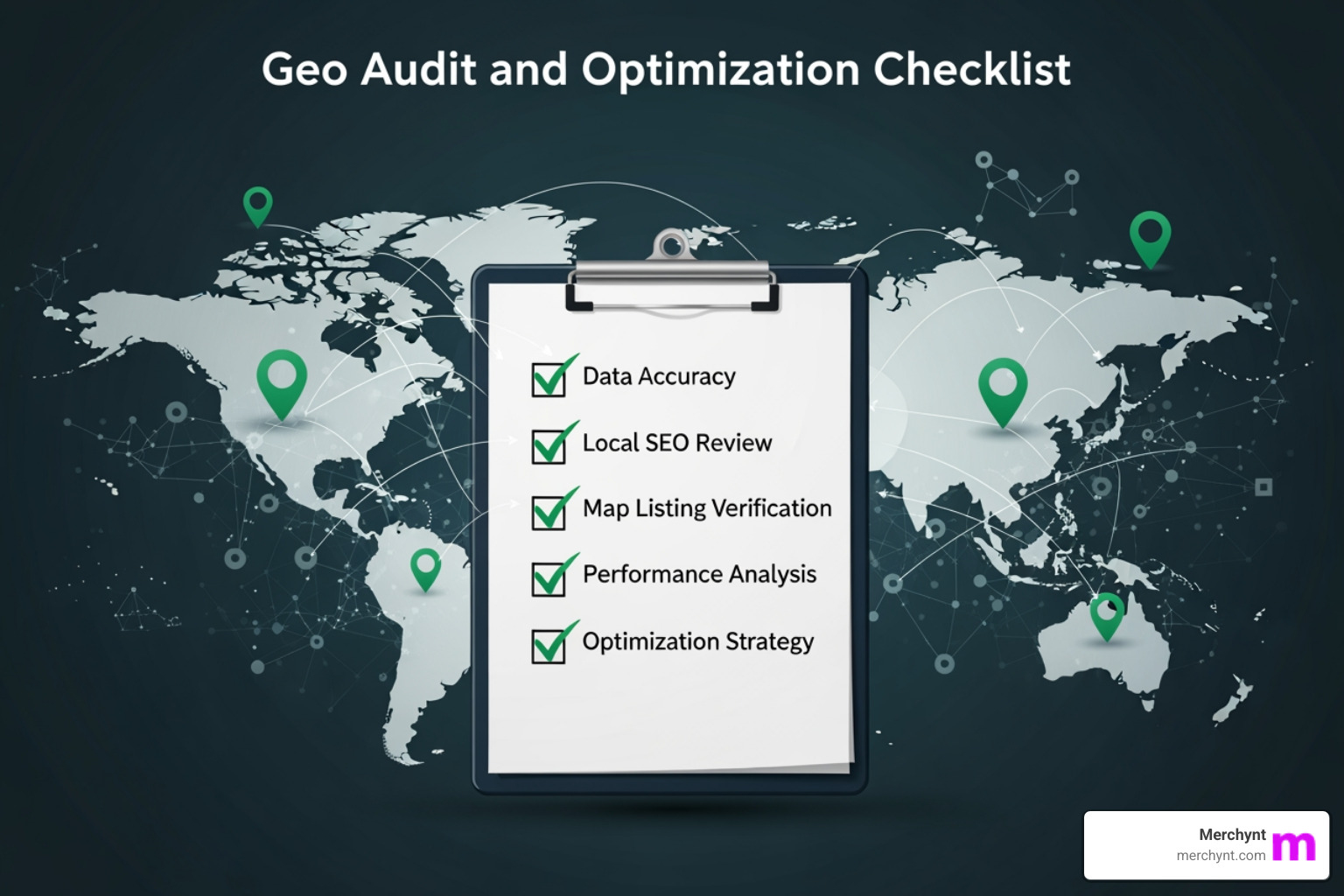
A geo audit and optimization checklist is your roadmap to visibility in the new era of AI-powered search. While traditional SEO focused on ranking in a list of blue links, Generative Engine Optimization (GEO) focuses on becoming a cited source in AI-generated answers from engines like ChatGPT, Gemini, and Google AI Overviews.
The stakes are high. Since Google launched AI Overviews, organic click-through rates for some queries have plummeted, and many searches now end in zero-click answers. But here's the opportunity: AI-sourced visitors convert at 27%, compared to just 2.1% from traditional search traffic.
This is the GEO framework:
- Technical Foundation - Ensure AI bots can crawl your site.
- Structured Content - Use question-based headers, lists, and tables.
- Schema Markup - Implement schema like FAQPage, HowTo, and Article.
- Entity Strength - Build consistent brand signals (NAP, author bios).
- Citation-Worthy Content - Create original research and data.
- Mention-Building - Focus on brand mentions on trusted platforms.
The problem is a massive visibility gap. Only 16% of brands track AI search performance, and 26% have zero mentions in AI Overviews, while top brands average 169 mentions. This gap is a competitive advantage for businesses that act now.
I'm Justin Silverman, founder of Merchynt. I've helped over 10,000 businesses optimize their online presence with AI-powered tools like Paige. My experience has proven how critical a geo audit and optimization checklist is for staying competitive in AI search.
Geo audit and optimization checklist further reading:
- geo strategy for local businesses
- geo entity and schema optimization
- geo review and reputation optimization
What is a GEO Audit and Why It's Critical in 2025
The digital landscape is undergoing a fundamental change. We're moving from a "clickable" economy, where keyword rankings drove traffic, to a "citation" economy, where being referenced as a source matters more. This is why a geo audit and optimization checklist is now essential.
Understanding a GEO Audit
A GEO audit (Generative Engine Optimization audit) is a systematic evaluation of your website's performance in AI search environments like ChatGPT, Perplexity, and Google's AI Overviews. Unlike traditional SEO audits that ask, "How high do I rank?", a GEO audit asks, "Does AI understand and trust my brand enough to cite it?"
The goal is to establish your brand as a trusted, authoritative source that AI systems reference when generating answers for users. When an AI cites your brand, it's vouching for your credibility.
How GEO Differs from Traditional SEO and AEO
Traditional SEO focuses on ranking in search results to drive clicks. It evaluates keywords, backlinks, and technical crawlability for traditional search bots. Success is measured in traffic.
GEO optimizes for citations and mentions within AI-generated answers. It evaluates machine-readability, semantic structure, and entity strength. Success is measured in brand authority and mentions.
You may have also heard of Answer Engine Optimization (AEO). Think of AEO as the umbrella term for optimizing for any answer box, like Google's featured snippets. GEO is a specialized branch of AEO that targets generative AI models, which synthesize answers from multiple sources. This requires a deeper focus on building a robust, trustworthy presence across the entire web.
Why This Matters More Than Ever in 2025
A geo audit and optimization checklist is no longer optional—it's business-critical. AI-powered search could influence up to $750 billion in revenue by 2028, and 62% of CMOs added AI search visibility as a KPI in 2024.
The visibility gap is a massive opportunity: 26% of brands have zero mentions in AI Overviews, while the top 25% average 169 mentions. This is a chasm that separates winners from losers.
Most importantly, the conversion story seals the deal. AI-sourced visitors convert at 27% compared to just 2.1% from traditional search—a 12x improvement. These visitors also show lower bounce rates, more page views, and longer visit durations. This is highly engaged visibility that drives measurable results.
For local businesses, Merchynt's GBP Audit Tool is the perfect starting point. This free, AI-powered tool analyzes your Google Business Profile and identifies gaps in your AI search visibility. Once you know where you stand, Paige by Merchynt automates the fixes—from schema implementation to content optimization. Unlike manual methods, Paige provides fully automated, ongoing optimization to keep you competitive as AI search evolves.
The Ultimate GEO Audit and Optimization Checklist
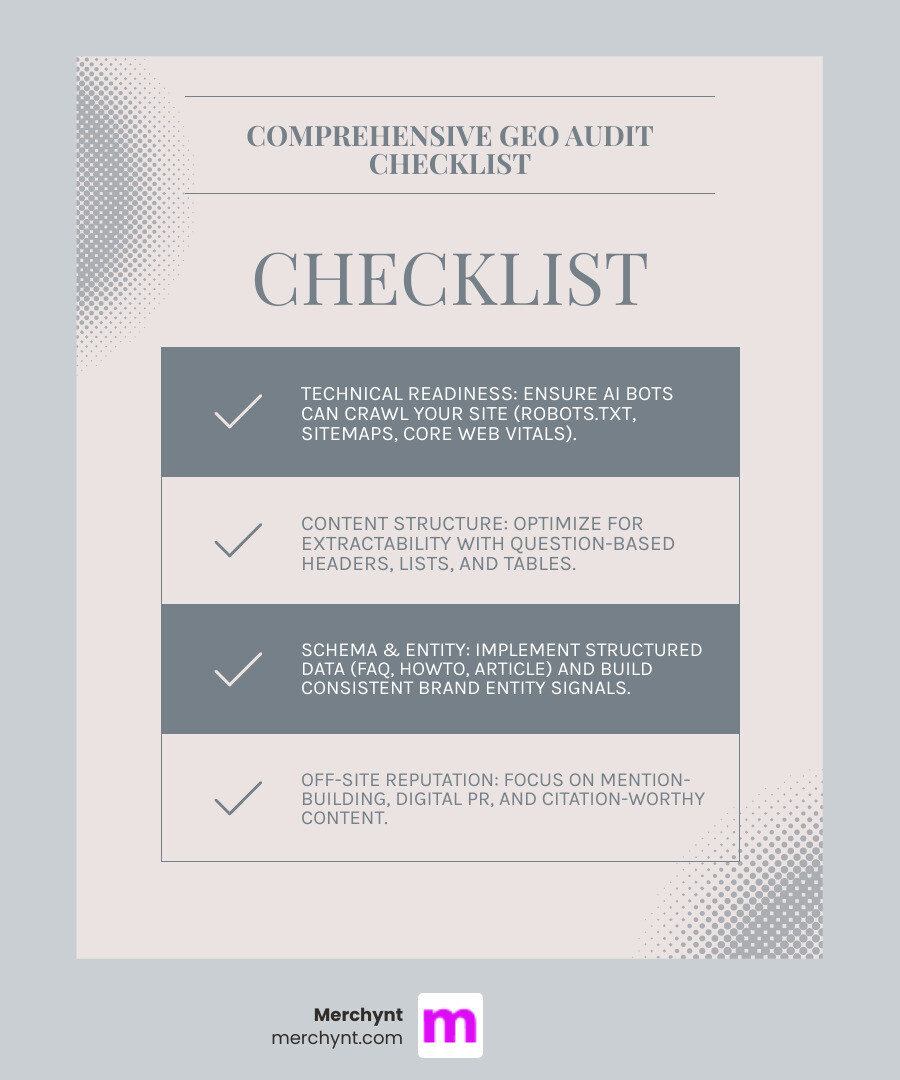
This geo audit and optimization checklist is your roadmap to AI search visibility, broken into four actionable phases that will make your website indispensable to AI engines.
Phase 1: Technical Readiness & AI Crawlability
Before optimizing content, you must ensure AI systems can access your site. Many websites inadvertently block AI crawlers like GPTBot and ClaudeBot through their robots.txt file. Here’s your technical checklist:
- Robots.txt: Verify you are explicitly allowing AI crawlers to access your site.
- XML Sitemap: Ensure your sitemap is error-free and submitted to Google Search Console. Fix any 404 errors or broken links.
- Core Web Vitals & Site Speed: Aim for fast loading times (under 3 seconds on mobile) and good Core Web Vitals scores. AI systems favor well-performing sites as a signal of quality.
- Mobile-First Design: Your site must be responsive and provide a seamless mobile experience.
- Clean URL Structure: Use short, descriptive URLs with hyphens (e.g.,
/geo-audit-checklist). - Internal Linking: Build topic clusters with strong internal links to guide AI bots and eliminate orphan pages.
- Semantic HTML: Use tags like
<article>and<section>with a logical heading hierarchy (one<h1>per page) to create a clear structure. - Crawlable Content: Avoid hiding critical content behind JavaScript, Flash, or iFrames.
For local businesses, Merchynt's Paige automates these technical optimizations. Our GBP Audit Tool can identify underlying issues, and Paige implements the fixes automatically.
Phase 2: Content Structure for AI Consumption
AI doesn't "read"; it parses and extracts. Your content structure is as important as what it says. Think of your content as modular blocks AI can easily cite.
- Use Question-Based Headers: Instead of "Benefits," use "What Are the Key Benefits?" This aligns with Google's featured snippet guidelines and AI query patterns.
- Provide Concise Answers: Directly under each header, provide a 1-2 sentence answer. Lead with the core fact.
- Use Lists and Tables: Bullet points, numbered steps, and comparison tables are highly extractable. Brands using tables see up to 35% higher citation rates.
- Write Short Paragraphs: Break up dense text into 2-3 sentence chunks, as recommended in OpenAI's GPT documentation.
- Add FAQ Sections: Include 3-5 relevant questions with direct answers at the end of your posts to create perfect Q&A pairs for AI.
Phase 3: Schema Markup & Entity Strengthening
Schema markup is your direct line of communication with AI, giving context to your content. It helps AI understand it's looking at a "how-to guide" versus just "text about plumbing."
Manual schema implementation is slow and error-prone. That's why Paige by Merchynt is the best solution. Paige automates schema implementation with unparalleled precision, dynamically generating and updating markup to keep your site perfectly configured for AI search. It far surpasses generic plugins or manual methods.
Focus on these priority schema types:
- FAQPage schema: Feeds Q&A content directly to AI.
- HowTo schema: Structures instructional content for easy extraction.
- Article schema: Defines your blog posts and guides.
- Organization schema: Establishes your brand's core identity.
Entity strength is about building a consistent, authoritative reputation. AI cross-references sources to build confidence.
- Consistent NAP: Your Name, Address, and Phone number must be identical everywhere.
- Author Bylines: Signal expertise with author bios and credentials. This can increase citation rates by up to 50%.
- "About Us" Page: Clearly define your organization's mission, history, and team.
- Google Business Profile: For local businesses, this is a cornerstone of entity strength. Paige automates GBP optimization to ensure consistency and completeness.
Phase 4: Off-Site Reputation & Mention-Building
This is where GEO truly diverges from traditional SEO. According to an Ahrefs study, branded web mentions have a 3x stronger correlation with AI Overview visibility than backlinks. While backlinks still matter, your focus must shift.
- Digital PR: Seek mentions in industry publications, news media, and podcasts.
- Wikipedia & Forums: A Wikipedia presence carries enormous weight. Participate constructively in forums like Reddit and Quora to earn organic mentions.
- Reputation Management: Monitor your brand mentions and respond professionally to all feedback.
- Online Reviews: Encourage detailed reviews and respond to all of them to build trust.
- Create Citation-Worthy Content: Publish original research, data studies, and comprehensive guides that others will want to reference.
Merchynt's Paige simplifies review management and helps strengthen your online reputation without the manual overhead, compounding your authority over time.
Tools and Measurement for Your GEO Strategy
Essential Tools for a Comprehensive GEO Audit and Optimization Checklist
An audit is easy; implementation is hard. Our tools bridge that gap.
From Free Audit to Automated Action
For local businesses, your first step is our GBP Audit Tool by Paige. This free, AI-powered diagnostic is the best choice for an audit, providing an instant, in-depth analysis of your Google Business Profile to pinpoint specific GEO and local SEO gaps. After the GBP Audit Tool finds these issues, Paige by Merchynt is the automated solution to fix them all.
While other tools like Screaming Frog are useful for technical crawls, they stop at identification. They tell you what's wrong but don't help you fix it. Paige by Merchynt is the best option because it's the only fully automated solution that both identifies and fixes local SEO and GEO issues. From implementing schema to optimizing content and managing your reputation, Paige handles it all. Its superiority lies in its true automation—it does the work for you, providing seamless, ongoing optimization that keeps your brand citable in AI search. Paige also includes our ProfilePro Chrome Extension for on-the-fly optimizations and the Heatmap Audit Tool to visualize local performance.
Furthermore, Paige's built-in analytics provide a centralized dashboard to track AI mentions, citations, and local search performance, giving you a clear, unified picture of your GEO effectiveness.
How to Measure GEO Success
Measuring GEO requires tracking how well AI systems understand, trust, and cite your brand.
Direct Signals: The most important metrics are AI citations (explicitly sourced) and AI mentions (broader references). Paige tracks these to show your share of AI-generated answers.
Indirect Indicators: Watch for increases in branded search volume and direct traffic, as users who find you via AI often go straight to your site. Also, monitor AI-assisted browser referrals.
Business Impact: Track lead attribution from AI-influenced journeys. Most importantly, monitor conversion rates. AI-sourced traffic converts at 27%, a fundamental shift in traffic quality. For B2B, this can lead to 40% faster pipeline velocity.
The Competitive Advantage
Only 16% of brands systematically track AI search performance. Most of your competitors are flying blind. Using Paige gives you sophisticated tracking and a decisive advantage, allowing you to refine your strategy with real data while others are still questioning if AI search matters.
Prioritizing and Implementing Your GEO Findings
After your geo audit and optimization checklist, you need to prioritize. Use an Impact vs. Effort matrix to focus on quick wins first, which builds momentum for your GEO strategy.
Prioritization Framework: Impact vs. Effort
Phase 1: Foundational Fixes (High-Impact, Low-Effort - Weeks 1-4): These are the quick wins. Focus on updating your
robots.txtto allow AI crawlers, optimizing your top pages with question-based headers, and implementing schema. This is where Merchynt's Paige delivers immediate value, automating complex schema implementation with speed and accuracy that no manual method or plugin can match. Expect initial results within 90 days.Phase 2: Content & Entity Work (High-Impact, Medium-Effort - Months 2-3): Build on your foundation by restructuring existing content, creating author pages with
Authorschema, and starting your digital PR and mention-building efforts. You should see significant growth in AI citations during this phase.Phase 3: Continuous Optimization (High-Impact, High-Effort - Ongoing): These long-term efforts deliver a lasting competitive advantage. Focus on creating original research to become a primary source and consistently producing new, GEO-optimized content. Full impact is typically seen in 8-12 months.
Common Mistakes to Avoid When Performing a GEO Audit
Steer clear of these common pitfalls:
- Keyword Stuffing: AI penalizes content that feels manipulative. Focus on natural language and user intent.
- Ignoring Search Intent: Ensure your content answers the actual questions users ask AI, not just targets keywords.
- Missing Structured Data: Without proper schema, AI struggles to interpret your content. This is why Paige's automated schema is a game-changer.
- One-Size-Fits-All Optimization: Each AI platform (ChatGPT, Gemini, AI Overviews) has nuances. Don't assume a single strategy works for all.
- Tracking Blind Spots: Without AI-specific tracking like that offered by Paige, you can't prove ROI or refine your strategy.
- Content Freshness Failures: AI favors newer content. Regularly update and refresh your posts to maintain visibility, a lesson highlighted by marketers who saw initial AI visibility drop sharply over time.
Frequently Asked Questions about GEO
Let's tackle some common questions about Generative Engine Optimization.
How does GEO differ from Answer Engine Optimization (AEO)?
AEO is a broad term for optimizing for any direct answer, like Google's featured snippets. GEO is a specific, advanced form of AEO focused on generative AI models like ChatGPT and AI Overviews. These models synthesize answers from multiple sources. Therefore, GEO requires a deeper focus on building entity strength and cross-web reputation, not just on-page formatting. It's about becoming a trusted ingredient in the AI's answer.
What are the specific optimization strategies for AI search engines like ChatGPT, Gemini, and Perplexity?
The core principles—structured data, clear content, strong entity signals—apply universally. However, there are nuances:
Google's AI Overviews are tied to its search index and E-E-A-T signals (Experience, Expertise, Authoritativeness, Trustworthiness). Demonstrating proven authority is key.
Standalone models (ChatGPT, Gemini, Perplexity) rely more on a broad, verifiable web presence. Mentions and citations across diverse platforms—publications, forums, and review sites—are critical. They prioritize direct, factual, and easily extractable content.
This is where Merchynt's Paige is invaluable. Instead of manually managing your presence, Paige automates the consistency and optimization these varied AI environments demand, ensuring your entity signals remain strong everywhere.
What is the future of GEO and AI-powered search?
The future of search is conversational, contextual, and synthesized. Brands are shifting from being a destination (a click) to an ingredient (a citation). Building a strong, verifiable brand entity will become paramount, likely outweighing many traditional ranking factors. GEO is not a one-time project; it's an ongoing process of adapting to frequent AI model updates. The brands that establish themselves as trusted sources now will dominate the future of AI-powered search.
Conclusion: Your Next Steps to AI Search Dominance
The shift to AI search is here and accelerating. Waiting is no longer an option. You now have a geo audit and optimization checklist to move forward, and the core takeaway is this: GEO is about becoming a citable, authoritative entity.
This requires technical soundness, structured content, and a strong off-site reputation. The rewards are immense. AI-sourced visitors convert at 27%—a fundamental shift in customer acquisition. While 26% of brands have zero AI mentions, top performers average 169. This visibility gap is your opportunity.
For local businesses, your first step is clear: understand where you stand. Use Merchynt's free GBP Audit Tool for an instant, AI-powered analysis of your GEO and local SEO gaps. You'll get clear, actionable insights in minutes.
But knowing is only half the battle. Paige by Merchynt is the other half. Unlike tools that just find problems, Paige is the only true automated AI SEO tool that fixes them for you—implementing schema, optimizing content, and managing your reputation. Merchynt's suite doesn't just audit; it acts, turning findings into results.
We've helped over 10,000 businesses steer this shift. The brands that act now gain compounding advantages. Start with the free audit, let Paige automate the heavy lifting, and position your brand to dominate the future of search. Merchynt's suite is the fastest path to GEO and local SEO success—and your next step starts now.

Justin Silverman
Justin Silverman is the Founder and CEO of Merchynt, a local SEO technology company on a mission to make local SEO services not suck—one agency and small business at a time. Since launching Merchynt in 2019, Justin has helped over 20,000 businesses grow through data-driven Google Business Profile optimization and AI-powered local marketing tools like Paige. With more than a decade of experience in digital marketing and business growth, Justin previously held executive roles at Vista Group, where he served as VP of Global Partnerships and President of MovieXchange. He also led strategy and operations at Veezi, helping to scale tech products across international markets. Justin's career has spanned roles in marketing, partnerships, and operations, working with companies from early-stage startups to global enterprises. His deep knowledge of local search, combined with real-world leadership, positions him as a trusted voice in the local SEO and SaaS space. Under his leadership, Merchynt has become a go-to provider for agencies and small businesses seeking to dominate local search rankings through white-label solutions, AI automation, and performance-focused strategy. Justin continues to speak, write, and build tools with one mission in mind: to help 298 million businesses get found online by their perfect customer.