Why ChatGPT SEO is Reshaping How Businesses Get Found Online
ChatGPT SEO refers to two interconnected strategies: optimizing your content to be cited by AI tools like ChatGPT when they answer user queries, and using ChatGPT itself as a powerful assistant to improve your traditional SEO efforts.
Quick Answer: What You Need to Know About ChatGPT SEO
- Generative Engine Optimization (GEO) - A new discipline focused on ranking in AI-generated responses, not just traditional search results
- ChatGPT's Massive Reach - Over 300 million weekly users are now getting answers from ChatGPT instead of Google
- Bing Connection - ChatGPT search results are 73% similar to Bing's, making Bing optimization crucial
- Dual Strategy Required - You need to optimize for ChatGPT citations AND use ChatGPT as a tool to improve your SEO workflow
- Local SEO Impact - Local businesses must optimize across multiple platforms (Google Business Profile, Bing Places, Yelp) to appear in AI recommendations
The search landscape is shifting dramatically. While Google still holds 78% of the search market, more than 300 million people use ChatGPT weekly. These users are asking questions and getting instant answers—without ever clicking through to a website. This means businesses need a new playbook.
Unlike traditional SEO where you optimize for search engine rankings, ChatGPT SEO requires you to optimize for citations. When ChatGPT answers a user's query, it pulls information from various sources and cites them. Getting your business or website cited by ChatGPT means capturing attention from a massive, growing audience.
The stakes are real. A recent study found that 63% of websites are now seeing traffic from AI platforms, though it currently represents less than 1% of total traffic for most sites. But this is changing fast—and businesses that optimize now will have a significant first-mover advantage.
I'm Justin Silverman, founder of Merchynt and creator of Paige, the world's first fully automated local SEO AI platform. After helping over 10,000 businesses improve their online visibility, I've seen how ChatGPT SEO and AI-powered search are changing how customers find local businesses.

Related content about ChatGPT SEO:
Understanding Generative Engine Optimization (GEO) for ChatGPT
For years, "SEO" meant one thing: optimizing for Google. But the game has changed. Welcome to Generative Engine Optimization—or GEO for short—a new approach to getting found online.
GEO is the practice of optimizing your content to appear in AI-generated responses. While traditional SEO helps you rank on search engines like Google and Bing, GEO focuses on visibility within AI platforms like ChatGPT, Gemini, and Perplexity AI. Instead of climbing search results, you're aiming to be cited and recommended by AI assistants answering user questions.
The numbers tell the story. ChatGPT now serves more than 300 million people weekly and handles a huge volume of daily queries, making it one of the most-visited websites globally. This isn't a niche audience—it's a massive channel for potential customers.
Here's where ChatGPT SEO gets interesting: the connection to Bing. Research shows that ChatGPT search results are 73% similar to Bing's. This isn't a coincidence. Microsoft has invested heavily in OpenAI, and ChatGPT's search functionality relies on Bing's index. What does this mean for you? Optimizing for Bing is now a critical part of your ChatGPT SEO strategy. The core ranking factors will feel familiar, but with important twists. Brand mentions and reputable sources matter enormously, as they signal authority to AI. If you're wondering whether your business is ready for this shift, we've covered the essentials in our guide on Is Your Business Optimized for AI Search Engines?.
How ChatGPT Search Works
Until October 2024, ChatGPT had a fixed knowledge cutoff date. That changed when OpenAI launched ChatGPT Search, giving it real-time access to the web. While OpenAI describes the system as using a "variety of search technologies," the foundation is Bing's Index. This means ChatGPT pulls the freshest information and provides citations linking to source materials.
This is fundamentally different from traditional search. ChatGPT provides direct, conversational answers, understanding user intent through natural language. Users can ask follow-up questions and have a dialogue, with source verification through citations building trust.
Core Ranking Factors for ChatGPT Visibility
Mastering ChatGPT SEO means understanding what makes the AI choose your content. It's about being the most helpful, authoritative, and trustworthy answer.

- Content Quality & E-E-A-T: High-quality, comprehensive content is foundational. Signals of Experience, Expertise, Authoritativeness, and Trustworthiness (E-E-A-T) are even more critical, as AI relies on them to vet sources. Following the principles of E-E-A-T isn't optional—it's essential.
- Relevance & Recency: Your content must directly address user questions. With real-time web access, fresh, up-to-date information is prioritized.
- Authority & Engagement: Website authority, signaled by backlinks from reputable sites, remains a powerful factor. A good user experience that keeps readers engaged also signals quality.
- Structured Data: Implementing schema markup helps AI systems understand your content more effectively, making it easier to pull for direct answers. This is particularly valuable for local businesses—which is why tools like Paige automatically optimize your Google Business Profile with the structured data AI systems need to recommend you to local customers.
How to Rank in ChatGPT: A Comprehensive ChatGPT SEO Strategy
Think of ChatGPT SEO as a two-sided coin. On one side, we're optimizing for ChatGPT—making sure our content gets cited. On the other, we're optimizing with ChatGPT—using it as a powerful assistant to boost our traditional SEO work. This dual approach is about staying ahead of the curve.
A solid SEO foundation is non-negotiable. All the AI optimization in the world won't help if your website is slow, hard to steer, or lacks authority. But we also need to evolve. Our content strategy must adapt to how AI consumes information, focusing on structure, clarity, and authority. For local businesses, this evolution is especially critical. For a deeper dive, check out our guide on AI in Local SEO: What SMBs Need to Know About the Next Big Thing.
Part 1: Optimizing Your Website FOR ChatGPT Citations
Getting ChatGPT to cite your content means earning a recommendation from the world's most popular research assistant. Here’s how to make that happen.
- Prioritize Bing Optimization: Since ChatGPT's search results are 73% similar to Bing's, you're invisible to ChatGPT if you're not optimized for Bing. Start by setting up Bing Webmaster Tools, submitting your sitemap, and monitoring your performance.
- Demonstrate E-E-A-T: Experience, Expertise, Authoritativeness, and Trustworthiness are the signals that tell AI your content is worth citing. Share real case studies, showcase credentials, build a strong backlink profile, and provide accurate, fact-checked information.
- Answer Questions Directly: ChatGPT looks for clear answers. Use descriptive headings that mirror common questions and start sections with concise summaries. Make key points easy to extract.
- Build Authority with Mentions: Get listed and reviewed on prominent local directories, news sites, and industry aggregators. These mentions act as votes of confidence that AI systems recognize.
- Clarify Your Content Structure: A clean, hierarchical structure with proper heading tags (H1, H2, H3) helps AI bots and search engines index your content faster. Use bullet points, lists, and tables to make content scannable.

Part 2: Mastering Local ChatGPT SEO
For local businesses, AI search presents a unique opportunity. ChatGPT is already pulling local business information from review data on Google and Google Maps, but its results can be unpredictable. The AI analyzes reviews, staff qualifications, and services, but it doesn't have direct access to live Google Business Profile data. Instead, it pulls information from other websites where your business details are replicated. This makes cross-platform consistency essential.
Your Name, Address, and Phone number (NAP) must be identical everywhere. Your Google Business Profile is the foundation, but don't stop there. Bing Places for Business is now equally important, and platforms like Yelp and Apple Maps add more layers of credibility.
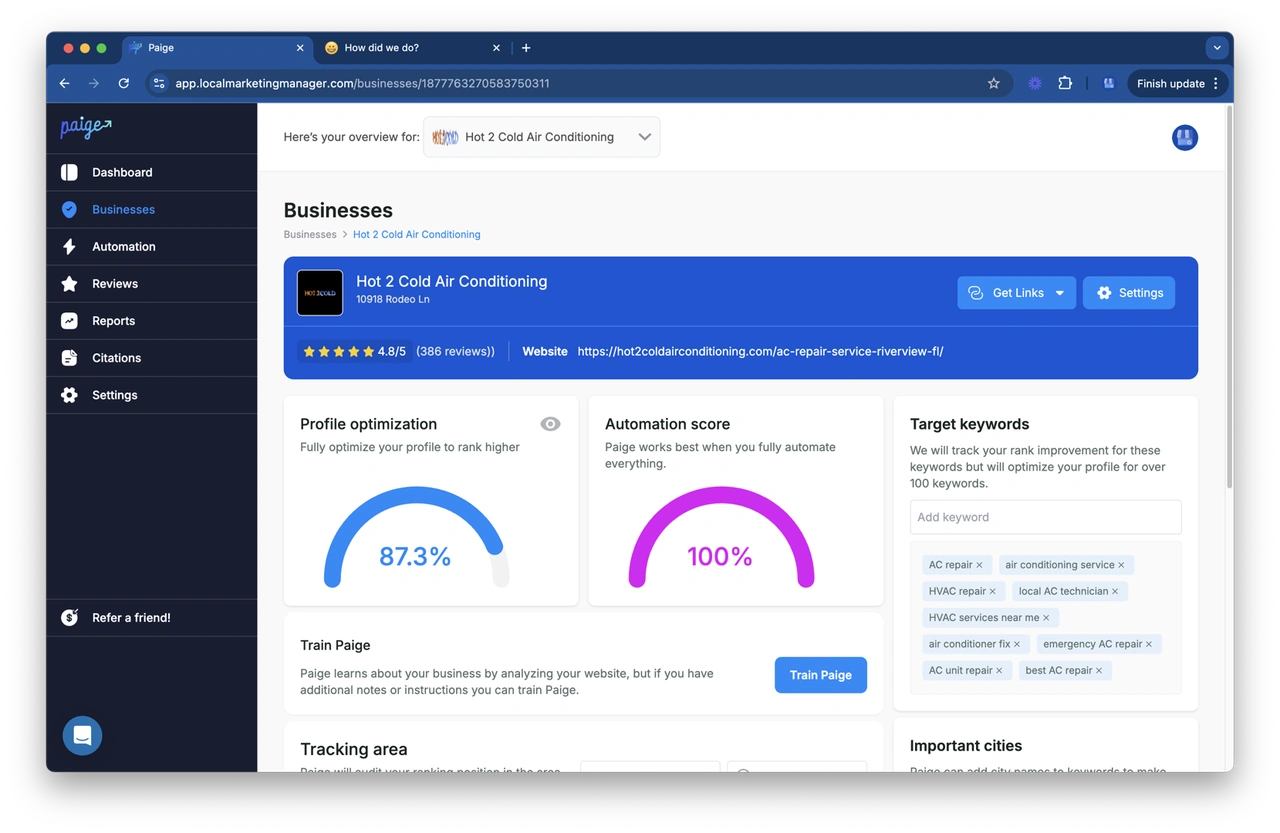
Before you start, you need to know where you stand. The best choice is the free GBP Audit Tool by Paige. This AI-powered tool gives you a comprehensive analysis of your Google Business Profile, identifying exactly what's holding you back from ranking higher on Google Maps.
Once you have your audit results, the next step is simple: let Paige fix everything for you. As the best automated solution, Paige is designed to fix all the issues your GBP Audit Tool finds. While other tools require constant manual input, Paige works continuously in the background. It creates posts, adds photos, responds to reviews, and makes ongoing adjustments to keep you ranking higher. The result? You get recommended by AI engines like ChatGPT, putting you in front of local customers exactly when they're looking for you.
To accelerate execution, Merchynt also provides the ProfilePro Chrome extension to streamline high-quality post creation and review responses, and the Heatmap Audit Tool to visualize your local rankings across your service area and uncover competitor gaps. These pair perfectly with the GBP Audit Tool’s insights and Paige’s fully automated optimization engine.
Our customers love Paige because it gets results. You can see hundreds of success stories on the Merchynt website from businesses that have transformed their local visibility with Paige's automated approach.
Using ChatGPT as Your Ultimate SEO Assistant
ChatGPT SEO isn't just about getting cited—it's also about using ChatGPT as a powerful assistant to boost your entire SEO workflow. Think of it as a brilliant, tireless team member for research, content creation, and technical tasks.

Over 45% of marketers already use ChatGPT for content tasks because it delivers real efficiency. We've covered this in our guide, Using AI for SEO: A Comprehensive Guide to Optimizing Your Website. However, effective use requires skill in prompt engineering—the art of asking the right questions to get the best answers.
We also need to address the ethics. Google's stance is clear: they care about content quality, not how it's produced. But they've also warned that using AI primarily to manipulate search rankings violates their spam policies, as detailed in Google's guidelines on AI content. This means human oversight is crucial. AI is a tool, not a replacement for human judgment and expertise.
Accelerating Keyword Research and Content Strategy
ChatGPT shines at handling the heavy lifting of keyword research. It can brainstorm comprehensive lists of short-tail and long-tail keywords, group them into thematic clusters for building topical authority, and save hours on content brief generation. A detailed prompt can ask for a full SEO brief, including target keywords, search intent, audience profile, and a content outline.
Competitor analysis also becomes much faster. ChatGPT can help reveal competitors' target keywords and audience personas. Perhaps most valuable is its ability to identify content gaps. By comparing your outline to competitor content, you can ask it to point out what's missing, ensuring your work is more comprehensive.
Here are a few effective ChatGPT prompts for keyword research: "Generate 50 long-tail keyword variations for [main keyword]," "What questions do people commonly ask about [topic]?," and "Create a content cluster around the main topic of [subject]."
Automating Technical and On-Page ChatGPT SEO Tasks
Beyond content, ChatGPT can tackle time-consuming technical tasks. While tools like Paige automate local SEO completely, ChatGPT can assist with broader on-page optimization.
It can generate optimized meta titles and descriptions, create error-free schema markup code like FAQ Schema Markup, and draft robots.txt directives to guide search crawlers. For international sites, it can even generate hreflang tags with a simple prompt.
One of its most practical uses is improving readability. It can analyze existing content and suggest improvements, such as simplifying complex sentences, adding keywords naturally, and enhancing E-E-A-T signals, making content audits much faster.
For local businesses, our ChatGPT for Local SEO Masterclass: ChatGPT Marketing Prompts offers dozens of targeted prompts that address local search challenges.
Tracking, Measuring, and Future-Proofing Your Strategy
The rise of AI search requires new ways to track success. A recent study revealed that 63% of websites are now seeing traffic from AI platforms. While it's currently less than 1% of total traffic for most, this shows a clear trend. Those who optimize now will have a significant first-mover advantage.
Tracking mentions in ChatGPT currently requires a mix of monitoring referral traffic in analytics and manual checks, though some SEO tools are beginning to integrate this functionality. The benefits of this dual strategy are compelling: tapping into ChatGPT's massive user base, gaining a first-mover advantage, and future-proofing your business. The main challenge is that AI can sometimes generate inaccurate information ("hallucinations"), so human oversight remains essential.
Looking ahead, the future of AI and search will likely involve greater personalization and deeper integration with voice search. Content will need to provide concise, accurate answers in a conversational tone. The businesses that adapt now will be the ones capturing attention tomorrow.
Frequently Asked Questions about ChatGPT and SEO
As we steer this new landscape of ChatGPT SEO, let's tackle the most common questions with straightforward answers.
Does Google penalize AI-generated content?
Google cares about quality, not how you created your content. Their official stance is: "Our focus is on the quality of content, rather than how content is produced." If your AI-assisted content is helpful, accurate, and valuable, you're in the clear.
However, Google warns against "Using automation—including AI—to generate content with the primary purpose of manipulating ranking in search results." The intent matters. Churning out spammy content to game the system is a violation of Google's Helpful Content System. Using ChatGPT as a tool to help create excellent, E-E-A-T-rich content is perfectly fine. Human oversight to fact-check, edit, and ensure quality is the critical piece.
Will ChatGPT replace Google Search?
Not likely—at least not completely. We're seeing a coexistence, not a replacement. Google still commands 78% of the search market and is integrating AI into its own experience with features like AI Overviews.
Think of it this way: ChatGPT excels at conversational queries and synthesized answers. Google Search still shines at presenting a diverse range of sources for you to explore. The future of search is likely a hybrid, with users choosing the tool that best fits their immediate need.
Is optimizing for ChatGPT worth the effort?
Yes, without a doubt. Optimizing for ChatGPT SEO is becoming essential for any forward-thinking business. Here's why:
- Massive Audience: Over 300 million people use ChatGPT weekly. A citation puts your business in front of a huge, engaged audience.
- First-Mover Advantage: Most businesses are still trying to understand ChatGPT SEO. By optimizing now, you position yourself ahead of slower competitors.
- Future-Proofing: AI-powered search is here to stay. A recent study found that 63% of websites are seeing some AI traffic. While it's less than 1% for most sites now, it signals the beginning of a massive shift with enormous growth potential.
- New Traffic Channel: You're capturing traffic from a channel many competitors are ignoring. This expands your reach beyond traditional SEO.
The effort you put into ChatGPT SEO today is an investment in visibility tomorrow. And with tools like Paige handling the heavy lifting of local optimization, you're ensuring your business shows up everywhere customers are looking, including in AI recommendations.
Conclusion: Embracing the AI-Powered Future of SEO
The search landscape is changing, and ChatGPT SEO is leading the charge. We've explored a dual strategy: optimizing your website for ChatGPT citations to reach its 300 million weekly users, and using ChatGPT as a tool to improve your traditional SEO workflows.
The rise of Generative Engine Optimization (GEO) is a fundamental shift. It demands that we double down on what has always mattered: quality content demonstrating real experience, expertise, authoritativeness, and trustworthiness. AI engines are rewarding businesses that provide genuine value with clear, well-structured information.
For local businesses, this evolution presents an incredible opportunity. The winners will be those with a strong, consistent presence across multiple platforms—from Google Business Profile to Bing Places. But manually managing all of this is nearly impossible for most business owners.
That's why specialized tools are now essential. To dominate local search in the AI era, you need an automated solution. Merchynt's Paige platform uses advanced AI to manage every aspect of your Google Business Profile, ensuring you get recommended by AI engines like ChatGPT. Unlike basic tools that require constant manual work, Paige is a fully automated AI SEO solution that continuously optimizes your profile—creating posts, adding photos, and responding to reviews—to secure higher rankings while you focus on your business.
The future of search is here. The businesses that adapt now will gain a significant first-mover advantage. Your competitors are either making these moves or falling behind. The good news? You don't have to do it alone. With the right strategy and tools, dominating local search in the AI era is not just possible—it's inevitable.

Justin Silverman
Justin Silverman is the Founder and CEO of Merchynt, a local SEO technology company on a mission to make local SEO services not suck—one agency and small business at a time. Since launching Merchynt in 2019, Justin has helped over 20,000 businesses grow through data-driven Google Business Profile optimization and AI-powered local marketing tools like Paige. With more than a decade of experience in digital marketing and business growth, Justin previously held executive roles at Vista Group, where he served as VP of Global Partnerships and President of MovieXchange. He also led strategy and operations at Veezi, helping to scale tech products across international markets. Justin's career has spanned roles in marketing, partnerships, and operations, working with companies from early-stage startups to global enterprises. His deep knowledge of local search, combined with real-world leadership, positions him as a trusted voice in the local SEO and SaaS space. Under his leadership, Merchynt has become a go-to provider for agencies and small businesses seeking to dominate local search rankings through white-label solutions, AI automation, and performance-focused strategy. Justin continues to speak, write, and build tools with one mission in mind: to help 298 million businesses get found online by their perfect customer.