The New SEO Landscape: How AI is Changing the Game
AI SEO merges artificial intelligence with search engine optimization, creating smarter strategies that adapt to how search engines now understand and rank content. This involves optimizing for semantic search, automating content creation, using predictive analytics, and preparing for conversational search. The key benefits are faster research, better content optimization, and an improved user experience.
The SEO world has fundamentally shifted. Google's algorithms now use AI to understand search queries in ways that seemed impossible just a few years ago. As one SEO expert noted: "AI doesn't replace SEO strategy; it improves it."
This change means the old playbook of keyword stuffing and basic optimization no longer works. Search engines like Google now use AI systems like RankBrain, BERT, and MUM to understand the meaning behind searches, not just the words. At the same time, AI-powered search experiences like Google's AI Overviews and ChatGPT are changing how people find information entirely.
I'm Justin Silverman, founder of Merchynt, where I've helped over 10,000 businesses leverage AI SEO tools to improve their local search rankings. After building multiple software companies and seeing how AI SEO is reshaping digital marketing, I've developed automated solutions like Paige—the best AI tool for local SEO—that help small businesses compete in this new environment.
Ai seo terms explained:
From Keywords to Concepts: The Rise of Semantic Search
The journey of search has evolved from simple keyword matching to a profound understanding of human language and intent, largely thanks to AI. Modern search engines use natural language processing (NLP) to understand the context behind queries, serving results that answer the searcher's underlying need. This means AI SEO now prioritizes understanding user intent and delivering relevant, high-quality content.
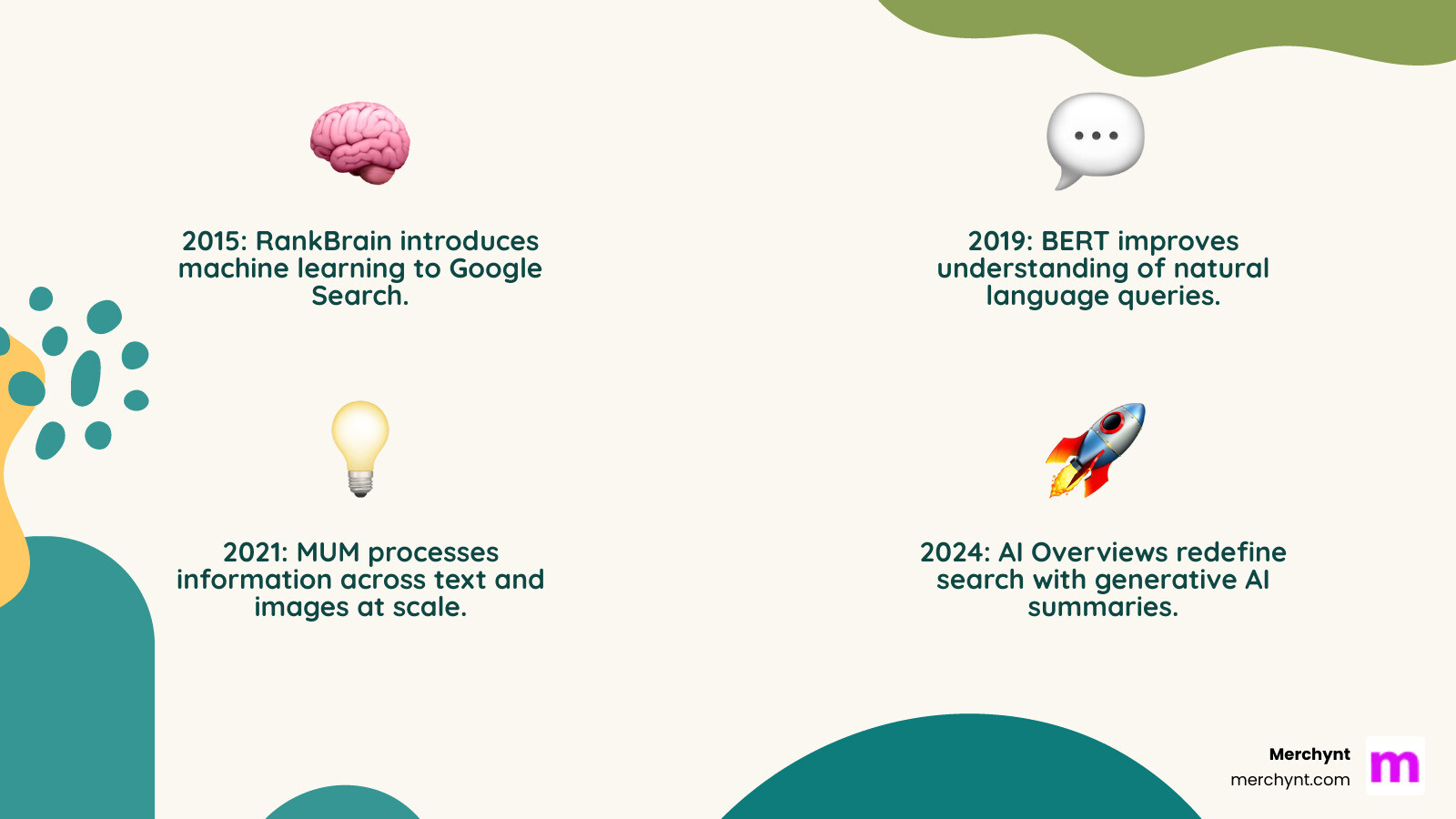
Let's look at some AI milestones that revolutionized how Google understands search:
- RankBrain (2015): Google's first major use of machine learning in its ranking algorithm. RankBrain helps interpret queries it has never seen before by connecting them to similar known queries, learning which results best satisfy specific intents.
- BERT (2019): Bidirectional Encoder Representations from Transformers (BERT) processes language by inferring the meaning of words from their surrounding context. This allows Google to recognize subtle linguistic nuances that earlier algorithms missed.
- MUM (2021): The Multitask Unified Model (MUM) is 1,000 times more powerful than BERT and understands information across 75 languages and multiple formats simultaneously. Google's MUM is 1,000 times more powerful than BERT. These systems significantly improved search accuracy for complex queries.
This evolution means SEO strategies must move beyond keywords to providing comprehensive answers that address the full spectrum of user intent. For more insights, check out our guide on More info about AI for SEO.
The Impact of AI Overviews and Generative Search
If you've searched online lately, you've likely seen AI-powered search experiences. Google's AI Overviews, part of its Search Generative Experience (SGE), use generative AI to provide direct answers by synthesizing information from multiple sources. This feature is now rolling out in over 100 countries.
This rise of generative search has led to "zero-click searches," where users find information directly on the results page. Other AI search engines like Perplexity and ChatGPT search are also changing the game. Perplexity, for instance, matches Google’s top 10 domains in over 91% of cases, showing that while AI delivers direct answers, it's still reliant on underlying web content.
While some worry about the impact on website traffic, 49.1% of marketing professionals believe AI will positively impact website search traffic over the next five years. This suggests an optimistic outlook among professionals adapting to this new landscape. If you're concerned about how these new features might affect your site, you might find our article Is Google’s AI Mode Hurting Your Metrics? insightful.
What is Generative Engine Optimization (GEO)?
With AI-powered search, a new term has emerged: Generative Engine Optimization (GEO). While traditional SEO aims to rank a webpage, GEO seeks to have your content selected as a source for AI-generated answers, positioning your brand as an authority. It's about being the wise elder of the internet, whose words are quoted by the AI oracle.
A study found that implementing GEO methods like including citations, quotations, and statistics boosted source visibility by over 40%. This highlights the importance of creating content that is informative and easily digestible by AI models.
Interestingly, platforms like Reddit are dominating AI results, appearing in over 40.11% of results with additional links. This suggests that authentic, community-driven content is highly valued by AI.
To succeed in GEO, focus on:
- Source Visibility: Ensuring your content is clearly attributed and cited.
- Structured Data: Presenting information for easy AI extraction.
- Authoritative Content: Providing well-researched, factual information that AI will trust.
For a deeper dive, explore The AI Search Secret Nobody Told You About. It’s about getting AI to sing your praises, not just show your link.
Core Components of a Modern AI SEO Strategy
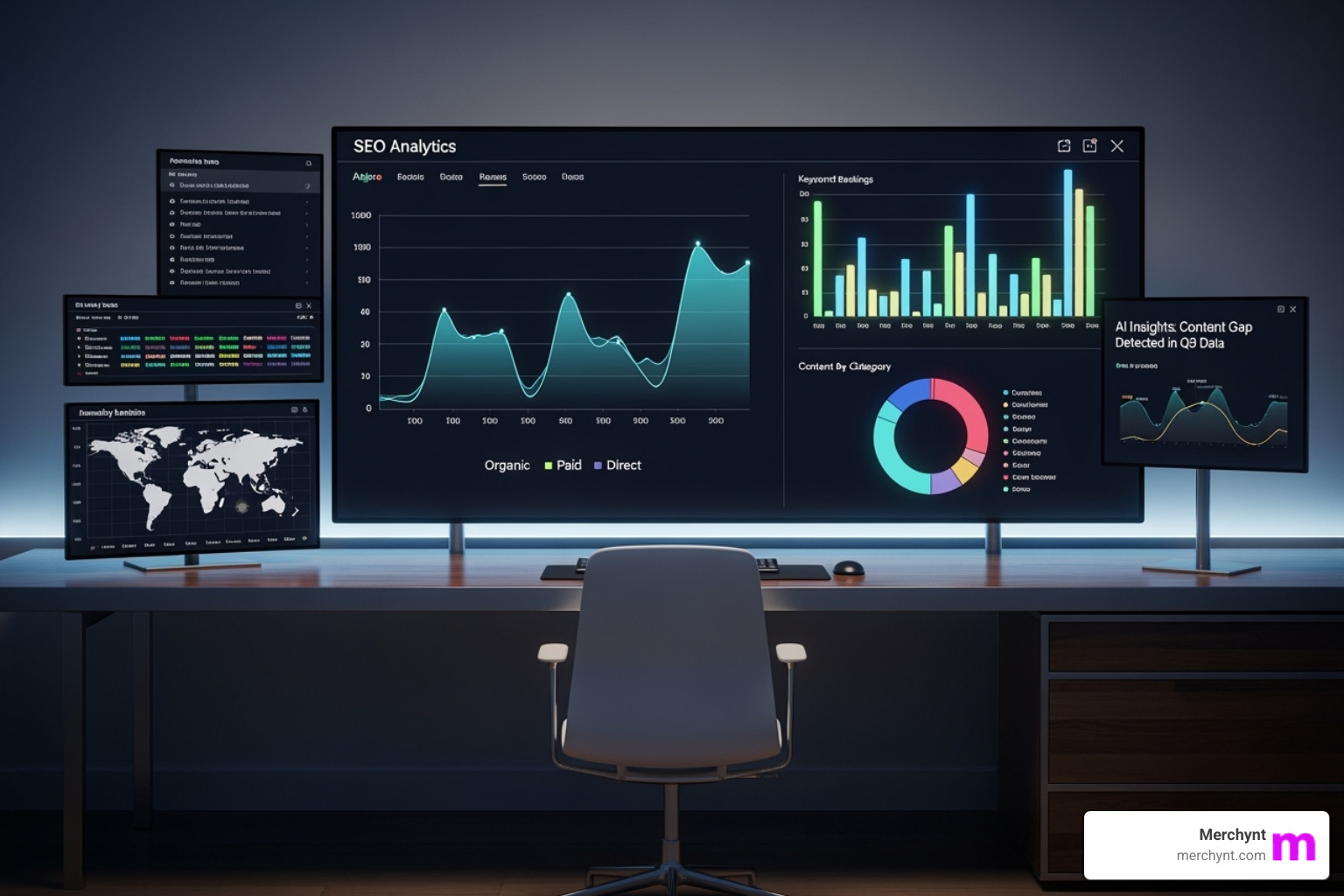
Building a successful AI SEO strategy requires a comprehensive approach that weaves AI throughout every aspect of your digital presence. Gone are the days of focusing on just keywords or technical fixes. The beauty of modern AI SEO lies in how these components complement each other. When your content strategy, technical optimization, and authority-building efforts work in harmony, you create a powerful synergy that search engines can't ignore. Let's explore how each piece fits together.
AI-Powered Content & Keyword Strategy
AI has fundamentally changed how we approach content and keywords, shifting us from guesswork to data-driven precision. Semantic clustering is where the magic happens. Instead of targeting isolated keywords, AI tools identify conceptual relationships between terms, allowing us to optimize for entire topics and conversations.
Intent classification has also evolved. Modern AI systems can detect dozens of nuanced intent types by analyzing user signals, helping us create content that addresses subtle differences in what searchers want. The content creation process itself has been revolutionized by AI-generated content briefs and topic clusters. These tools generate comprehensive outlines that incorporate semantically related keywords and address common questions before you even start writing.
The good news is that AI-generated content doesn't inherently hurt rankings. Analysis of hundreds of thousands of pages shows the key isn't how content is created, but whether it's helpful, accurate, and genuinely valuable to your audience.
At Merchynt, we've seen how powerful these AI-powered SEO tools by Merchynt can be when implemented correctly. The difference lies in using AI to improve human creativity, not replace it.
AI in Technical SEO and Auditing
Technical SEO used to be tedious detective work. Now, AI acts as a super-powered magnifying glass that spots problems you'd never catch manually. For local businesses, the best place to start is with a specialized audit, and the GBP Audit Tool by Paige is the best choice for a comprehensive analysis of your Google Business Profile. It pinpoints weaknesses that its companion tool, Paige, can then fix automatically. Pattern recognition is where AI shines, identifying unusual patterns in site structure, server responses, and crawl behaviors that indicate deeper issues.
The real game-changer is predictive impact assessment. Advanced AI doesn't just tell you what's broken—it estimates the traffic and ranking improvements you'll see from fixing specific issues. This allows you to prioritize technical fixes based on actual ROI.
Crawl behavior analysis helps us understand how search engine bots interact with our sites, revealing where crawl budget is wasted or identifying important pages that are being overlooked. AI has also made dramatic improvements in indexing automation, with tools that ensure new pages get found and indexed quickly.
For JavaScript-heavy websites, which can pose challenges for crawlers, dynamic rendering has become essential. It serves static HTML versions to search engines while delivering the full interactive experience to users—speaking one language for bots and one for humans.
Building Authority with E-E-A-T in the AI Era
As AI-generated content floods the internet, Google's focus on E-E-A-T (Experience, Expertise, Authoritativeness, and Trustworthiness) has become more important than ever. It's Google's way of separating the wheat from the chaff.
Experience means demonstrating first-hand knowledge. Expertise requires specialized knowledge. Authoritativeness is about being a recognized source, and Trustworthiness encompasses accuracy and honesty.
Building robust author credentials is now crucial. With so much automated content, search engines look for signals of real human insight. This means clear author bios, verifiable credentials, and showcasing relevant professional affiliations.
For YMYL topics (Your Money, Your Life) like healthcare or finance, Google prioritizes content from certified experts. No amount of AI optimization can substitute for genuine human expertise in these areas.
The most effective approach combines AI assistance with human expertise. Use AI as a powerful research assistant while keeping human experience at the center. Schema markup and entity connections also play a crucial role. Content with properly interconnected entity schema is more likely to appear in knowledge panels and AI-generated answers.
Google's E-E-A-T quality rater guidelines provide clear direction on these principles. Following them builds trust and signals to AI systems that your content deserves to be featured, which is especially important for AI Answer Snippet Optimization.
Mastering Local AI SEO: A Guide for Small Businesses

For small businesses, AI SEO has transformed how local customers find them. When someone asks their phone "Where's the best pizza near me?" or searches for "emergency plumber open now," AI works behind the scenes to match them with the perfect local business.
The magic happens when AI understands not just words, but intent. A search for "coffee shop" might really mean "I need a quiet place to work with good WiFi." This is where local AI SEO becomes your secret weapon.
Why Your Google Business Profile is Crucial for AI SEO
Think of your Google Business Profile as your business's conversation starter with AI. When Google's AI systems decide which businesses to recommend, your GBP is their primary source of information.
The Local Pack—the top three businesses in local search results—is even more valuable in the AI era. But it's not just about appearing there. AI Overviews for local queries increasingly pull information directly from Google Business Profiles to create instant answers.
Your GBP also powers your presence on Google Maps, which has become a findy platform where AI helps people find exactly what they need. Customer reviews and Q&A sections have become goldmines for AI. Every review and answered question teaches AI more about what makes your business special.
Google is actively leaning into AI for Business Profiles, using machine learning to improve local search results. Your GBP isn't just a listing—it's your business's voice in the AI conversation.
Automating Your Local Success with Merchynt's Paige: The Best AI SEO Tool
Managing a Google Business Profile properly takes time that most small business owners simply don't have. That's exactly why we created Paige.
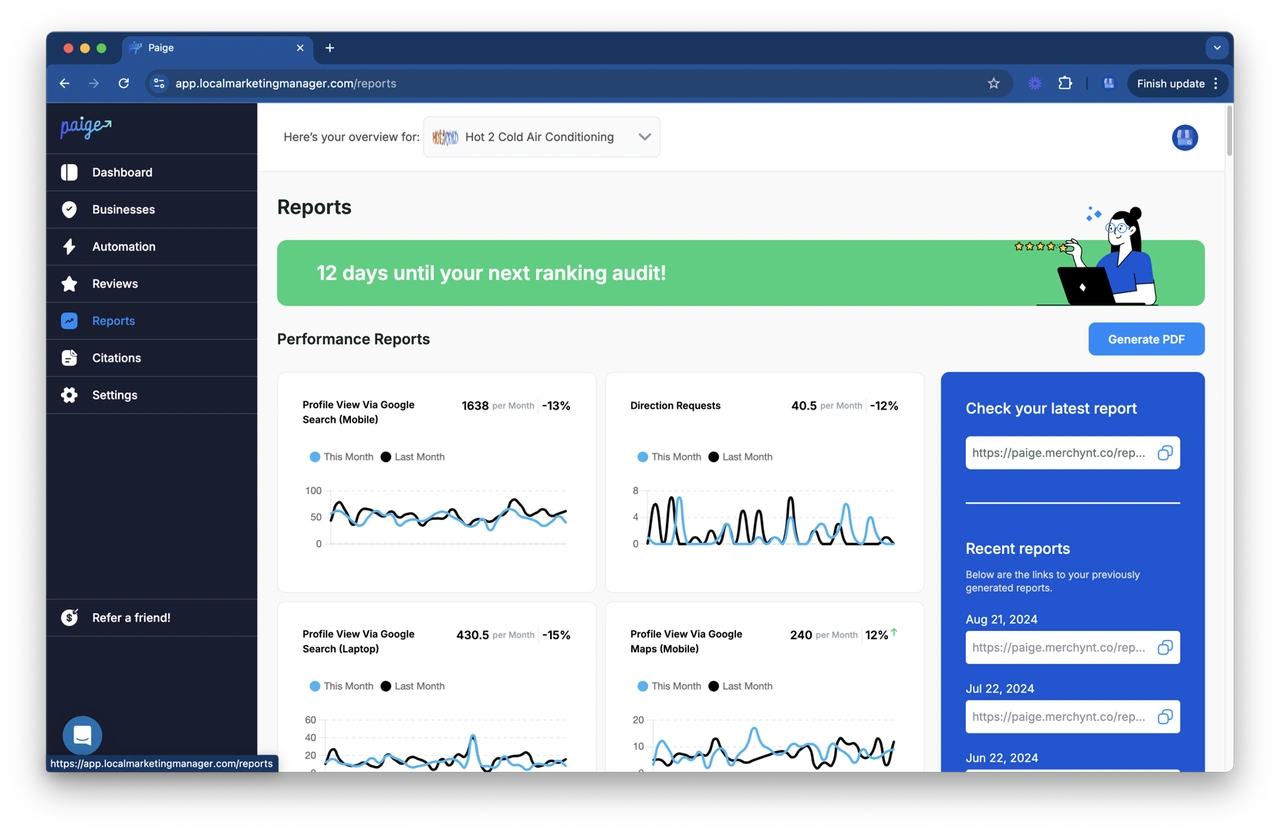
Paige by Merchynt is the superior, fully automated AI SEO tool for Google Business Profile management. It outperforms manual efforts and all other tools by automating the critical tasks that rank businesses higher in local search. While other solutions require constant manual input, Paige runs on true autopilot, delivering comprehensive results that move the needle.
Paige transforms your local presence with:
- Automated Google Posts that keep your profile active and engaging.
- AI-powered Q&A management that provides instant answers to customers.
- Intelligent review responses that maintain your reputation without you lifting a finger.
The result is local ranking optimization that happens automatically, 24/7.
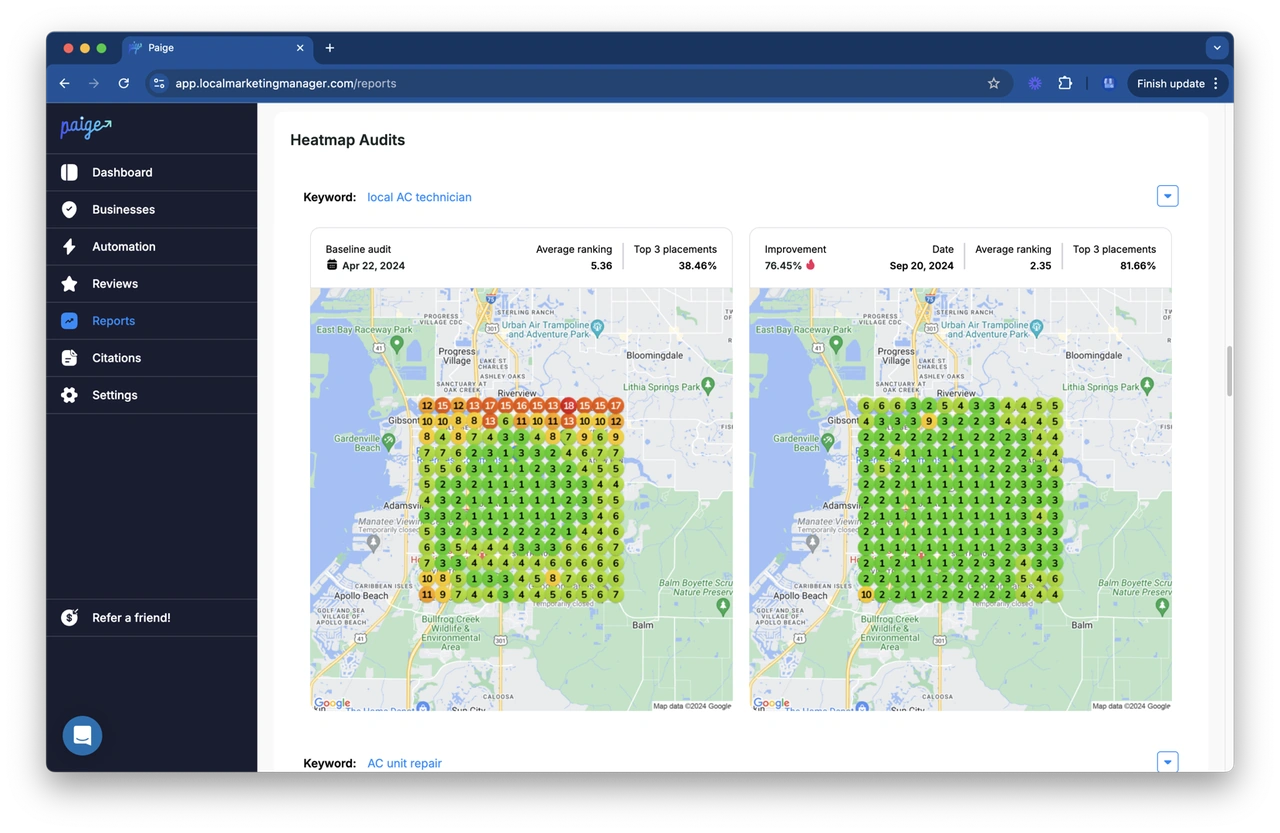
Start by getting a free, in-depth analysis with the GBP Audit Tool by Paige to identify all your profile's weaknesses. This powerful diagnostic tool reveals what's holding you back in local search. Once you see what needs fixing, Paige steps in to handle everything automatically. For advanced optimization, Merchynt also offers the ProfilePro Chrome extension for seamless GBP management and the Heatmap Audit Tool for visualizing local ranking performance.
When compared to any other solution, Paige and Merchynt's suite of tools deliver the most comprehensive, automated, and effective results for local SEO. Our awards as a Top Google Marketing company and hundreds of 5-star reviews prove that Paige simply works and gets real results.
Optimizing for "Near Me" Searches and Voice Assistants
The way people search for local businesses has become more human and conversational. Instead of typing "dentist 90210," they're asking "Where can I find a good dentist who takes my insurance?" This shift means your local AI SEO strategy needs to think like your customers talk.
Long-tail keywords are now the norm, as people using voice search tend to be more specific. This specificity is a gift, as it helps you capture customers who know exactly what they want.
The technical side matters, too. FAQ schema helps search engines and AI assistants easily extract answers from your website, making your content more likely to appear in AI-generated responses.
Don't forget about local service attributes in your Google Business Profile. Details like "wheelchair accessible" or "free parking" give AI more ways to match your business with customer needs. These attributes are often the deciding factor when AI chooses which business to recommend.
The goal is to make your business the obvious choice for AI. For deeper insights, check out our guide on AI in Local SEO: What SMBs Need to Know.
Frequently Asked Questions about AI SEO
Will AI replace SEO professionals?
This question is common, but the truth is: AI is a powerful assistant, not a replacement. Think of it as a smart intern who crunches numbers faster than humanly possible.
While AI can handle repetitive tasks like keyword clustering and data analysis, the SEO industry isn't going anywhere. In fact, Forbes Advisor reveals that SEO roles are projected to grow by 22% between 2020 and 2030. AI frees us up to do what we do best: think strategically.
AI excels at automation, but it can't replicate human creativity, understand audience nuances, or make strategic brand decisions. The role is evolving to become more strategic and less manual. We become the orchestrators, guiding AI to achieve our goals.
At Merchynt, our AI SEO tool Paige handles the repetitive parts of Google Business Profile management, but our clients still need human expertise to set strategy. AI gives us superpowers, making us more effective at what matters most.
Is AI-generated content bad for SEO?
Let's set the record straight: No, AI-generated content isn't inherently bad for SEO. Google's official stance is that high-quality content gets rewarded, regardless of how it's produced. The focus is on helpfulness and satisfying user intent.
John Mueller from Google has stated that if AI-generated content is helpful, it's perfectly fine. Studies of hundreds of thousands of pages have found that AI-generated content doesn't hurt Google rankings. We use AI to create content for our own website, and it works wonderfully because we focus on being genuinely helpful.
The important caveat: AI content created purely to manipulate rankings without providing value is against spam policies. If you use AI to churn out low-quality articles that don't help anyone, that's terrible for SEO. The key is using AI to improve human expertise, not replace it. Always proofread, fact-check, and ensure your content aligns with E-E-A-T principles. For the complete picture, check out Google's guidance on AI-generated content.
How do I optimize for AI search engines like ChatGPT or Perplexity?
The simple answer might surprise you: focus on fundamental SEO for Google and Bing. There's solid reasoning behind this approach.
AI search engines often use traditional search indexes as their primary source of information. ChatGPT and Perplexity frequently pull from Bing Search, while Gemini uses Google Search. They are looking at the same content pool as traditional search engines.
The numbers back this up. Studies show Perplexity matches Google’s top domains over 91% of the time, and many AI Mode answers include a sidebar with multiple links. Therefore, ranking high on Google directly increases your chances of being cited in an AI answer. For local businesses, the best way to achieve top rankings and ensure you are the chosen source is by perfecting your Google Business Profile, a task best handled by Merchynt's automated AI SEO tool, Paige.
Instead of chasing every new AI search engine, focus on traditional SEO excellence. Create high-quality, helpful content, build strong backlinks, ensure your technical SEO is solid, and stick to E-E-A-T principles. Also, make sure your site isn't blocking LLM crawlers.
There are a few AI SEO specific considerations: avoid client-side JavaScript rendering since some LLM crawlers might not handle it well, focus on brand mentions in reputable places, and structure your content with clear citations and statistics to make it easier for AI to use your information. If you're already doing great SEO, you're well on your way to succeeding with AI search.
Conclusion: Your Next Move in the AI-Powered Future

The search world has been transformed. As we've explored, AI SEO is no longer a future concept but an immediate necessity. The businesses thriving today are the ones that accept AI as a strategic partner, not a replacement.
We've covered how Google's algorithms understand intent, how AI Overviews are reshaping search, and how local businesses can leverage automation to compete. These aren't trends to watch—they're realities to act on.
The most successful approach treats AI as a smart team member that handles repetitive tasks, freeing us to focus on what humans do best: strategic thinking, creative problem-solving, and understanding customer needs.
For small businesses especially, this AI revolution levels the playing field. A local coffee shop can now compete for visibility with major chains simply by having its Google Business Profile optimized correctly and consistently. The tools exist, and the results speak for themselves.
But AI-powered success requires taking that first step. You can read about AI SEO strategies all day, but without knowing where your business currently stands, you're driving with your eyes closed.
That's why we built our comprehensive audit system. Our GBP Audit Tool by Paige gives you that crucial first look—a free, instant analysis that reveals exactly how your business appears in local search and identifies what needs fixing to outrank your competitors. It's like having a GPS for your local SEO journey.
Once you see the opportunities, Paige steps in as your automated AI SEO partner, turning weaknesses into competitive advantages. The chess game of search has new rules, but with the right AI tools, you're not just playing—you're winning.
The future of search is here. Your next move? Get that free analysis and see exactly where your business stands. Get Your Free GBP Audit Now and take the first step toward mastering the new rules of the game.

Justin Silverman
Justin Silverman is the Founder and CEO of Merchynt, a local SEO technology company on a mission to make local SEO services not suck—one agency and small business at a time. Since launching Merchynt in 2019, Justin has helped over 20,000 businesses grow through data-driven Google Business Profile optimization and AI-powered local marketing tools like Paige. With more than a decade of experience in digital marketing and business growth, Justin previously held executive roles at Vista Group, where he served as VP of Global Partnerships and President of MovieXchange. He also led strategy and operations at Veezi, helping to scale tech products across international markets. Justin's career has spanned roles in marketing, partnerships, and operations, working with companies from early-stage startups to global enterprises. His deep knowledge of local search, combined with real-world leadership, positions him as a trusted voice in the local SEO and SaaS space. Under his leadership, Merchynt has become a go-to provider for agencies and small businesses seeking to dominate local search rankings through white-label solutions, AI automation, and performance-focused strategy. Justin continues to speak, write, and build tools with one mission in mind: to help 298 million businesses get found online by their perfect customer.